


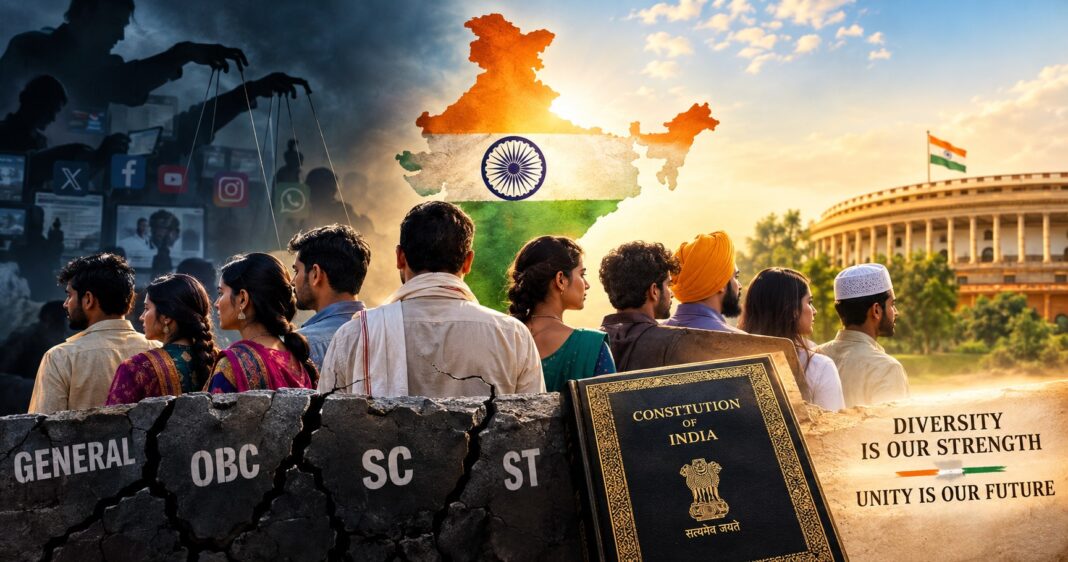

India’s greatest strength is also one of its greatest vulnerabilities. We are a civilisation of enormous diversity, bound together by a constitutional idea of India that is larger than caste, religion, language, region and community. But where there is diversity, there are also fault lines. And in an age of information warfare, social-media manipulation and geopolitical competition, those fault lines can become targets.
One such fault line is caste.
The danger is not that India has caste differences. Caste has existed as a complex social reality for centuries and continues to influence social identity, marriage, political mobilisation, access to opportunity and, in some places, everyday social relations. The danger is that these differences could be deliberately transformed from social distinctions and legitimate grievances into antagonistic political identities – General versus OBC, OBC versus SC, SC versus ST, one OBC community against another, or one regional caste group against another.
That is where caste could become the Achilles’ heel that hostile actors attempt to exploit.
This is not an argument against discussing caste. Quite the opposite. A mature democracy must be capable of discussing inequality, historical discrimination, representation, reservation, economic opportunity and social mobility without turning those discussions into a war between communities. The Constitution itself recognises the need to address social disadvantage while simultaneously establishing equality before law and prohibiting discrimination on grounds including caste.
The distinction between addressing caste inequality and weaponising caste is therefore critical.
India is entering a period in which caste data will occupy an increasingly prominent place in public policy and political debate. The Union government has stated that caste questions will be included in the second phase of the Census, with the questionnaire to be finalised and notified before that phase begins. Bihar has already demonstrated how extensive caste-based demographic data can become part of public policy and political discourse, with the state continuing to maintain administrative processes and data related to its caste survey.
Better data can be useful. It can help governments understand deprivation and design targeted policies. But data can also be selectively interpreted.
The real danger begins when statistics cease to be instruments of governance and become ammunition for social mobilisation.
Imagine a political narrative that tells one community that another community is taking everything from it. Imagine another narrative telling a historically disadvantaged community that another caste group is responsible for its lack of progress. Imagine social-media accounts continuously circulating carefully selected incidents, edited videos and emotionally charged claims designed to convince communities that they are under attack.
The objective would not necessarily be to make every Indian hate every other Indian.
The objective would be much simpler: make Indians distrust one another.
A society does not need to descend immediately into large-scale violence for national cohesion to weaken. Conflict begins much earlier – with suspicion, resentment, stereotyping and the belief that another community represents an existential threat.
That is precisely why caste tensions deserve strategic attention.
India’s adversaries – whether state or non-state actors – would not need to invent caste differences. They already exist. They would only need to amplify them. This is an important distinction.
There is no evidence that every caste dispute, protest or demand for reservation is the product of foreign interference. Most caste-related movements arise from domestic political, economic and social circumstances. Genuine grievances must not be dismissed as conspiracies. Farmers, students, workers and communities have legitimate democratic rights to demand representation, opportunity and justice.
But the existence of genuine grievances does not mean that those grievances cannot subsequently be exploited by others. That is the strategic vulnerability.
The digital environment makes such exploitation easier. A provocative message can travel across thousands of phones within minutes. A local dispute can be presented as evidence of a national conspiracy. An isolated incident can be stripped of its context and transformed into collective anger. Algorithms reward emotional engagement, and anger is one of the most powerful forms of engagement.
The result can be what I would call the fragmentation of national consciousness.
Instead of asking, “How do we create greater opportunity for every Indian?” society begins asking, “What has my caste received compared with yours?”
Instead of discussing whether a policy reduces deprivation, the conversation becomes a competition over victimhood.
Instead of measuring progress through education, employment, entrepreneurship and living standards, communities begin measuring their position against other communities.
That is dangerous territory.

India must therefore refuse to allow legitimate caste discourse to become a zero-sum contest.
The General Category should not be portrayed collectively as an enemy of social justice. OBC communities should not be treated as a monolithic political bloc. Scheduled Castes should not be reduced to a permanent category of victims. Scheduled Tribes should not be treated as peripheral to the national story. Nor should differences within these broad categories be ignored.
India’s social structure is considerably more complicated than four political boxes.
Indeed, one of the greatest mistakes Indian politics could make is to reduce millions of individuals to caste arithmetic.
A person can simultaneously be Indian, Maharashtrian, Goan, Tamil, entrepreneur, worker, student, professional, Hindu, Christian, Muslim, Sikh, Buddhist or atheist – and belong to a particular caste or community. Human identity is layered. Political actors who reduce that complexity to one identity create the conditions for polarisation.
This is where India’s institutions have a crucial role.
The government must ensure that welfare and affirmative-action policies are based on transparent evidence. Governments must communicate clearly why particular policies exist and what outcomes they are producing. Academic institutions must encourage serious research rather than ideological caricatures. The media must distinguish between reporting a caste dispute and inflaming it.
And citizens must develop a new form of digital literacy.
Before forwarding an inflammatory message, ask: Who created it? What evidence supports it? Is the incident verified? Is the video complete? Is the statistic being presented in context? Who benefits if I become angry with another Indian?
That final question may become increasingly important. Because the next generation of warfare may not always begin with missiles crossing borders. It may begin with narratives crossing screens.
India’s enemies do not necessarily need to defeat India militarily if they can weaken India’s internal cohesion. A divided society consumes enormous political energy fighting itself. Governments become preoccupied with managing internal tensions. Economic priorities are disrupted. Social trust declines. Political discourse becomes more extreme. Every policy becomes interpreted through the prism of identity.
That is how an external strategic objective can sometimes be achieved without a conventional attack.
But India possesses an enormous advantage: its constitutional framework and its civilisational experience of living with diversity.
The answer cannot be to suppress conversations about caste. It cannot be to deny discrimination. It cannot be to delegitimise legitimate demands for equality and representation.
The answer is to prevent legitimate grievances from being converted into permanent hostility.
India must move from caste consciousness to constitutional consciousness.
We can acknowledge history without becoming prisoners of history. We can correct inequality without creating new antagonisms. We can provide affirmative action without turning citizens against one another. We can discuss representation without converting democracy into a permanent caste battlefield.
The greatest victory for anyone seeking to destabilise India would be to convince Indians that their neighbour is their enemy.
The greatest defeat of such a strategy would be for Indians to recognise the manipulation before it succeeds.
India does not need to pretend that caste differences do not exist. It needs to ensure that those differences do not become weapons.
The fault lines are real. The grievances are real. The political contest over them is real.
But the wedge must not become a wall.
And if India is to remain united in an increasingly contested world, the first line of national security may ultimately be not at the border, but in the minds of its citizens.