



Key Takeaways
- India’s pothole problem is causing thousands of deaths annually due to poor road maintenance and contractor corruption.
- The government needs to prioritize road maintenance and increase accountability to improve India’s road infrastructure.
- Effective quality control measures and technology can help prevent potholes and improve road conditions in India.
India’s pothole problem is a nation-wide issue that affects millions of citizens every year. The rich can afford to jump over them in their SUVs, while the poor are forced to fall into them on their two-wheelers. Meanwhile, the government drives comfortably above them, ignoring the issue altogether.
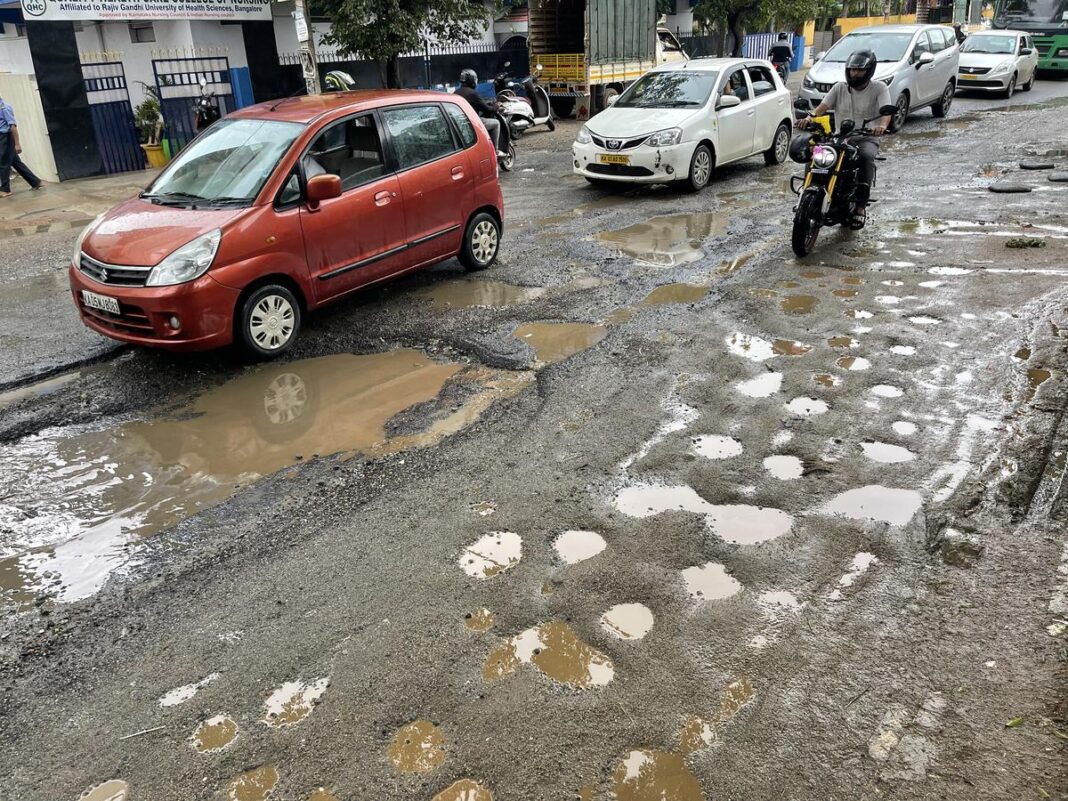
Let’s be honest – we have normalised the pothole. It is as Indian as the traffic jam, the honking, and the chai stall at the corner. Every city, town, and village has its signature version – the Panjim puddle, the Mumbai moon-crater, the Delhi death trap, the Bengaluru belly-dipper. They come in all shapes, depths, and hazards. Some can swallow a tire. Some can swallow a life. But all have one thing in common – they are born from apathy and die only when they are filled by another contractor’s corruption.
India’s pothole problem is not just an infrastructural issue – it’s an economy. According to a 2023 Ministry of Road Transport and Highways report, poor road conditions, including potholes, accounted for over 3,600 deaths annually. But behind every death is a thriving ecosystem – contractors who underfill, bureaucrats who overlook, engineers who overbill, and politicians who inaugurate the same stretch of road three times in one election cycle.
Road contracts in India are not merely about construction – they’re about convenience. A contractor wins a bid by quoting the lowest price, then reduces the cost by using substandard material. When the road disintegrates with the first monsoon, a new tender is floated, and the cycle repeats. The system thrives on decay. The longer the road fails, the longer the cash flows.
It’s not that India doesn’t spend on roads. In the Union Budget 2025, infrastructure received a record allocation of over ₹11 lakh crore, with the Ministry of Road Transport and Highways getting ₹2.78 lakh crore. Yet, the results on ground – or rather, in the ground – remain dismal. What we have perfected is not road engineering but road re-engineering. Every few months, a section of road is broken, repaired, broken again – an endless theatre of dust, tar, and blame.
The Indian pothole is not a joke when it kills. Over the years, news headlines have screamed: “Pothole claims techie’s life in Bengaluru,” “Mother-daughter duo dies after skidding into crater in Delhi,” “Youth thrown off bike after hitting pothole in Goa.” Yet, there’s no outrage. A celebrity’s dog dies, and it trends for a week. A citizen dies in a pothole, and it’s forgotten before the funeral ends.
In 2019, the Supreme Court called road fatalities due to potholes “unacceptable” and urged accountability. But accountability in India has the same fate as the tar – it melts away with the first rain. Local municipalities and PWD departments pass the blame like a political hot potato — each one claiming that maintenance isn’t their jurisdiction. In truth, no one wants the jurisdiction of responsibility.
Technically, building a durable road is not rocket science – though ironically, India’s rocket science is doing better. Developed nations use weather-resistant asphalt, proper drainage systems, and strict quality monitoring. In India, however, roads are built as if they’re temporary installations, meant to last just until the next ribbon-cutting ceremony.
Rainwater stagnation is the pothole’s best friend. Our drainage systems are clogged with plastic, garbage, and municipal laziness. Water seeps through the bitumen, loosening the foundation. Vehicles then hammer it with every pass, until a small crack becomes a full-blown crater. The tragedy is not that we lack the technology to prevent this – it’s that we lack the intent.
We build roads for political milestones, not for public mobility. Every new chief minister wants to leave behind a “legacy road” project – a six-lane expressway, a coastal beltway, a smart city boulevard – all designed for ribbon-cutting and media flashbulbs. Maintenance, the boring and invisible part of governance, never gets photo-ops.
India builds the world’s largest statue, the fastest train, and one of the longest expressways – and yet, a five-kilometre stretch in your neighbourhood is an obstacle course of mud, rubble, and water. Our road development is a mirror of our governance – grand in announcement, fragile in execution.

Ironically, some state governments boast of “AI-driven road inspections” and “geo-tagging of potholes.” But technology cannot fix what corruption breaks. Drones may map the craters, but they can’t repair the rot in accountability. It’s not data we lack – it’s discipline.
In some cities like Mumbai and Pune, citizens have taken matters into their own hands — literally. Groups have filled potholes with gravel and cement, while local officials watched. In 2018, activist Dadarao Bilhore from Mumbai filled over 600 potholes after losing his son to one. His story is one of resilience. But it also exposes a truth – when citizens have to do the government’s job, governance has already failed.
India’s economy loses billions annually due to poor road conditions – not just in repairs, but in vehicle damage, fuel inefficiency, and logistics delays. The average Indian driver spends 10–15% more on vehicle maintenance annually because of bad roads. Truckers lose hours – sometimes days – due to damaged routes, directly affecting supply chains.
Add to that the cost of lives, the cost of productivity, the cost of reputation. For a country aiming to be a $5 trillion economy, it’s ironic that one of its most visible indicators of development — roads – remains its weakest link.
The pothole, however, is not just a physical defect – it’s a metaphor for India’s governance mindset. We fix problems temporarily, never structurally. We reward contractors for completion, not for endurance. We measure progress in kilometres of new roads, not in years of sustained quality.
It’s also cultural. We tolerate the intolerable. We see a pothole every day and do nothing – until it becomes a crater big enough to trend on social media. Our civic consciousness has been replaced by complaint consciousness. We shout, not act. We outrage, not organize.
It doesn’t take a miracle to fix India’s roads. It takes honesty. Transparent tenders, independent audits, modern materials, and maintenance accountability. States like Tamil Nadu and Gujarat have shown that quality assurance programs and local monitoring can drastically reduce pothole incidents. The technology exists – what’s missing is the political will to enforce it.
Public participation, too, must go beyond social media outrage. Citizen road audits, local vigilance groups, and grievance platforms that actually lead to repairs can make a difference. Because governance works best when watched.
Potholes are India’s oldest political party – they have survived every government, every ideology, every promise. They don’t discriminate between the rich and poor, or between BJP and Congress constituencies. They unite India – in frustration and fatalism.
And until we fix our governance mindset – not just our roads – the pothole will remain India’s most consistent national symbol. It will outlive manifestos, ministers, and monsoons.
Because in India, roads are built for ribbon-cutting ceremonies. Potholes, on the other hand, are built for eternity.