
Key Takeaways
- The Women’s Reservation Bill aims to reserve one-third of seats in Parliament and state assemblies for women, promoting gender parity in governance.
- Women’s political representation is crucial for inclusive governance, social welfare, and education.
- Increased women’s representation correlates with reduced corruption and greater accountability.
- The concept of Shakti is deeply embedded in Indian culture, representing energy, creation, resilience, and transformation.
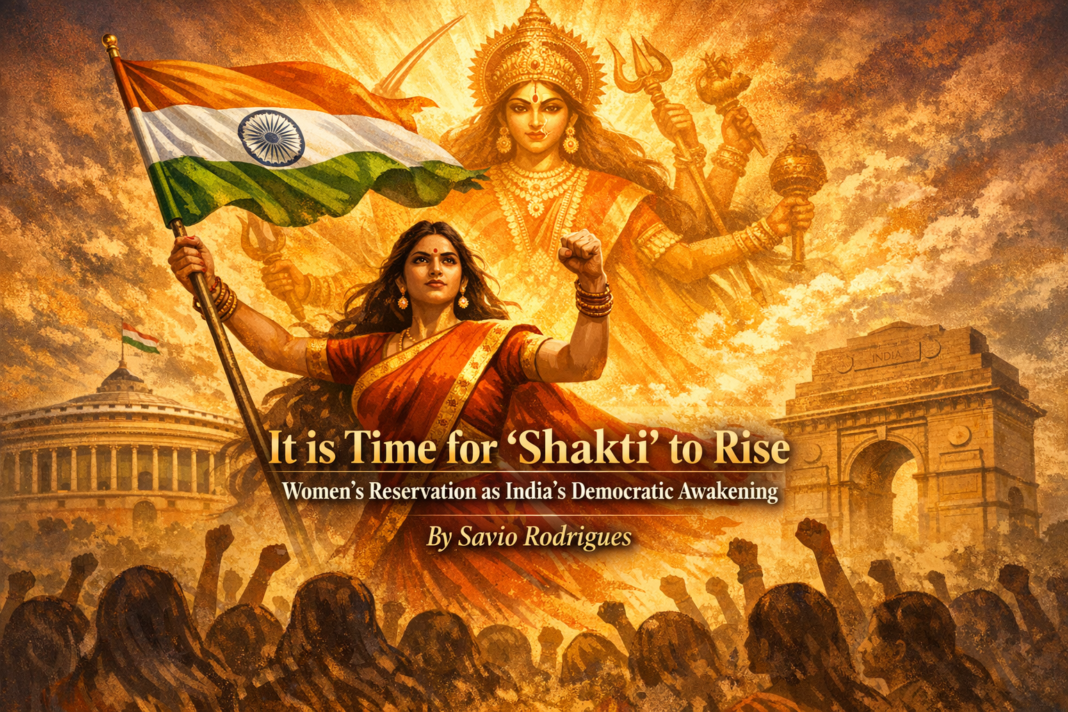
India today stands at the cusp of a long-overdue democratic correction. For decades, the country that prides itself as the world’s largest democracy has functioned with a deep and uncomfortable contradiction – nearly half its population is female, yet its legislative voice has been overwhelmingly male. The call for 33% reservation for women in Parliament and state assemblies is not merely a political reform; it is the awakening of Shakti – the inherent feminine power that India has worshipped culturally but systematically excluded politically.
The numbers expose this contradiction with brutal clarity. Women constitute close to 49% of India’s population, yet their representation in the Lok Sabha hovers around 14-15%, while in the Rajya Sabha it remains between 13-17%. When placed in a global context, the disparity becomes even more glaring. The global average for women in national parliaments stands at approximately 27%, meaning India significantly lags behind. In fact, India ranks below 140 countries in terms of women’s political representation, placing it behind several developing nations that have taken more decisive steps toward gender parity in governance. This is not just a gap – it is a democratic deficit.
Women often entered politics through familial connections, such as wives or daughters of male politicians. This is not a system that actively nurtures and promotes independent female leadership. While India has produced iconic women leaders, from Indira Gandhi to numerous chief ministers across states, these remain exceptions that prove the rule. The broader political ecosystem has remained structurally skewed against women.
The barriers are both visible and invisible. Patriarchal social norms continue to discourage women from entering politics. Financial constraints and lack of access to political networks make campaigning difficult. Safety concerns and the often adversarial nature of political life further deter participation. Political parties themselves, driven by winnability calculations rooted in outdated assumptions, tend to field far fewer women candidates. Yet, data consistently shows that when women do contest elections, their success rates are comparable to men. The issue, therefore, is not capability or electability – it is access and opportunity.
This is precisely where the Women’s Reservation framework becomes critical. The proposal to reserve one-third of seats in Parliament and state assemblies for women is not about tokenism or charity; it is about structural correction. It acknowledges that historical imbalances cannot be addressed by passive evolution – they require deliberate intervention. Globally, countries that have implemented gender quotas have seen a rapid and measurable increase in women’s political participation, which in turn has reshaped governance priorities and outcomes.
India already has a working model of this success at the grassroots level. Through the 73rd and 74th Constitutional Amendments, reservation for women in Panchayati Raj Institutions has transformed rural governance. Today, over 20 states provide 50% reservation for women in local bodies. This has led to millions of women entering public life, many for the first time. Studies have shown that women-led local governments often prioritise issues such as water, sanitation, education, and healthcare more effectively. Beyond policy outcomes, the social impact has been profound – changing perceptions, inspiring younger generations, and normalising women in leadership roles.
The concept of Shakti is deeply embedded in Indian civilisation. It represents energy, creation, resilience, and transformation. From Durga to Saraswati, the feminine force is revered as the foundation of balance and power. Yet, this reverence has largely remained symbolic. The political domain has not reflected this philosophical belief. The rise of women through reservation is, therefore, not just a policy shift – it is a cultural realignment. It is India finally practising what it has long preached.

The benefits of increased women’s representation are neither abstract nor speculative. Evidence from across the world suggests that women leaders tend to bring greater focus on social welfare, education, healthcare, and inclusive growth. They often introduce more collaborative and less confrontational styles of governance. There is also research indicating that higher representation of women correlates with reduced corruption and greater accountability, although this varies across contexts. In a country like India, where governance challenges are complex and multi-dimensional, the inclusion of diverse perspectives is not just beneficial – it is essential.
There is also a strong economic argument for women’s political empowerment. India’s aspiration to become a $5 trillion economy cannot be achieved while underutilising half its human capital. Greater gender equality in decision-making leads to better policy design, improved human development indicators, and more sustainable economic growth. Political representation is a key enabler in this process, as it shapes the priorities and direction of national development.
The push for women’s reservation marks the culmination of nearly three decades of debate, negotiation, and political hesitation. Its eventual realisation signals a shift in India’s democratic consciousness. It is an acknowledgment that representation matters – not just as a number, but as a voice, a perspective, and a lived experience. For too long, policies affecting women have been shaped without adequate participation from women themselves. This imbalance has consequences that go beyond politics – it influences social priorities, economic policies, and national narratives.
Yet, reservation alone is not a silver bullet. It must be accompanied by broader reforms. Political parties need to institutionalise gender diversity in candidate selection beyond mandated quotas. Training and mentorship programs must be developed to prepare women for leadership roles. Societal attitudes need to evolve to support and respect women in public life. Safety, both physical and digital, must be ensured to encourage participation. Only then can the full potential of this reform be realised.
India has spent centuries venerating the idea of feminine power, but reverence without representation is incomplete. The rise of Shakti in Indian politics is not about replacing men – it is about restoring balance. It is about ensuring that the democratic structure reflects the society it serves.
The Women’s Reservation initiative is, therefore, not just a legislative step; it is a civilisational moment. It bridges the gap between symbolism and substance, between cultural ideals and political reality. It challenges India to move beyond rhetoric and embrace genuine inclusivity.
A democracy cannot claim maturity if half its population remains underrepresented in its highest decision-making bodies. The time has come for India to stop speaking on behalf of women and start listening to them directly. The rise of Shakti is not just necessary – it is inevitable. And with it, India’s democracy will not weaken, but deepen, becoming more representative, more responsive, and ultimately, more just.