



Key Takeaways
- The Caspian Sea is a geopolitically insulated region where Iran and Russia have a durable partnership.
- The Caspian Sea limits Trump’s ability to enforce his will through military presence or economic sanctions.
- The Caspian Sea’s emerging significance has implications for India’s delicate balance between its relationships with the United States, Iran, and Russia.
Donald Trump’s Iran strategy is based on an assumption that geography will behave as he wants it to. However, geography rarely behaves as expected, and this is precisely where Trump will discover the limits of his Iran playbook.
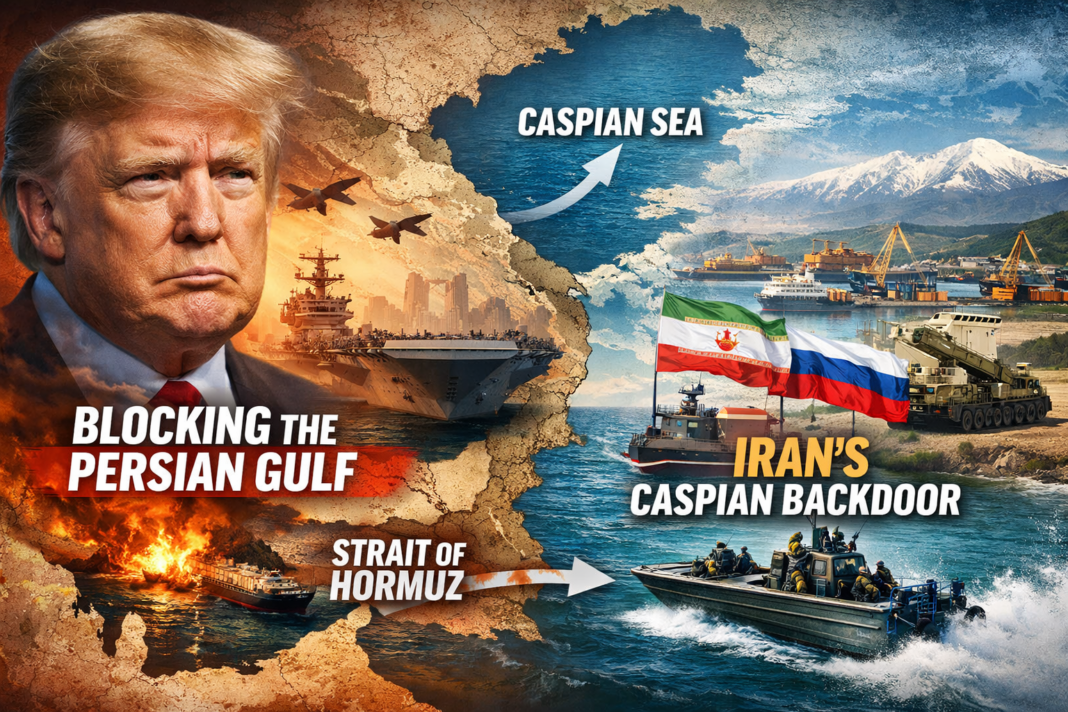
Much of the current discourse around isolating Iran revolves around the Persian Gulf – blockades, naval presence, chokepoints like the Strait of Hormuz. It makes for compelling television graphics and assertive policy briefings. But it is also, quite possibly, the wrong theatre.
Because the real game is not unfolding in the warm, oil-heavy waters of the Gulf. It is unfolding quietly, almost invisibly, in the cold, brackish expanse of the Caspian Sea. And that changes everything.
The Caspian is not your conventional maritime space. It behaves less like a sea and more like a contained geopolitical ecosystem – a massive lake bordered by five countries: Iran, Russia, Kazakhstan, Turkmenistan, and Azerbaijan. Its waters are only about a third as salty as the ocean, but its strategic density is far richer. There are no Western navies patrolling it, no NATO exercises, no easy projection of American power.
In simple terms: what happens in the Caspian stays in the Caspian.
This is where the strategic partnership between Russia and Iran becomes far more consequential than most analysts are willing to admit. Unlike the transactional, often fragile alliances the United States builds, the Russia-Iran relationship is rooted in a shared resistance to Western dominance. It is not perfect, but it is durable.
And crucially – it is geographically insulated.
Iran’s northern ports – Bandar Anzali and Chalus – are not just logistical points; they are strategic lifelines. Bandar Anzali, with its traditional port infrastructure, has long been a conduit for trade and movement across the Caspian. It is mundane, almost unremarkable – which is precisely why it is effective.
Then there is Chalus, which carries a more complex profile. It hosts facilities linked to the Islamic Revolutionary Guard Corps (IRGC), an entity that operates at the intersection of military power and ideological enforcement. Chalus is not just a port; it is a controlled gateway – one that has reportedly hosted high-value individuals under tight supervision.
This dual-port system gives Iran something invaluable: flexibility.
Even if Washington succeeds in tightening the screws in the Persian Gulf – through sanctions, surveillance, or outright military pressure – Tehran retains an alternative channel. And that channel is shielded not just by geography, but by partnership with Moscow.
Now place that reality against Trump’s strategy. The Trump doctrine, if one can call it that, relies heavily on pressure – economic sanctions, diplomatic isolation, and the implicit threat of force. It is a strategy that assumes compliance will follow constraint. And in many cases, it has worked, at least partially.

But Iran is not a conventional adversary. It is a state that has spent decades perfecting the art of operating under pressure. Sanctions are not an anomaly for Tehran; they are a baseline condition. The Iranian system is designed to adapt, reroute, and endure. And the Caspian Sea is one of its most under appreciated tools in doing so.
What makes the Caspian particularly challenging for the United States is its legal and political structure. Unlike international waters, the Caspian is governed by agreements among its littoral states. External military presence is effectively excluded. This means the U.S. Navy cannot simply sail in and enforce its will.
In geopolitical terms, it is a closed room – and Washington does not have a key.
Meanwhile, Russia does. Under the leadership of Vladimir Putin, Moscow has steadily expanded its influence in the region. Its naval capabilities in the Caspian are modest compared to its global fleet, but they are more than sufficient for the environment. More importantly, Russia provides Iran with something even more valuable than ships: strategic cover.
This creates a scenario where Iran can continue to receive fuel, weapons, and other critical supplies through northern routes that are largely immune to American interference. It is not a perfect system – there are operational challenges, logistical constraints – but it is functional.
And in geopolitics, functionality is often enough.
For India, this evolving dynamic carries its own set of implications. New Delhi has historically maintained a delicate balance between its relationships with the United States, Iran, and Russia. The International North-South Transport Corridor (INSTC), which links India to Russia via Iran and the Caspian, suddenly becomes more than just an economic project – it becomes a strategic artery.
If the Caspian emerges as a key theatre in the Iran containment debate, India will need to navigate this space with even greater precision. Align too closely with Washington, and it risks losing access to critical Eurasian corridors. Lean too far toward Tehran and Moscow, and it invites Western scrutiny.
It is a tightrope – and it is getting thinner.
The larger point, however, is this: strategies that ignore geography are strategies that fail.
Trump’s approach to Iran may yet yield tactical victories. Sanctions may bite. Diplomatic pressure may isolate. But as long as Iran retains access to alternative networks – especially those embedded in regions like the Caspian Sea – complete isolation will remain elusive.
Because power is not just about force. It is about routes, relationships, and resilience. And in the quiet waters of the Caspian, Iran has all three.