


Key Takeaways
- Goa needs to adopt a zero-tolerance policy for corruption and abuse of power, inspired by Lord Parshuram’s uncompromising war against injustice.
- Corruption in Goa is systemic and embedded, cutting across political parties, bureaucratic structures, and sections of civil society.
- Goans must move beyond WhatsApp outrage and social media activism to sustained civic engagement, transparency, and accountability.
Goa does not suffer from a shortage of symbols. It suffers from a shortage of spine.
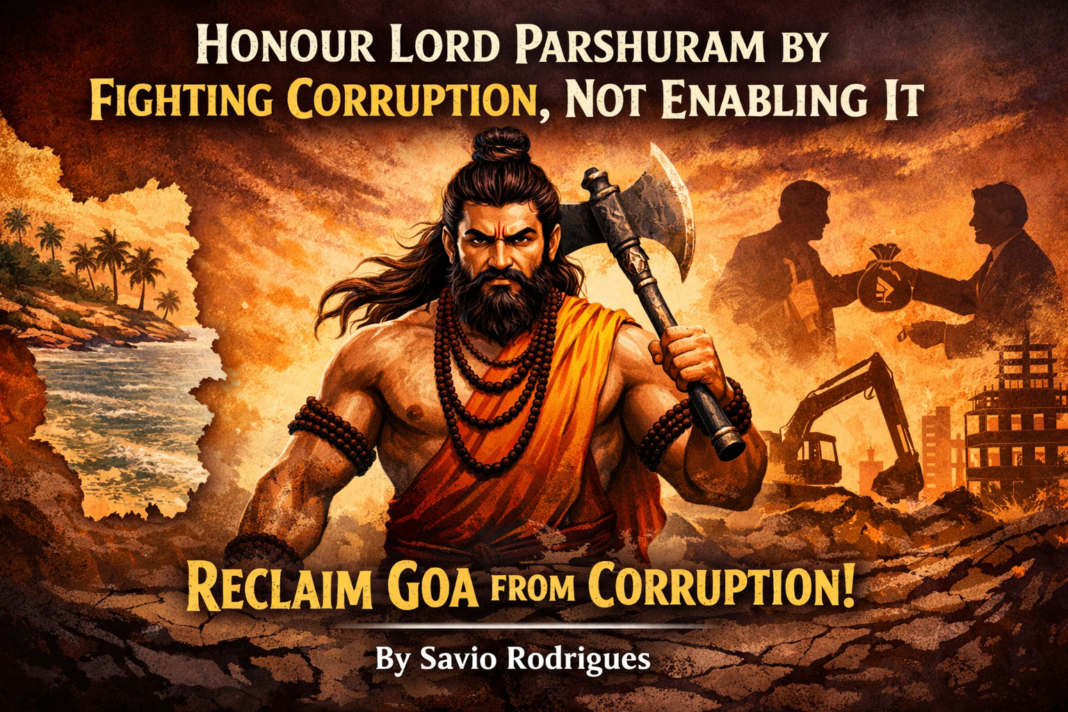
Every few months, the name of Lord Parshuram is invoked in our public discourse – sometimes reverentially, sometimes politically, often opportunistically. We are told that Goa itself is his creation, reclaimed from the sea by the throw of his axe. Yet, if Lord Parshuram were to walk the streets of present-day Goa – from Panaji’s corridors of power to the hinterlands of Quepem and Pernem – he would not recognise the moral landscape we have built on the land he is believed to have reclaimed.
Because Lord Parshuram was not merely a creator. He was a destroyer – of injustice, of arrogance, of entrenched corruption. And that is precisely what Goa today refuses to confront.
We have reduced Lord Parshuram to a mere symbol, stripping him of his most inconvenient attribute – his uncompromising war against corruption and abuse of power. This has neutralised his impact and turned him into a convenient rallying cry. In doing so, we have not honoured him; we have neutralised him.
Look around: Illegal land conversions masquerade as ‘development’. Coastal regulations are bent with surgical precision. Hill-cutting continues with bureaucratic blessings. Files move not on merit but on influence. The ordinary Goan, whether in Salcete or Bardez, knows this reality intimately – but feels increasingly powerless against it.
And yet, at public events, speeches ring out with pride about Goa being ‘Parshuram’s land’.
If this is Lord Parshuram’s land, then where is his rage?
Lord Parshuram’s legend is not comfortable reading for the corrupt. He did not negotiate with injustice. He did not form committees to “study” wrongdoing. He did not outsource morality to regulatory bodies. When faced with systemic abuse, he acted – with clarity, with conviction, and without fear of consequence.
Today, Goa needs that spirit – not in mythology, but in governance.
The reality is stark: corruption in Goa is systemic and embedded, cutting across political parties, bureaucratic structures, and even sections of civil society that have grown too comfortable with selective outrage.
The tragedy is not just that corruption exists. The tragedy is that we have learnt to live with it.
We shrug when a questionable project gets clearance. We rationalise when rules are bent for the powerful. We look away when public resources are quietly diverted into private hands. And then, on festive occasions, we invoke Lord Parshuram – as if symbolism can substitute for integrity.
It cannot.
Invoking Lord Parshuram while tolerating corruption is not devotion. It is hypocrisy.

If Goa truly wishes to honour Lord Parshuram, it must do so not through statues, slogans, or ceremonial speeches – but through action that reflects his core principle: zero tolerance for injustice.
What would that look like?
First, it would require political courage – something increasingly rare. Leaders must be willing to confront corruption within their own ranks, not just weaponise it against opponents. Selective outrage is not reform; it is theatre.
Second, it would demand administrative accountability. Files, clearances, and decisions must be transparent and traceable. Technology can enable this, but only if there is intent. Without intent, even the most sophisticated systems become tools of obfuscation.
Third, it would require an empowered citizenry. Goans must move beyond WhatsApp outrage and social media activism to sustained civic engagement. Public hearings, RTIs, community mobilisation – these are the modern equivalents of Lord Parshuram’s axe. They may not be as dramatic, but they are just as powerful when used consistently.
Fourth, and perhaps most importantly, it would require a cultural shift. Corruption thrives not just because of corrupt individuals, but because of a permissive environment. When society begins to reward integrity and punish dishonesty – socially, economically, politically – change becomes inevitable.
But let us not romanticise this process. Upholding Lord Parshuram’s spirit will be uncomfortable. It will disrupt networks of influence. It will expose inconvenient truths. It will challenge people who are used to operating without scrutiny.
And that is precisely why it has not been done. Because invoking Lord Parshuram is easy. Becoming Lord Parshuram – metaphorically speaking – is hard.
Goa today stands at a crossroads. On one path lies continued erosion – of land, of institutions, of public trust. On the other lies the possibility of renewal – driven not by nostalgia, but by courage.
The choice is ours.
We can continue to celebrate Lord Parshuram as a distant, mythical figure – safe, sanitised, and stripped of relevance. Or we can reclaim his essence as a symbol of resistance against corruption and moral decay.
But we cannot do both. Because Lord Parshuram, if he stands for anything, stands for action. And action demands sacrifice. It demands that we call out wrongdoing even when it is politically inconvenient. It demands that we refuse to participate in systems we know are compromised. It demands that we hold our leaders – not just in government, but across institutions – to standards that go beyond rhetoric.
It demands that we stop pretending. Goa does not need more speeches about Lord Parshuram.It needs fewer excuses for corruption. Until that happens, every invocation of his name will ring hollow – an echo of what we claim to value, and a reminder of what we refuse to practice.
If Lord Parshuram reclaimed land from the sea, perhaps it is time for Goans to reclaim their state from corruption. Not with mythology. But with resolve.