


Key Takeaways
- The Chandrayaan-3 Lander and Rover have discovered a buried crater on the Moon, which is around 160 km in size and 4.4 km deep.
- The crater is likely to be older than the South Pole-Aitken (SPA) basin and provides valuable insights into the Moon’s geological history.
- The discovery was made using images obtained by the Navigation Cameras on the Chandrayaan-3 Pragyan Rover and the Chandrayaan-2 Orbiter’s Optical High Resolution Camera.
Chennai: In a significant breakthrough, the Vikram Lander and the Pragyan Rover
onboard India’s third Moon Mission Chandrayaan-3 has discovered buried crater on the Moon.
In an update, ISRO said in a study published in peer-reviewed journal Icarus, scientists from PRL and ISRO have shown that Indian Lunar mission Chandrayaan-3 landed within a buried impact crater.
The crater is around 160 km in size, 4.4 km deep, and likely to be older than the South Pole Atkin (SPA) basin.
This is revealed based on analysis of images obtained by Navigation Cameras on Chandrayaan-3 Pragyan rover and Chandrayaan-2 Orbiter’s Optical High Resolution Camera.
The Chandrayaan-3 mission with the Vikram Lander and the Pragyan Rover landed in the high latitude highland region near the south pole of the Moon.
The landing site is located 350 km from the SPA basin rim, an ancient and the largest impact basin in the Solar System.
This landing site has undergone the complex emplacement sequence of SPA basin ejecta
followed by the nearby and distant impact basins and complex crater ejecta materials.
“We found that the SPA basin is the major contributor, which deposited nearly 1400 m of
ejecta materials, and 11 other basins deposited 580 m of ejecta. The other complex craters
contributed up to 90 m of ejecta”, the Scientists said.
Meanwhile, secondary craters of a few km’s in diameter located adjacent to the Vikram lander contributed to 0.5 m ejecta, which are crucial target materials for the Pragyan rover insitu analysis.

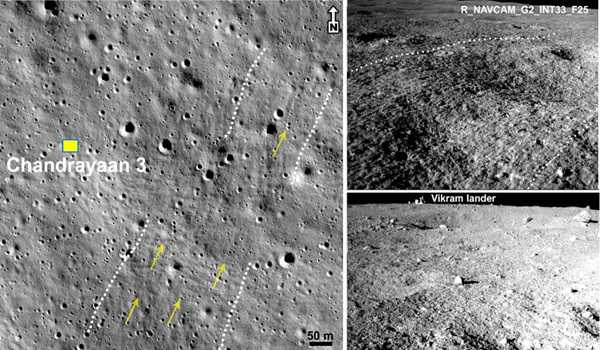
The Pragyan rover Navcam and Optical High Resolution Camera images gave the first clue about the linear, distal ejecta rays or groove-like structures possibly formed due to the distant impacts deposited at the Chandrayaan-3 landing site.
Pragyan rover images revealed the landing site is devoid of greater then 1 m boulders along the traverse, which reveals typical highland terrain.
The regional exploration around the Chandrayaan-3 landing site revealed a near semi-circular like structure, with highly degraded in nature. This semi-circular structure encompassed the Statio Shiv Shakti (yellow star).
Further detailed geomorphological and topographical analysis revealed that the semi-circular structure is a heavily degraded crater structure or a buried impact crater with a diameter of 160 km.
This semi-circular structure was highly degraded due to the mantling of thick ejecta deposits from the SPA basin and followed by many other complex craters throughout the geological history of the Moon.
This buried crater is one of the oldest crater on the Moon, and the Chandrayaan-3 Vikram lander and Pragyan rover landed and roved within this buried crater, which is hosting the SPA basin ejecta material and some of the most deeply excavated materials on the Moon.
The regional exploration around the Chandrayaan-3 landing site research work with the title “Chandrayaan-3 landing site evolution by South Pole-Aitken basin and other impact craters”,
was authored by S Vijayan, KB Kimi, Anil Chavan, R Aditi, U Thahira, V Rama Subramanian, Rishitosh K Sinha, Santosh Vadawale, M Shanmugam, NPS Mithun, Arpit R Patel, S Amit
Basu, KV Iyer, K Suresh, Ajay Prashar, G Rima, Anil Bhardwaj.