


Key Takeaways
- India’s Northeast has emerged as a critical national security frontier.
- Matthew VanDyke and Jordan Brown cases highlight the region’s strategic significance.
- Drone warfare is becoming increasingly prevalent in the Myanmar conflict, with commercially available drones being used for reconnaissance, surveillance, logistics, and improvised explosive attacks.
The arrest of American national Matthew VanDyke by the National Investigation Agency (NIA), followed within weeks by the detention of another American, Jordan Brown, near the Indo-Nepal border, has renewed attention on a region that has quietly emerged as one of India’s most critical national security frontiers – the Northeast. While the two cases are separate and remain under investigation, they underscore a larger reality that security planners have long recognised: India’s eastern frontier is no longer merely a border region; it has become a theatre where domestic security, regional instability and global geopolitical competition increasingly intersect.
Matthew VanDyke is not an ordinary traveller. Over the past two decades, he has built an international profile through his involvement in conflict zones across Libya, Syria and Ukraine. Earlier this year, the NIA arrested VanDyke along with six Ukrainian nationals on allegations that they entered India on tourist visas before travelling through the Northeast into Myanmar, where they allegedly trained armed ethnic organisations in drone warfare and facilitated the movement of drone equipment sourced from Europe. The agency has invoked provisions of the Unlawful Activities (Prevention) Act (UAPA), alleging that Indian territory was used as a transit corridor to support armed groups operating across the border. These allegations are now before the courts, and the accused remain entitled to due process under Indian law. Whether the charges are ultimately proved will be determined through the judicial process.
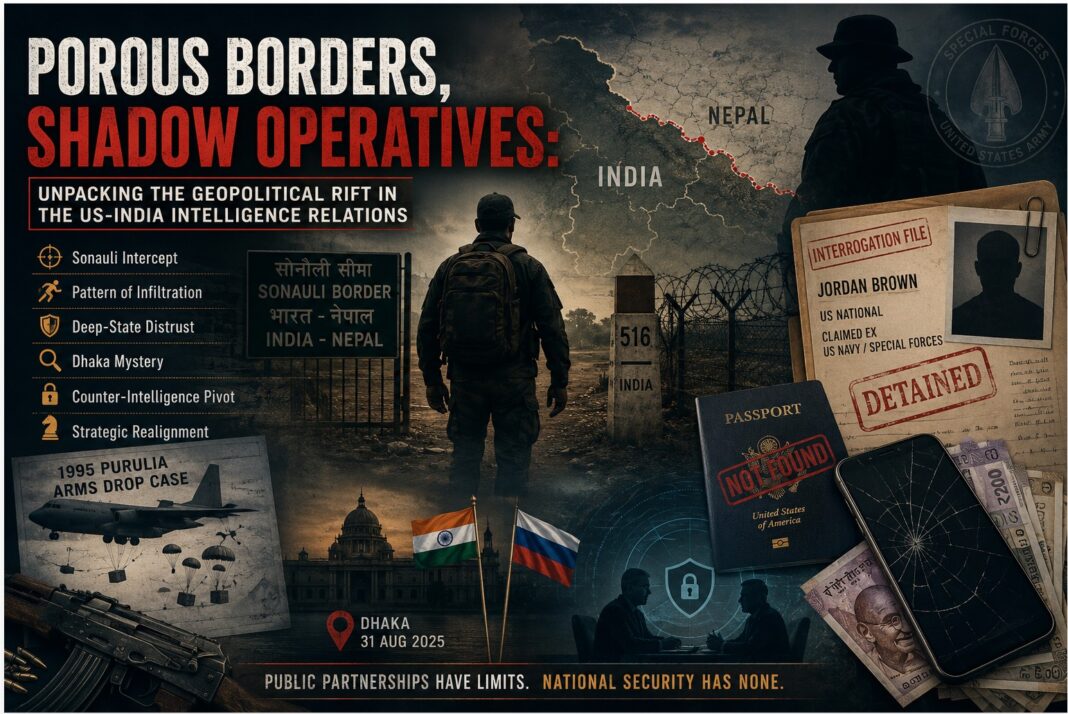
Days later, another American citizen, Jordan Brown, was detained near the Indo-Nepal border in Uttar Pradesh after allegedly attempting to cross into Nepal without valid travel documentation. Public reports indicate that Brown claimed previous military service in the United States, while investigators questioned inconsistencies in his travel history and stated purpose of visit. There is presently no official allegation connecting Brown to the VanDyke investigation or to any espionage activity. Nevertheless, from the standpoint of counter-intelligence, repeated encounters involving foreign nationals with military backgrounds in strategically sensitive areas naturally invite closer examination. Intelligence agencies are trained to identify patterns before drawing conclusions, and unusual incidents are rarely assessed in isolation.
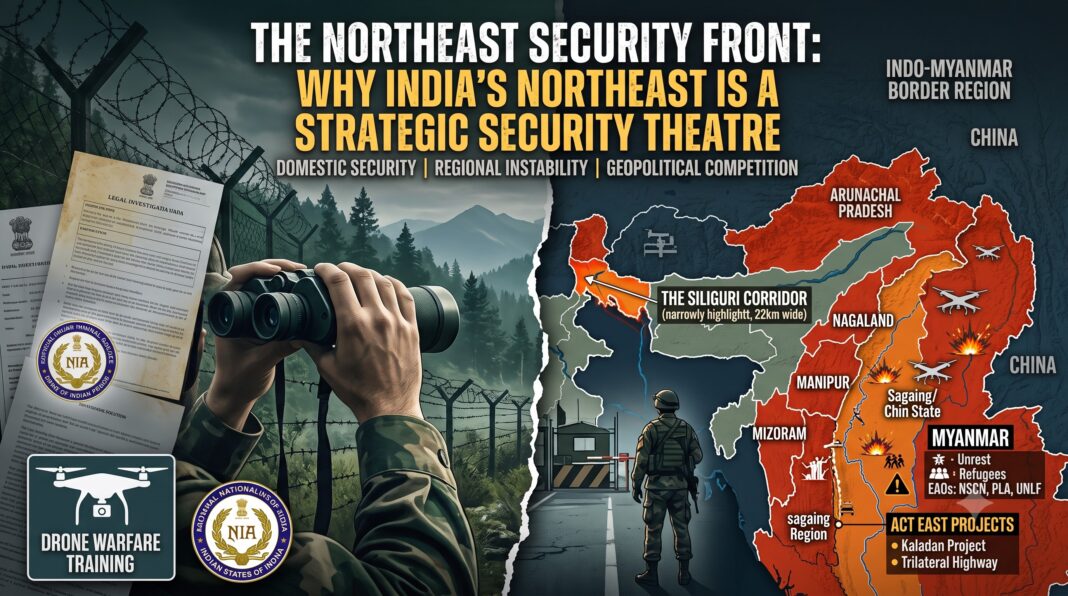
To understand why these cases have generated concern, one must first understand the strategic importance of India’s Northeast. Although the region accounts for roughly eight per cent of India’s geographical area, it shares more than 5,300 kilometres of international borders with China, Myanmar, Bangladesh and Bhutan, while remaining connected to the rest of India through the narrow Siliguri Corridor. At its narrowest point, this corridor is barely twenty-two kilometres wide, making it one of the most strategically sensitive stretches of territory in the country. Any instability along India’s eastern frontier has implications not only for border security but also for connectivity, trade and military logistics.
The security environment in India’s Northeast has changed dramatically since Myanmar’s military coup in February 2021. The overthrow of the elected government triggered a nationwide civil conflict, with large parts of Sagaing Region, Chin State, and Kachin State remaining outside the military government’s control. These areas directly border the Indian states of Manipur, Mizoram, Nagaland, and Arunachal Pradesh. The instability has led to refugee flows, increased cross-border movement, and expanded capabilities of non-state armed actors.
One of the defining characteristics of the Myanmar conflict has been the rapid adoption of drone warfare. Open-source defence analyses indicate that commercially available drones are now routinely used by armed organisations for reconnaissance, surveillance, logistics and improvised explosive attacks. What once required sophisticated military infrastructure can today be achieved with commercially available technology, modified software and specialised operational training. It is against this backdrop that the allegations against VanDyke assume strategic significance. If investigators ultimately establish that foreign military expertise was used to train armed groups operating immediately across India’s borders, it would represent an important development in the evolution of the conflict and its implications for India’s national security.
India’s Northeast has, of course, witnessed insurgencies for decades. Organisations such as the National Socialist Council of Nagaland (NSCN), the United Liberation Front of Asom (ULFA), the People’s Liberation Army (PLA), the United National Liberation Front (UNLF), PREPAK, KYKL and the National Democratic Front of Bodoland (NDFB) have, at different times, operated across porous international borders. Many maintained camps in neighbouring Myanmar before sustained military operations by India and Myanmar disrupted these networks. Operations such as Golden Bird in 1995 and the coordinated Operation Sunrise launched in 2019 reflected the recognition that insurgencies in the Northeast cannot be addressed without close cross-border cooperation. Over the past decade, government data has shown a significant reduction in insurgency-related violence, civilian casualties and attacks on security forces, demonstrating that coordinated security operations and political engagement have produced measurable gains.

However, the nature of modern conflict has evolved. Strategic analysts increasingly describe today’s security environment as one characterised by hybrid warfare – a combination of conventional military capabilities, cyber operations, information campaigns, proxy organisations, private military actors, economic coercion and advanced technologies such as drones and artificial intelligence. In such an environment, conflicts rarely remain confined within national borders. Civil wars attract foreign volunteers, private military contractors, ideological organisations and transnational logistical networks, all operating with varying degrees of state support or independent motivation.
India’s security agencies therefore cannot afford to examine incidents involving foreign nationals with extensive conflict-zone experience through the narrow lens of immigration violations alone. Every sovereign nation routinely assesses whether such individuals possess connections, logistical support, funding mechanisms or operational objectives that may have implications for national security. This is neither unusual nor unique to India. It is standard counter-intelligence practice across the world.
The VanDyke investigation also raises important policy questions regarding visa screening, monitoring of dual-use technologies and cross-border intelligence sharing. Commercial drones, encrypted communications, satellite internet services and cryptocurrencies have significantly reduced the barriers for non-state actors to organise sophisticated operations. Equipment that once required state-level procurement can now be acquired commercially and modified for military purposes. As technology continues to evolve, security agencies must adapt with equal speed.
Equally important is the changing geopolitical significance of the Northeast itself. India’s Act East Policy has transformed the region into the country’s gateway to Southeast Asia through projects such as the India-Myanmar-Thailand Trilateral Highway and the Kaladan Multi-Modal Transit Transport Project. Simultaneously, China’s expanding strategic footprint in the region, continuing tensions along the Line of Actual Control and the prolonged instability in Myanmar have combined to make the eastern frontier one of the most strategically consequential regions in the Indo-Pacific. Security in the Northeast can no longer be viewed merely as a regional law-and-order issue; it is directly linked to India’s broader economic, diplomatic and strategic interests.
The detention of Jordan Brown should not be prematurely merged with the VanDyke investigation, and the legal process must determine the facts in each case independently. However, it is entirely legitimate – and necessary – to question why foreign nationals with military backgrounds are repeatedly surfacing in or around India’s sensitive strategic frontiers. Counter-intelligence is built on identifying patterns before they become established threats, not after the damage has been done. When such incidents occur within a short span of time against the backdrop of an active conflict in Myanmar and growing geopolitical competition in the Indo-Pacific, they deserve the highest level of national security scrutiny.
India cannot afford to treat these developments as routine or coincidental. The Northeast today sits at the intersection of the Myanmar civil war, China’s expanding strategic footprint, cross-border insurgent networks and India’s own Act East ambitions. The allegations against Matthew VanDyke, together with the detention of Jordan Brown under suspicious circumstances, raise serious and unavoidable questions about whether India’s eastern frontier is increasingly attracting foreign actors with military expertise. Whether the two cases are ultimately found to be connected is for investigators to establish. What is beyond dispute, however, is that these incidents warrant the assumption that India is confronting a far more complex security environment than in the past.
The appropriate response is neither alarmism nor complacency, but rigorous counter-intelligence backed by decisive action. India’s security agencies must investigate every lead, map every network, scrutinise every foreign military-linked presence in sensitive border regions and strengthen coordination with friendly governments. The Northeast is no longer simply a border region; it is one of the principal theatres in which India’s national security will be tested in the coming decade. Ignoring repeated warning signs would be a strategic mistake. Recognising them, investigating them thoroughly and acting upon credible evidence is the responsibility of every sovereign nation committed to protecting its territorial integrity and national security.