


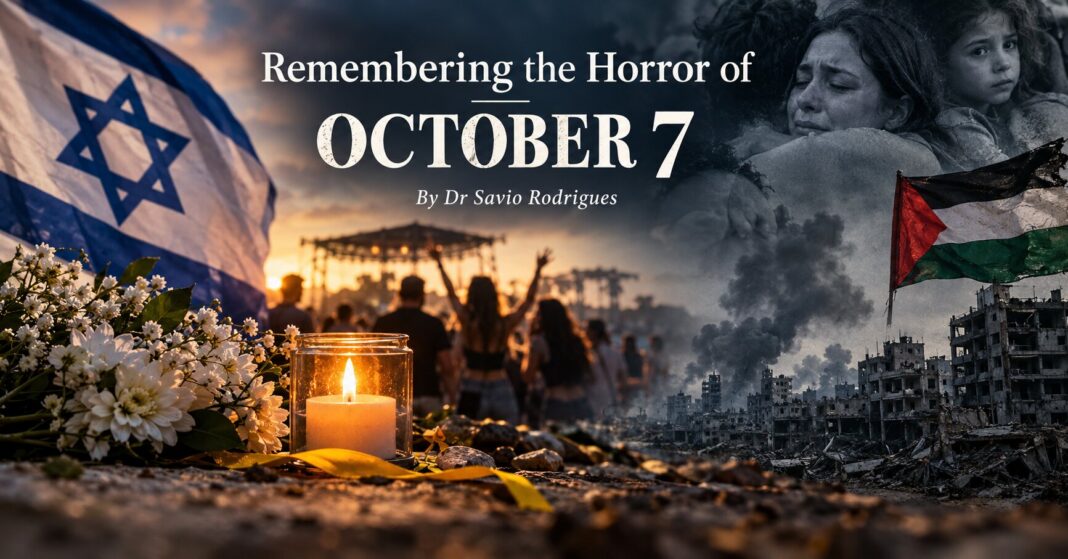

There are dates in history that cease to be merely dates. They become wounds in the collective memory of a people and warnings to humanity about what happens when hatred is allowed to overpower our basic recognition of another human being.
October 7, 2023, is one such date.
Three years ago, the people of Israel woke to a nightmare. Hamas and other Palestinian armed groups launched a coordinated assault from Gaza into southern Israel. Communities were attacked, homes were invaded and civilians were murdered. The Nova music festival, where young people had gathered to dance and celebrate life, became one of the killing grounds.
More than 1,200 Israelis and foreign nationals were killed and 251 people were abducted into Gaza. Women, children and elderly people were among those taken hostage. United Nations investigations subsequently documented killings, hostage-taking, torture and sexual and gender-based violence associated with the attacks and captivity.
Behind those statistics were human beings.
They were mothers and fathers. Sons and daughters. Grandparents. Friends. Young people beginning their adult lives. Foreign nationals who happened to be working in Israel. People who went to sleep the previous night expecting to wake up to another ordinary morning.
That ordinariness is important to remember because terrorism seeks precisely to destroy it.
The objective of terrorism is larger than the killing of the immediate victim. Terrorism attempts to inject fear into the psychological bloodstream of a society. It wants citizens to question whether their homes are safe, whether their borders can protect them, whether their institutions can defend them and whether tomorrow will resemble yesterday.
October 7 achieved that psychological rupture in Israel.
It was also an extraordinary intelligence and security failure. A country possessing one of the world’s most sophisticated intelligence and military establishments was caught catastrophically unprepared. That failure deserves investigation, accountability and serious institutional introspection. National security cannot be built upon the assumption that technological superiority makes strategic surprise impossible.
But no security failure can become an explanation for terrorism, much less a justification for it.
There is a dangerous intellectual habit in global discourse where terrorism is sometimes contextualised until the humanity of its victims disappears beneath geopolitics. History matters. Palestinian suffering matters. Occupation, security, borders, settlements, statehood and political rights are legitimate subjects for debate. The immense suffering subsequently endured by Palestinian civilians in Gaza cannot be ignored either.
But none of these questions changes the moral character of deliberately murdering civilians or taking them hostage.
One can recognise Palestinian suffering without rationalising October 7. One can condemn Hamas while questioning Israeli policies. One can defend Israel’s right to security while demanding that Palestinian civilians possess the right to life, dignity and a political future.
Moral consistency should not be complicated. Unfortunately, our increasingly tribal world has made it so.
The tragedy of the Middle East has increasingly been reduced to competing camps demanding that humanity recognise only their suffering. If you mourn Israeli children, some assume you are indifferent to Palestinian children. If you mourn Palestinian civilians, others assume you have forgotten the victims of October 7. This binary morality is poisoning international discourse.
A dead Israeli child and a dead Palestinian child do not belong to competing categories of human grief. They represent the same catastrophic failure of politics, diplomacy and leadership to protect innocence.
The war unleashed after October 7 has devastated Gaza and inflicted enormous suffering upon Palestinian civilians. Families have been displaced, communities destroyed and generations traumatised. Recognising that suffering does not require us to forget what happened on October 7.
Indeed, remembrance becomes meaningless if memory is selective.
There is another lesson the world must learn from that morning: never underestimate ideological extremism merely because it appears strategically irrational.

States often calculate through deterrence, economic interests and conventional assessments of costs and benefits. Extremist movements may calculate differently. Ideology, martyrdom, symbolism and psychological impact can outweigh conventional strategic logic. That makes them extraordinarily difficult adversaries.
Military power can destroy infrastructure, eliminate commanders and degrade terrorist organisations. It cannot by itself extinguish the political and ideological conditions in which generations inherit hatred.
Three years after October 7, the strategic questions created by that terrible morning remain profound.
What will Gaza eventually become? Who will govern it? Can Hamas or an organisation resembling it be prevented from rebuilding military capability? What political future will Palestinians have? What security architecture can convince Israelis that another October 7 will never happen? And what diplomatic framework can convince Palestinians that their children have a future beyond recurring war?
These questions cannot be answered by rage alone. Nor can they be answered by pretending October 7 was simply another episode in a decades-old conflict.
It represented something darker: the deliberate destruction of the distinction between combatant and civilian. Once that boundary disappears, barbarity acquires ideological permission.
That should concern the entire world.
The international community must also confront the uncomfortable reality that outrage has become increasingly selective. Atrocities are condemned or rationalised depending upon political alignment. Victims are mourned according to nationality, religion or ideology. Social media has accelerated this degradation, transforming human tragedy into competing narratives, hashtags and propaganda.
Humanity cannot function according to such a moral hierarchy.
Peacebuilding is often misunderstood as the absence of war. It is much more demanding. Sustainable peace requires institutions, security, economic opportunity, political legitimacy and, eventually, the enormously difficult reconstruction of trust.
There will never be lasting peace if Israelis believe their neighbours ultimately seek their destruction. There will never be lasting peace if Palestinians believe their children are condemned to permanent conflict and hopelessness.
Someone, somewhere, must eventually break that cycle. But reconciliation cannot begin with historical amnesia.
October 7 must be remembered because forgetting atrocities creates the conditions for their repetition. Remembrance is not vengeance. Remembrance is the insistence that certain boundaries of human behaviour remain sacred regardless of politics.
Today, therefore, remember the families destroyed in their homes. Remember the young people who went to a music festival and never returned. Remember those dragged across the border into captivity. Remember the survivors who continue to carry memories that will never completely disappear. And remember some of the Palestinian civilians whose lives have subsequently been consumed by a war they did not choose.
History should never become a competition in suffering.
October 7 reminds us where dehumanisation ultimately leads. The moment we stop seeing another person as a mother, father, daughter, son or child and begin seeing them merely as an ethnicity, religion, nationality or enemy, we create the psychological permission for barbarity.
Three years later, perhaps the most important words we can say are therefore the simplest:
Never justify terrorism. Never celebrate the murder of innocents. Never allow ideology to erase humanity. And never stop searching for a peace in which an Israeli mother and a Palestinian mother can put their children to bed without wondering whether those children will survive the night.
That would be the most meaningful way to remember October 7. Not through hatred. Through ensuring that its horror is never repeated.