

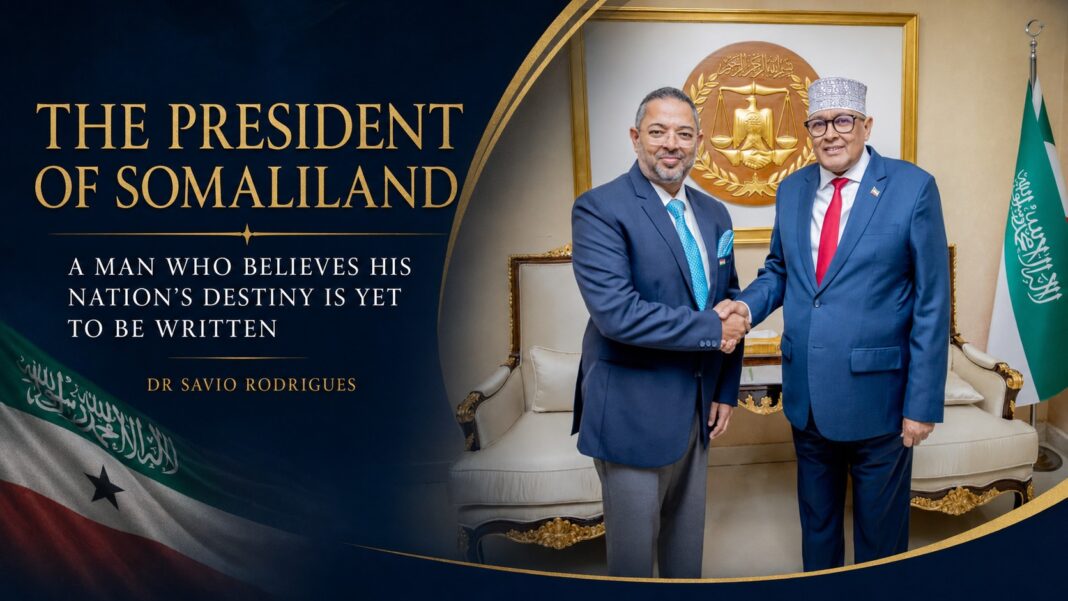

I have had the privilege of meeting several political leaders, policymakers and influential personalities over the years. Some impress you with their knowledge, others with their authority, and a few with their ability to articulate a vision. But occasionally, you encounter a leader whose simplicity, humility and conviction leave an impression that goes beyond the formalities of an official meeting.
My recent interaction with the President of Somaliland, His Excellency Abdirahman Mohamed Abdullahi Irro, was one such experience.
What was expected to be a conversation about Somaliland’s geopolitical aspirations, economic transformation and international recognition evolved into an engaging discussion lasting over two hours. During those two hours, I discovered something remarkable about the man leading a nation that has spent decades seeking its rightful place in the international community.
I discovered a man who genuinely believes in the destiny of his people.
What struck me first was his simplicity. There was no unnecessary display of authority, no attempt to overwhelm the conversation with the weight of his office. Instead, there was an openness to discuss ideas, listen to perspectives and explore possibilities.
The last time I experienced a similar impression of simplicity and humility in a leader was with my own Prime Minister, Narendra Modi. I am not comparing their political journeys, circumstances or achievements. Those are vastly different. But certain human qualities transcend geography, political systems and the size of the nations they lead.
Humility is one of them.
The President of Somaliland possesses a rather interesting combination of seriousness and wit. He understands the gravity of the challenges confronting his nation, yet he has the ability to introduce humour into a conversation without diminishing the seriousness of the subject.
His wit is natural, his responses thoughtful, and his enthusiasm infectious.
What amazed me most was the almost childlike energy with which he spoke about Somaliland’s future. I use the expression deliberately. There is something extraordinarily powerful about a leader who can retain the excitement of a child while carrying the responsibilities of a Head of State.
Many leaders eventually become prisoners of the limitations surrounding them. They begin to see obstacles before opportunities. President Irro, from my interaction with him, appeared determined not to allow Somaliland’s challenges to define the limits of its ambitions.
He spoke about his vision with an enthusiasm that suggested he was not merely discussing government programmes or political objectives. He was speaking about something he deeply believed could be achieved.
And that distinction matters.
One of the most compelling aspects of our conversation was his belief in the youth of Somaliland.
He understands that the transformation of Somaliland cannot rest solely on the shoulders of its present political leadership. The future must be shaped by a generation that is educated, confident, entrepreneurial and willing to assume responsibility for the nation’s progress.
His desire to inspire young Somalilanders to become leaders of transformation was particularly striking.
For a nation seeking greater economic opportunities, stronger institutions, technological advancement and international engagement, its young people represent an enormous reservoir of possibility.
I sensed that the President does not merely want the youth to inherit Somaliland. He wants them to build the Somaliland they aspire to inherit.
That is an important distinction between governing for the present and preparing a nation for the future.
Another aspect of our conversation that touched me personally was his warmth towards India and the people of India.
His affection for India was evident in the manner in which he spoke about our country. As an Indian, I found this particularly meaningful.
India’s journey as a democracy, its technological progress, economic ambitions, entrepreneurial culture and development experience offer several areas where meaningful engagement with Somaliland could be explored.
I believe there is considerable potential for cooperation in education, healthcare, technology, agriculture, skills development and entrepreneurship.
The warmth I experienced in my conversation with the President reinforced my belief that relationships between nations are not built through diplomatic documents alone. They also emerge from genuine respect between peoples and an appreciation of each other’s aspirations.

But above everything else, there was one conviction that stood out throughout our conversation.
President Irro’s rock-solid belief that Somaliland will one day secure global recognition as a sovereign nation.
There was no hesitation when he spoke about this aspiration. No uncertainty in the manner in which he articulated it. For him, recognition appeared not merely as a diplomatic objective but as a fundamental expression of the identity, dignity and aspirations of the people he represents.
Somaliland’s pursuit of international recognition is a complex question involving history, international law, African regional diplomacy and competing interpretations of sovereignty and territorial integrity. These realities cannot be wished away.
Yet what interested me was the President’s personal conviction.
He did not speak like a man resigned to waiting indefinitely for the international community to determine his nation’s future. He spoke like a leader who believes that Somaliland must continue strengthening its institutions, expanding its economic possibilities and demonstrating its capacity for responsible self-governance.
There is an important lesson in that approach. Recognition may be a diplomatic destination, but nation-building is a continuous responsibility. And in my assessment, the President understands the importance of pursuing both.
During our conversation, I found myself observing not merely what he said but how he said it. His expressions changed when he discussed the possibilities before Somaliland. His enthusiasm became particularly evident when the discussion turned towards the future.
It was almost as though the President could already see the Somaliland he wanted his people to experience.
That childlike enthusiasm was perhaps the most memorable part of our interaction.
It reminded me that great national aspirations often begin with a simple human quality: the courage to imagine a future different from the present.
Of course, vision alone cannot transform a nation. It must be supported by institutions, capable administrators, economic policies, investment, accountability and measurable outcomes. The real test of any leader’s aspirations is whether they translate into improvements in the lives of ordinary citizens.
Somaliland faces significant challenges, and its leadership will ultimately be judged by how effectively it addresses them.
But my interaction with President Irro gave me a valuable insight into the thinking of the man entrusted with navigating those challenges.
I came away with the impression of a leader who wants his people to dream beyond their present circumstances, who sees the youth as central to national transformation, who holds genuine warmth towards India, and who remains deeply committed to Somaliland’s pursuit of sovereign recognition.
For me, the most meaningful conversations with leaders are rarely those that revolve around power. They are the conversations that reveal purpose.
My two hours with President Irro were about purpose.
I travelled to Somaliland to understand its people, their aspirations, their struggles and their determination to shape their own future. I returned with a deeper appreciation of the human conviction behind the nation’s political aspirations.
I have always believed that leadership is not defined merely by the office a person occupies, but by the ability to make others believe that a better future is possible.
What remains with me from my conversation with President Irro is not the grandeur of the presidency, but the simplicity of the man, the sharpness of his wit, the warmth of his hospitality and the extraordinary enthusiasm with which he speaks about his country’s tomorrow.
There was something profoundly human about watching a President discuss his nation’s future with the excitement of a child and the conviction of a man who has dedicated his life to public service.
I went to meet the President of Somaliland. I came away having met a man who believes in Somaliland with every fibre of his being.
And perhaps that is where every meaningful national transformation begins: with someone who refuses to stop believing.