


Key Takeaways
- The Indian Subcontinent hosts significant Christian populations, especially in Mizoram and Manipur.
- Geopolitical interests of India, Bangladesh, and Myanmar make a sovereign Christian state unlikely.
- A potential transnational corridor could link Christian communities across the Bay of Bengal region.
Sheikh Hasina’s warning in May 2024 sounded almost extraordinary: that there was a conspiracy to carve out parts of Bangladesh and Myanmar and create a Christian state, potentially accompanied by a foreign military base in the Bay of Bengal. Her remarks were immediately dismissed by many as conspiracy theory. Yet geopolitics has a habit of making yesterday’s improbable scenario today’s strategic conversation. The question, therefore, is not whether Sheikh Hasina’s allegation has been proven – it has not – but whether the demographic, ethnic, geographical and strategic conditions exist that could theoretically make some form of Christian-majority political entity in the eastern Indian subcontinent conceivable.
The answer is complicated. A conventional independent “Christian nation” carved out of Bangladesh, Myanmar and India remains highly improbable. But a transnational political-geographic zone linking Christian-majority populations across the eastern Himalayan and Bay of Bengal region is a considerably more plausible subject for strategic analysis.
Hasina’s original statement is important because she was not simply talking about Christianity as a religion. She spoke of territory. Bangladesh’s then-prime minister alleged that a plan existed to take part of Bangladesh and Myanmar, “like East Timor”, and create a Christian country, with a base in the Bay of Bengal. She did not identify the alleged foreign power behind the proposal.
That distinction matters. Religion alone does not create a state. Territory, political organisation, armed capacity, external sponsorship, economic viability and international recognition are required. Yet history demonstrates that when ethnicity, religion, geography and great-power competition overlap, political borders can eventually become negotiable.
The most interesting demographic evidence comes from India’s Northeast.
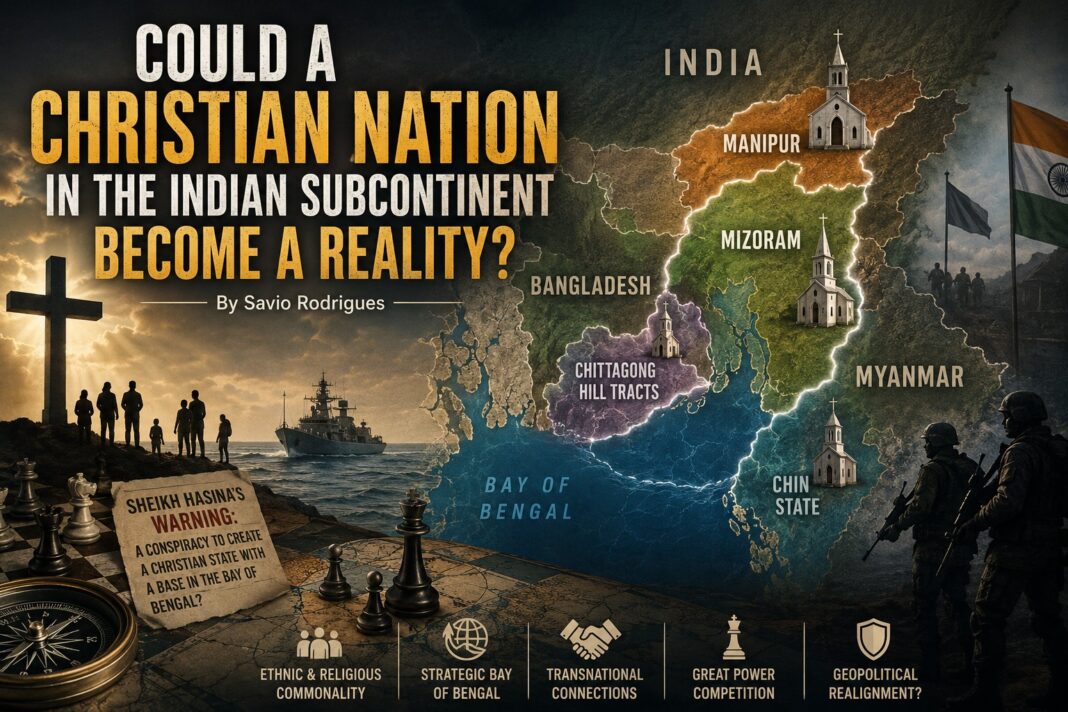
According to India’s 2011 Census, Christians constituted approximately 41.3 percent of Manipur’s population – about 1.18 million people out of 2.86 million. Mizoram was dramatically different: Christians numbered approximately 956,000 out of a population of 1.097 million, meaning that Christians constituted roughly 87 percent of the state’s population.
And Mizoram does not exist in demographic isolation.
The Mizo and related Zo communities extend across today’s international boundaries. Their historical homeland predates the borders separating India, Myanmar and Bangladesh. This is why the idea of “Zo reunification” periodically enters political discourse. Mizoram Chief Minister Lalduhoma himself spoke in 2024 about the possibility of Zo people in India, Myanmar and Bangladesh aspiring to reunification under India, while emphasising the historical division of the community.
This is where the geopolitical equation becomes fascinating.
Imagine drawing a map based not upon existing national boundaries but upon overlapping ethnic and religious communities. From Mizoram and parts of Manipur, the map moves eastward into Myanmar’s Chin State, where Christianity is deeply embedded among several ethnic communities. It then moves southwest toward the Chittagong Hill Tracts of Bangladesh, where indigenous communities include Buddhist and Christian minorities and where ethnic autonomy has historically been a sensitive political issue.
The resulting geography would not constitute a ready-made country. But it would represent a corridor of minority and indigenous populations spread across three sovereign states. That distinction is crucial.
The probability of these territories suddenly becoming one independent Christian republic is extremely low. India, Bangladesh and Myanmar have powerful territorial interests in preventing such fragmentation. India in particular has no obvious strategic incentive to surrender Mizoram or Manipur territory. Bangladesh would have little interest in losing the Chittagong Hill Tracts. Myanmar, despite its internal fragmentation, would resist the loss of Chin and other border territories.
Yet geopolitical projects do not always begin with a declaration of independence.
They can begin with autonomy movements, ethnic consolidation, humanitarian corridors, cross-border political mobilisation, refugee flows, religious networks, foreign-funded civil society organisations, security partnerships and competing narratives about self-determination.
This is why the Bay of Bengal component of Hasina’s argument deserves attention.
The Bay of Bengal is no longer merely a maritime space between South and Southeast Asia. It sits at the intersection of India’s Act East strategy, China’s Indian Ocean ambitions, Myanmar’s instability, Bangladesh’s strategic geography and the growing Indo-Pacific competition involving the United States and its allies.
A strategically positioned territory on the Bay of Bengal could therefore possess value far beyond its population.
But there is another reality that makes the Christian-state hypothesis much harder to sustain: the demographics of the region are not exclusively Christian.
Bangladesh is overwhelmingly Muslim. The Chittagong Hill Tracts themselves are religiously diverse. Manipur contains large Hindu, Christian and Muslim populations. Myanmar is overwhelmingly Buddhist nationally, although several frontier ethnic regions have Christian majorities. Consequently, any attempt to create a state based purely on Christianity would immediately encounter substantial demographic and political contradictions.

The Christian population itself is also not a unified geopolitical bloc. Catholics, Baptists, Presbyterians, Evangelicals and numerous indigenous churches possess different institutions and political orientations. The Catholic leadership in Bangladesh, for example, publicly expressed concern after Hasina’s 2024 statement and rejected the idea of a “Christian state” as an appropriate political concept in the modern secular world.
Therefore, Christianity provides a demographic commonality, but not necessarily a common political objective.
There is, however, another variable: China.
Any serious assessment of this hypothetical state must consider the India-China-Myanmar-Bangladesh strategic triangle. The Northeast is India’s gateway to Southeast Asia, while Myanmar provides China with access toward the Bay of Bengal. Bangladesh sits beside India’s narrow Siliguri Corridor and provides enormous strategic depth to India’s eastern theatre.
Consequently, any attempt by an external power to reorganise territory in this region would not simply be a religious project. It would become a contest over ports, roads, energy corridors, maritime access and military positioning.
That may actually be the most important insight hidden inside Hasina’s controversial allegation.
The real strategic question may not be “Can a Christian country be created?” It may be “Can Christian-majority frontier populations become the political vehicle for a larger geopolitical realignment?”
That scenario is more conceivable.
Consider the ingredients: Christian-majority Mizoram; substantial Christian populations in Manipur; Christian-majority Chin areas of Myanmar; ethnic communities extending across international borders; instability inside Myanmar; historic ethnic grievances; Bangladesh’s strategically important Chittagong Hill Tracts; and the increasing strategic importance of the Bay of Bengal.
Individually, none of these proves a conspiracy. Collectively, however, they create a geopolitical environment in which identity politics can intersect with great-power competition.
There is also an important counterargument. The modern international system strongly favours territorial integrity. India is unlikely to accept territorial dismemberment. Bangladesh has historically resisted separatism. Myanmar’s ethnic conflicts have demonstrated how extraordinarily difficult it is to convert insurgent geography into stable sovereign states. And the international community has generally become cautious about creating new states through externally sponsored territorial fragmentation.
Therefore, the probability of a sovereign Christian nation emerging from parts of Bangladesh, Myanmar and India in the foreseeable future should be regarded as low. But the probability of increasing political interaction among Christian-majority and ethnic communities across these borders is considerably higher. And that is where India needs to pay attention.
The Northeast should not be viewed merely through the lens of insurgency or religion. It should be understood as a geopolitical zone where ethnicity, faith, migration, borders, economics and great-power competition intersect.
The danger is not Christianity. The danger is the weaponisation of Christianity – or for that matter any religion – for territorial politics.
India’s response, therefore, should not be communal. It should be strategic: strengthen border infrastructure, improve intelligence cooperation, accelerate economic integration of the Northeast, protect indigenous identities, deepen engagement with Myanmar and Bangladesh, and ensure that foreign strategic interests do not exploit local grievances.
Sheikh Hasina’s allegation may ultimately prove to have been exaggerated or unsupported. But dismissing the underlying geopolitical question would be equally shortsighted.
A Christian nation carved from Bangladesh, Myanmar and India’s Northeast may remain improbable. A new geopolitical fault line built around ethnicity, religion, territory and the Bay of Bengal is not.
And history teaches one uncomfortable lesson: nations are often created not because they were considered possible, but because enough political forces eventually decided that they were.