

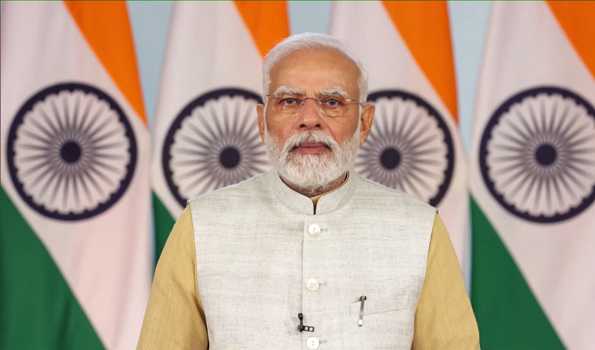

New Delhi: There is a need for an institutional approach by the international community to help each other during a crisis, Prime Minister Narendra Modi said on Tuesday adding that “the Covid-19 pandemic should have been a wake-up call for taking everyone along”.
The Prime Minister was addressing the United Nations World Geospatial International Congress via video message.
“Global organisations like the United Nations can lead the way in taking resources to the last mile in every region… Hand-holding and technology transfer are also crucial in fighting climate change,” Modi said.
He suggested that best practices may be shared for saving our planet.
Modi pointed out that the theme of the conference, ‘Geo-enabling the Global Village: No one should be left behind’ can be seen in the steps India has taken over the last few years.
“We have been working on a vision of Antyodaya which means empowering the last person at the last mile, in a mission mode,” he said.
“450 million unbanked people, a population greater than that of the US, were brought under banking net and 135 million people, about twice the population of France, were given insurance,” he said.
He said that the sanitation facilities were taken to 110 million families and tap water connections to over 60 million families in India.
India is ensuring no one is left behind, the Prime Minister added.

“In India, technology is not an agent of exclusion. It is an agent of inclusion,” Modi said.
He highlighted the role of geospatial technology in driving inclusion and progress.
The role of technology in schemes like Svamitva and housing, and the outcomes in terms of property ownership and women empowerment, have a direct impact on the UN’s Sustainable Development Goals on poverty and gender equality, the Prime Minister emphasized.
Citing the example of the South Asia Satellite for facilitating communication in India’s neighbourhood, the Prime Minister said that India has already set an example in sharing the benefits of geo-spatial technology.
Modi underscored the endless possibilities that geo-spatial technology offers. These include sustainable urban development, managing and mitigating disasters, tracking the impact of climate change, forest management, water management, stopping desertification and food security.
He expressed wish that the conference becomes a platform to discuss developments in such important areas.
“With the stakeholders of the global geo-spatial industry coming together, with the policy makers and academic world interacting with each other, I am confident that this conference will help steer the global village into a new future,” the Prime Minister concluded.
The Congress is being attended by over 2,000 delegates including 700 plus international delegates and participants from about 120 countries.