

Key Takeaways
- The dialogue highlighted how Steven Pinker views consciousness as a brain product, while Sadhguru sees it as a non‑intentional force.
- Harvard Medical School hosted the event, bridging scientific research with yogic wisdom.
- Both speakers agreed that modern life improves physical comfort but shifts challenges to mental health, urging deeper mindfulness practices.
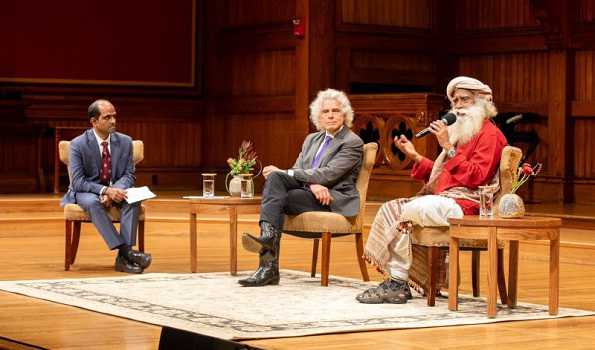
Boston: In a highly anticipated and intellectually stimulating event, the mystic, yogi, and spiritual leader, Sadhguru, and the renowned experimental psychologist and author, Steven Pinker, shared the stage at the prestigious Harvard Medical School’s Sanders Theatre, Boston, to discuss Consciousness and its unexplored territories on Thursday.
It was the key session on day 1 of the two-day conference on “Consciousness: Science, Spirituality & Social Impact,” an endeavor by the Sadhguru Center for a Conscious Planet, BIDMC, Harvard Medical School held in Boston on October 26-27. The session was moderated by Balachundar Subramaniam, MD, MPH at SCCP.
Sadhguru emphasised, “Consciousness doesn’t really represent an intellect that is functioning within us.
Consciousness which is referred to as Chitt in yogic terms is the fundamental force that drives us and it is that aspect of intelligence that has no intent.”
Steven Pinker initiated the discourse by asserting that consciousness is not a miracle but rather a product of the brain and external factors such as drug chemistry and electrical activity. Sadhguru clarified that the term ‘miracle’ should not be misconstrued as an attempt to deceive, but rather as that which eludes easy logical explanation within the realm of human experience.
Expanding on this, Sadhguru noted, “If you put seed into the soil, it becomes a flower, that’s a miracle. If you put bread in your body, it becomes part of your body, that’s a miracle. We can explain some physical aspects of how this happens, but what makes it happen is miraculous. Usually, we see something that’s not easily explainable in human experience, we call it miraculous, however, calling something miraculous doesn’t mean it is not explainable. Just everything in life is a miracle.”
Sadhguru went on to elucidate, “The brain was manufactured by the human body, it didn’t come from elsewhere, so essentially, it is just a body with a different, significant level of functionality.” He stressed that the brain cannot account for the entirety of human experience and that there exist numerous uncharted facets of life.

He further explained the difference between consciousness and awareness. “These two are different aspects of life. Awareness is all that’s happening in the brain, a consequence of activity, while Consciousness has no intent.
He emphatically pointed out, “Science should not conclude what we do not know does not exist,”
The session also witnessed an insightful discussion on deep meditative states. Steven Pinker diverged from popular perceptions of meditation in the context of intuition and clarity, whereas Sadhguru contended that the English term ‘meditation’ is an umbrella concept, encompassing practices from Japa, Tapa to Samyama.
Lastly, the topic of mental health was also touched upon. Sadhguru said, “We are the most comfortable generation in the history of humanity, especially for women and children. In earlier generations, survival was always a challenge, as the survival issue is settled, now the struggle goes to mind and hence mental health issues. While we have engineered the most sophisticated machines, we have stopped engineering ourselves.
Earlier in the day, on Thursday, a captivating discussion with Sadhguru and Christof Koch, PhD; Rudolph Tanzi, PhD; Deepak Chopra, MD; Bernard Carr, PhD was also held that intended to bridge the realms of spirituality and science, offering a rare insight into one of humanity’s most enduring mysteries.
In order to enhance human health and well-being, the Sadhguru Center, BIDMC integrates medical and contemplative sciences by scientific methods. It carries out studies that use clinical and mindfulness-based interventions to improve brain health and enhance the physical and mental health of patients recovering from surgeries and critical illness.