


Key Takeaways
- India has undergone a remarkable infrastructure and economic transformation between 2014 and 2026 under Prime Minister Narendra Modi’s leadership.
- The 26 milestones of India’s growth include digital payments revolution, aviation growth, railway electrification, and many more.
- Narendra Modi’s vision for India is to create a self-reliant, connected, and globally competitive India through infrastructure and economic development.
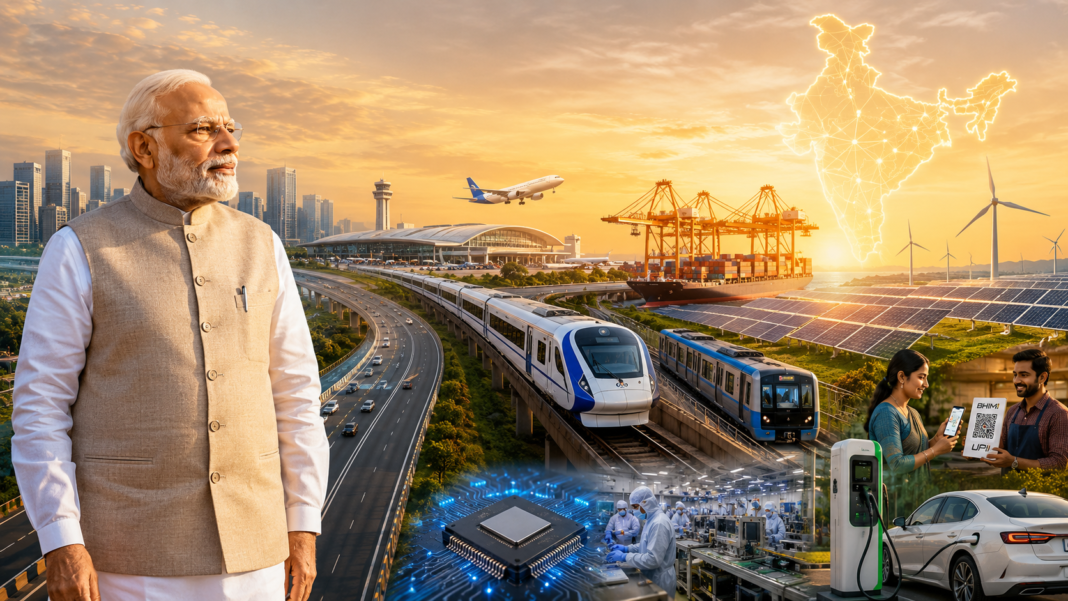
The story of modern India is one of roads built, villages connected, homes constructed, industries established, and opportunities created. Under Prime Minister Narendra Modi’s leadership, India has undergone a remarkable infrastructure and economic transformation between 2014 and 2026. 26 milestones reflect a larger vision of creating a self-reliant, connected, and globally competitive India.
- Digital Payments Revolution
In 2014, digital payments were limited to urban India and largely dependent on cards and banking infrastructure. Today, India processes more than 18 billion digital transactions every month. UPI has transformed the financial ecosystem, making instant payments possible for everyone – from street vendors to multinational corporations. India has become a global benchmark for digital financial inclusion.
- Massive Expansion of Port Capacity
India’s port handling capacity has grown from 800 MTPA to over 2,760 MTPA. This expansion has strengthened India’s trade competitiveness, reduced congestion, improved logistics efficiency, and enhanced India’s role in global supply chains.
- Aviation Growth Reaches New Heights
The number of airports in India has increased from 74 to over 160. Cities once disconnected from the national economy are now linked through regional connectivity schemes, boosting tourism, trade, and investment opportunities.
- Railway Electrification at Historic Scale
Railway electrification has increased from 21,000 kilometres to more than 65,000 kilometres. This modernisation reduces fuel imports, lowers operational costs, improves efficiency, and contributes to India’s environmental goals.
- Building a Modern Expressway Network
India’s expressway network has expanded from approximately 1,000 kilometres to over 6,700 kilometres. Faster connectivity between major economic centres has significantly reduced travel time and logistics costs.
- Metro Rail Transformation
Metro rail coverage has grown from 250 kilometres to more than 1,000 kilometres. Urban mobility has been transformed in major cities, reducing congestion and improving quality of life for millions.
- Expansion of CNG Infrastructure
The number of CNG stations has increased from 738 to over 8,600. This expansion supports cleaner transportation and helps reduce urban pollution.
- PNG Connections Reach Millions
Piped Natural Gas connections have expanded from 25 lakh households to over 1.6 crore households, providing cleaner, safer, and more convenient energy access.
- Strengthening the Gas Pipeline Network
India’s gas pipeline network has expanded from 15,000 kilometres to 26,000 kilometres. This infrastructure supports industries, power generation, and household energy needs.
- Near Universal LPG Coverage
LPG coverage has risen from approximately 55% to nearly 100%. Millions of women have been freed from dependence on traditional cooking fuels, improving health and quality of life.
- Doubling India’s Power Capacity
Power generation capacity has increased from 249 GW to over 520 GW. Reliable electricity has become a critical enabler of economic growth and industrial expansion.
- Solar Energy Revolution
Solar capacity has skyrocketed from 2.6 GW to over 110 GW, representing one of the fastest renewable energy expansions anywhere in the world.
- Growth in Renewable Energy
Overall renewable energy capacity has increased from roughly 76 GW to over 275 GW. India is increasingly becoming a global leader in clean energy adoption.
- Record Coal Production
Coal production has risen from 565 million tonnes to over one billion tonnes. Despite renewable growth, coal continues to provide critical energy security for India’s expanding economy.
- Expansion of Transmission Networks
Transmission infrastructure has expanded from 2.9 lakh circuit kilometres to more than 5 lakh circuit kilometres, ensuring electricity reaches every corner of the country.

- Creation of an EV Ecosystem
From being virtually non-existent in 2014, India now has more than 25,000 EV charging stations. Electric mobility is steadily becoming a key component of India’s transport future.
- Ethanol Blending Success
Ethanol blending has increased from just 1.5% to 20%. This achievement reduces oil imports, supports farmers, and strengthens energy security.
- Tap Water Access Revolution
Household tap water access has grown from just 17% of homes to over 80%. Millions of families now enjoy access to safe drinking water directly at home.
- Nationwide Sanitation Drive
More than 11 crore toilets have been constructed across India. What was once a major public health challenge has become one of the largest sanitation transformations in human history.
- Universal Rural Electrification
Thousands of villages that lacked electricity in 2014 are now connected to the power grid. Rural electrification has become nearly universal.
- Housing for the Poor
Over 4 crore homes have been provided to economically weaker sections under various housing schemes. Home ownership has become a reality for millions.
- Optical Fibre Connectivity
India’s optical fibre network has expanded from minimal rural presence to more than 2 lakh connected villages, enabling digital governance, education, and telemedicine.
- Internet Penetration Explosion
Internet users have increased from 25 crore to over 95 crore. India is now one of the largest digital societies in the world.
- Mobile Manufacturing Hub
Mobile phone production has increased from approximately 6 crore units annually to over 33 crore units annually. India has evolved into a major global electronics manufacturing centre.
- Birth of India’s Semiconductor Industry
In 2014, India had virtually no semiconductor manufacturing ecosystem. Today, multiple semiconductor fabrication and OSAT projects are under development, marking the beginning of a strategic new industry.
- Defence Export Transformation
Defence exports have grown from ₹700 crore to over ₹23,000 crore. India is increasingly becoming a trusted supplier of defence equipment to countries around the world.
The Bigger Picture
Taken individually, each of these achievements is significant. Taken together, they represent a structural transformation of India. Roads, railways, ports, airports, digital infrastructure, energy systems, housing, sanitation, manufacturing, and defence production have all expanded simultaneously.
No nation becomes a developed economy through welfare alone. Development requires infrastructure, connectivity, productivity, energy security, industrial capacity, and technological innovation. The numbers from 2014 to 2026 demonstrate that India has not merely grown – it has been rebuilt.
The task ahead remains enormous. India must continue creating jobs, improving healthcare and education, strengthening institutions, and ensuring that growth reaches every citizen. But the foundation has been laid. The infrastructure of a New India is no longer a vision on paper. It is visible in every village connected by fibre, every home receiving tap water, every airport serving a new city, every digital payment made by an ordinary citizen, and every Indian entrepreneur building for the future.
The India of 2026 is not the India of 2014. And that transformation is one of the defining national stories of our time.