
Key Takeaways
- Peaceful protests are essential for a democratic republic.
- Violence can erase the credibility of peaceful protesters.
- Accountability is crucial for maintaining law and order and respecting democratic rights.
The right to protest is a fundamental right in India, earned through sacrifice and protected by the Constitution. Every generation has strengthened this right by exercising it responsibly. Students, farmers, workers, professionals, women, senior citizens – every Indian has the right to raise their voice against what they believe is unjust. Governments are not infallible, and public dissent has often been the catalyst for reform. But there is one line that must never be crossed: the moment a protest transforms into violence, it ceases to be a movement for justice and becomes an assault on democracy itself.
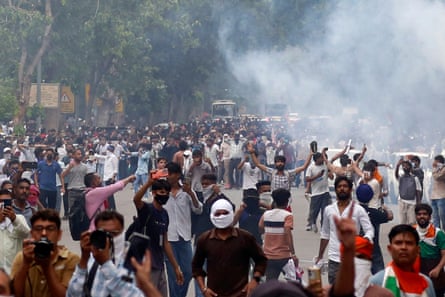
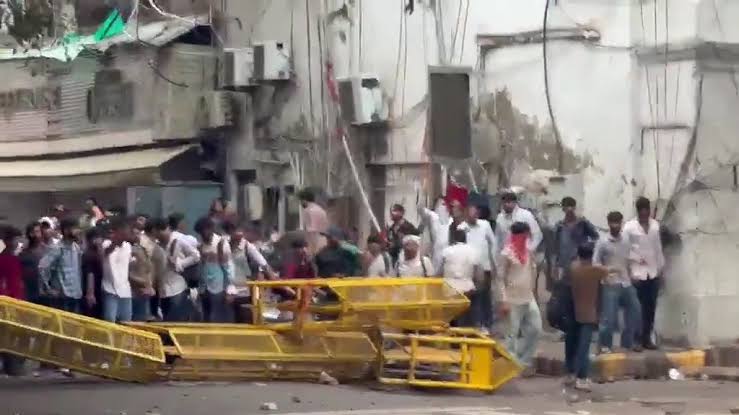
The ongoing protests in New Delhi once again force us to confront this uncomfortable truth.
Every citizen has the freedom to assemble peacefully. Every student has the right to demand fairness. Every parent has the right to seek accountability from institutions that shape the future of their children. These rights are not merely legal protections; they are moral pillars of a democratic republic. However, nowhere does the Constitution permit violence in the name of protest. Nowhere does it justify attacking police personnel, damaging public property, intimidating ordinary citizens, or creating an atmosphere of fear.
Violence is not courage. Violence is not revolution. Violence is the admission that one has abandoned reason.
History repeatedly teaches us that the most transformative movements were those that commanded moral authority rather than physical force. Mahatma Gandhi did not shake the British Empire through riots. He challenged it through discipline, sacrifice, and moral conviction. Dr. B.R. Ambedkar did not seek social justice by burning institutions; he strengthened them through constitutionalism. Both understood that lasting change comes from winning the conscience of society, not from coercing it through fear. Even leaders with vastly different ideologies recognised that legitimacy comes from the strength of one’s argument, not the force of one’s actions.
Unfortunately, many protests today are no longer judged by the legitimacy of their demands but by the images that emerge from them. A single burning vehicle, a shattered barricade, an injured police officer, or a vandalised public building can erase the credibility of thousands of peaceful protesters. Television cameras and social media algorithms rarely remember the speeches; they remember the flames.
That is precisely why every genuine protester must isolate those who seek violence. Every movement attracts opportunists – political actors looking for mileage, ideological extremists seeking chaos, and habitual agitators who thrive on confrontation. They do not strengthen a movement; they hijack it. The real protesters become secondary while the violent fringe dominates headlines.
There is another question that every honest citizen must ask. Where did the stones come from?
Peaceful protesters do not ordinarily arrive at demonstrations carrying stones. If stones were available in sufficient numbers to be hurled at police personnel, someone brought them, someone stockpiled them, or someone ensured they were readily available. Was it a section of the protesters? Were they political provocateurs? Were they organised miscreants who infiltrated the gathering solely to provoke violence? These are not rhetorical questions; they demand a thorough, transparent and impartial investigation. Until the facts are established, no responsible person should jump to conclusions. But one fact is undeniable: the moment stones were thrown, the protest ceased to be entirely peaceful. Those responsible, irrespective of their political affiliation, ideology or organisational backing, must be identified and prosecuted according to law.
Students, in particular, must recognise this danger.
India’s students have historically been agents of positive change. They have questioned governments, challenged injustice, and contributed immensely to national discourse. Their energy, idealism and fearlessness are assets to the Republic. But those very qualities can also be exploited by individuals whose objectives have little to do with the cause being protested. The enthusiasm of youth should never become a weapon in the hands of those seeking political instability.
The police, too, have an extraordinarily difficult responsibility. They are expected to maintain law and order while respecting the democratic rights of citizens. Like every institution, the police are not beyond criticism. Allegations of excessive force, if any, must always be investigated impartially and transparently. Accountability cannot be selective. It applies equally to governments, police forces, protesters and political leaders. A democracy cannot ask for restraint from one side while excusing excesses from another.
What is equally troubling is the growing tendency of political parties to selectively endorse protests depending on who is in power. Violence does not become acceptable because it serves one’s political narrative. A stone thrown under one government is no different from a stone thrown under another. Principles lose all meaning when they are applied selectively. Democracy cannot survive if political convenience determines what is acceptable conduct on the streets.
The issue before us is much larger than the immediate protests in New Delhi. It concerns the future culture of democratic engagement in India.
If every disagreement is settled by paralysing cities, blocking roads indefinitely, destroying public infrastructure or provoking confrontation with law enforcement, then democracy itself becomes weaker. Public property is not government property; it belongs to taxpayers. The buses that are burned, the roads that are damaged, the railway stations that are vandalised and the public offices that are attacked are built with the hard-earned money of ordinary Indians. Destroying them is not an act of resistance; it is an act against fellow citizens.
Those who defend such actions often argue that governments only listen when protests become disruptive. This is a dangerous argument because it rewards lawlessness over dialogue. Democracies function through institutions – courts, legislatures, commissions, the media, elections and public debate. These mechanisms may not always move as quickly as we desire, but replacing them with mob pressure is a path that ultimately harms everyone.

India has achieved remarkable stability despite its extraordinary diversity because our constitutional framework allows dissent without descending into anarchy. That delicate balance must be protected at all costs.
One of the most common justifications offered for violent protests is the invocation of Bhagat Singh. Those who quote him often fail to understand the principle behind his actions. Bhagat Singh was not an anarchist who believed in mindless violence. He was a revolutionary who acted against a foreign colonial regime that denied Indians every democratic avenue to seek justice. Even when he and Batukeshwar Dutt threw bombs in the Central Legislative Assembly, they deliberately used low-intensity devices intended “to make the deaf hear,” not to cause mass casualties. They stayed back, surrendered voluntarily and transformed their trial into a platform to awaken the conscience of the nation. Their objective was sacrifice, not destruction; inspiration, not intimidation.
To compare that extraordinary struggle against colonial oppression with violence in a democratic India – where every citizen has the right to vote, approach the courts, petition Parliament, challenge governments and protest peacefully – is not only historically inaccurate but also an injustice to Bhagat Singh’s legacy. If anything, his life teaches us that conviction must always be guided by purpose, discipline and accountability, not by uncontrolled rage.
Those who invoke Bhagat Singh while justifying hurling stones at police officers fundamentally misunderstand the difference between resisting colonial tyranny and weakening one’s own democratic institutions. Bhagat Singh fought to create a free India governed by law, not to legitimise violence whenever one disagrees with an elected government. To reduce his legacy to images of confrontation while ignoring his intellect, discipline, writings and willingness to embrace martyrdom is to diminish one of India’s greatest revolutionaries.
The responsibility also lies with governments. Listening is not a sign of weakness. Engaging with protesters, communicating transparently, correcting mistakes where necessary and acting swiftly against genuine grievances strengthens public confidence. Arrogance breeds alienation, while responsiveness builds trust. Governments should never mistake criticism for disloyalty.
Similarly, protesters should never mistake confrontation for patriotism.
The measure of a democratic society is not whether protests occur – they always will – but whether they remain peaceful despite deep disagreements. Peaceful protest commands respect even among opponents. Violent protest alienates even potential supporters.
India does not need more rage. It needs more reason.
The students protesting today will become tomorrow’s administrators, judges, entrepreneurs, scientists, journalists and political leaders. The values they practise today will shape the India they inherit tomorrow. If they embrace peaceful democratic engagement, they strengthen the Republic. If they normalise violence, they weaken the very freedoms they seek to protect.
As Indians, we must defend both the right to protest and the rule of law with equal conviction. These are not competing ideals; they are complementary ones. Democracy flourishes only when both exist together.
Raise your voice. Question authority. Demand accountability. Organise peacefully. March with conviction. Debate passionately. Criticise fearlessly.
But never pick up a stone where an argument will suffice. Never light a fire where dialogue can build a bridge. Never allow violence to masquerade as the language of democracy.
India has paid too high a price throughout history to earn the freedoms we enjoy today. Those freedoms carry responsibilities. The Constitution guarantees us the right to dissent; it does not guarantee the right to destroy. It protects freedom of expression; it does not protect violence. It empowers citizens to challenge authority; it does not empower mobs to replace the rule of law.
The true test of democracy is not whether citizens can protest. It is whether they can protest peacefully while preserving the institutions that safeguard their freedoms. The true strength of a movement is not measured by the damage it causes, the barricades it breaks or the headlines it generates. It is measured by its ability to persuade, to inspire and ultimately to bring about meaningful change.
Because in the end, democracies are not defended by stones thrown in anger. They are defended by ideas expressed with conviction, by institutions strengthened through accountability, and by citizens who understand that the greatest victories are won not through violence, but through the enduring power of truth, reason and peaceful resolve.