



Key Takeaways
- Bavdhan’s green natural landscape has been disrupted by ongoing coal development projects
- Daily commuters experience near-standstill traffic due to infrastructure delays
- Citizen expectations now focus on sustainable urban planning solutions
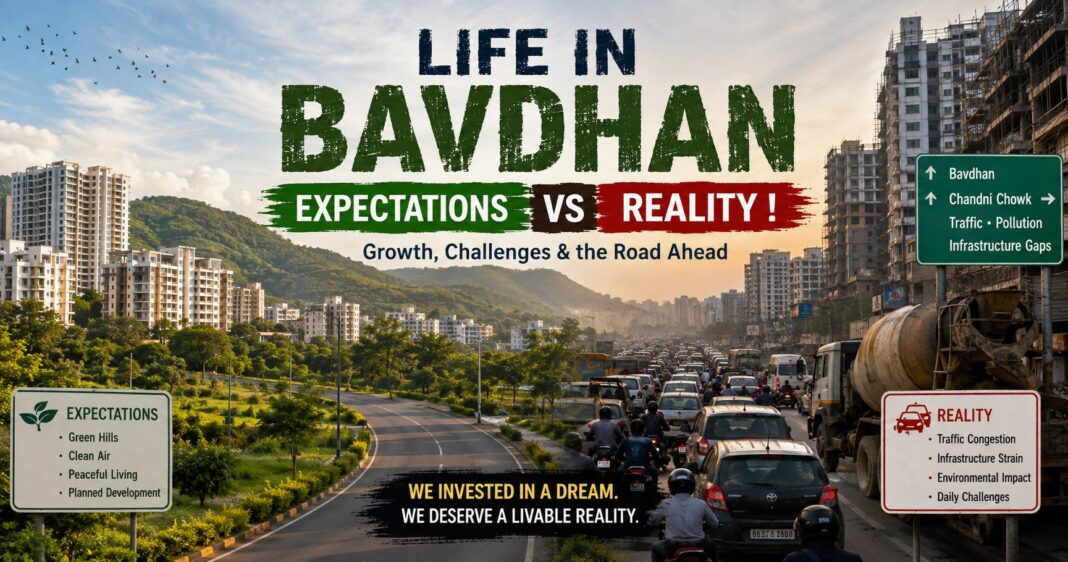
In year 2010, Bavdhan was emerging as Pune’s next residential destination, my family and I felt fortunate. Being Bavdhankars, investing in our own neighbourhood was both an emotional and practical decision. The vision presented to us was simple yet compelling—green hills, clean air, peaceful surroundings, and planned development that would preserve the area’s natural character.
Like many families, we believed in that vision.
For the first few years, Bavdhan reflected its promise with minimal traffic and abundant greenery. Residents enjoyed nature as part of daily life.
Over time, however, the area has changed significantly. As development trends, Bavdhan and its adjoining areas have seen a sharp rise in residential growth over the past decade, with multiple high-rise projects along the NDA–Pashan corridor. With this growth, both population and daily vehicular movement have increased substantially.
Growth is necessary and welcome, but as a resident, I often wonder whether infrastructure has kept pace.
Today, traffic is part of daily life rather than an occasional inconvenience. During peak hours (8:00–10:00 AM and 6:00–8:30 PM), stretches such as the Bavdhan–Chandni Chowk road and internal society access roads often experience slow or near-stationary movement. Roads that once served local residents now carry school buses, private vehicles, cabs, service vehicles, and construction traffic simultaneously.
The neighbourhood often feels stretched beyond its designed capacity.
As a daily commuter, a few patterns stand out.
Heavy vehicles, particularly RMC trucks and construction carriers, frequently use internal residential roads not designed for such traffic. This adds to congestion and raises safety concerns, especially near school routes and society entrances.
Near the Medical centres & PET Scan Centre on the main road, roadside parking often reduces usable carriage width, creating bottlenecks during peak hours. Similarly, at the junction points near the local commercial cluster, turning constraints for larger vehicles frequently lead to temporary standstills affecting commuters, school buses, and emergency movement.
These are not complaints, but lived daily realities for residents.
Like all taxpayers, we contribute through road tax, property tax, and civic charges. Yet issues such as uneven road surfaces, repeated digging and patchwork repairs, intermittent water supply in some pockets during summer, and inconsistent waste collection in internal lanes continue to affect daily life.
This naturally raises a simple question: how can development and basic civic infrastructure progress in balance?
Another concern is the visible change in Bavdhan’s natural landscape. The hill belt, once a continuous green buffer, has gradually reduced due to ongoing construction and land development. Residents also experience higher dust levels during dry months and increased noise from construction and transport activity.
Development is essential, but it also offers an opportunity to preserve the natural environment that made this area desirable in the first place. The question is whether both can coexist.
Over the years, residents have heard about road widening plans, alternate access routes, and improved connectivity between Bavdhan and Chandni Chowk. Some improvements have been implemented in phases, yet daily bottlenecks suggest a gap between planning and execution.
Perhaps what Bavdhan needs most is coordinated planning—where roads, public transport, traffic management, water systems, environmental protection, and residential growth evolve together rather than in isolation.

This article is not about assigning blame.
It is about asking questions that residents deserve clarity on.
How do we balance development with sustainability in a rapidly growing suburb?
How do we ensure infrastructure keeps pace with population growth and approvals?
How do we preserve the natural topography and green cover while meeting urban needs?
And most importantly, who will guide this transformation with a long-term, integrated vision for those who already call Bavdhan home?
Living here since 2011 has taught me that cities are not built only with concrete and buildings. They are shaped by planning, accountability, and citizen participation.
My biggest learning is simple:
When we vote, we are not just choosing a party—we are choosing who shapes our everyday lives.
Roads, water, traffic, cleanliness, public spaces, and environmental protection are not election promises alone; they are daily expectations.
I still believe in Bavdhan.
I still believe it can become the well-planned, livable neighbourhood so many of us once envisioned.
The questions have been asked.
As residents, we now hope the answers will follow.
By,
Radhika Kashikar
DISCLAIMER: This article reflects author’s view point. Goa Chronicle may or may not subscribe to views of the author