

Key Takeaways
- India aims to shift from a back‑office role to a global deep‑tech powerhouse.
- Funding reached a record $2.96 billion in 2025, with government schemes like the ₹10,000 crore Startup India Fund boosting growth.
- Semiconductor development is central, with a ₹76,000 crore commitment to design, manufacture and IP ownership.
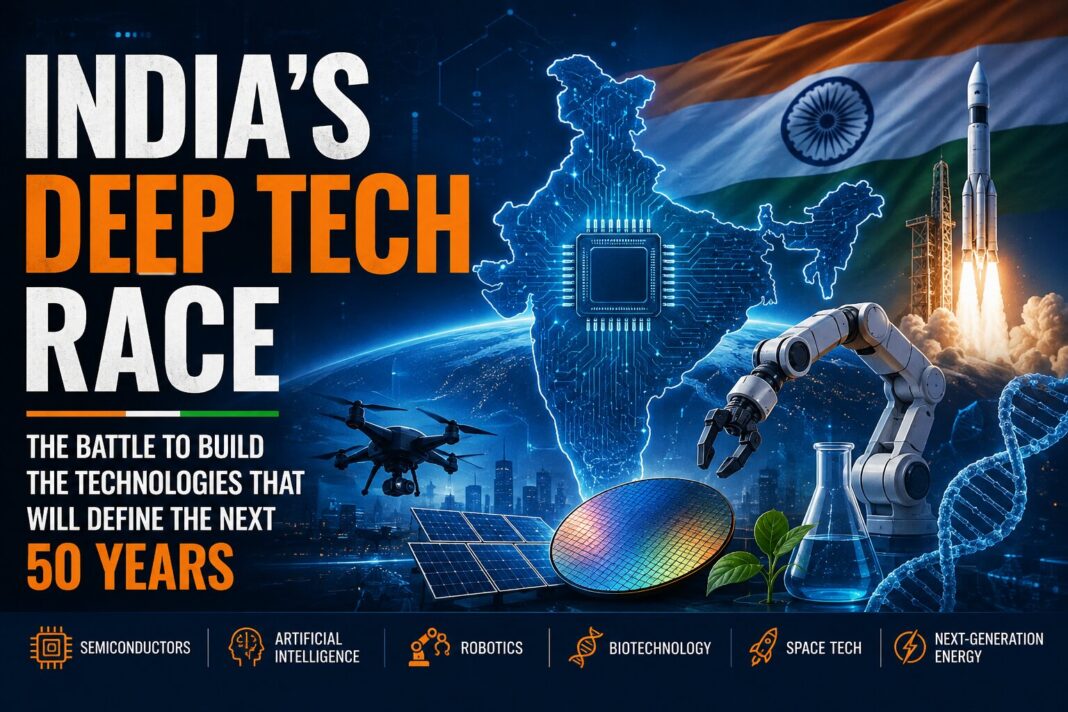
India has won one technology battle already. It became the back office of the world. Now it must win a much bigger one: becoming the technology laboratory, manufacturing base and strategic brain of the world. That is the real meaning of India’s emerging deep-tech race. Deep technology is not another app economy. It is not another food-delivery platform, e-commerce marketplace or social-media company. Deep tech is built around difficult science and engineering – semiconductors, artificial intelligence, quantum computing, robotics, biotechnology, space technology, advanced materials, defence systems and next-generation energy. These are technologies that take years to develop, require patient capital and often demand collaboration between universities, governments, industry and the military. India has begun moving, and the numbers suggest that something significant is changing.
Indian deep-tech companies raised $2.96 billion across 189 deals in 2025, making it the strongest funding year on record for the sector. By July 2026, another $997 million had already been raised across 103 deals. Since 2015, India’s deep-tech sector has attracted approximately $11.4 billion across 957 private-equity and venture-capital deals. These are not merely startup numbers. They are signals of a strategic transformation.
For decades, India’s technology success story was primarily built around software services. Indian engineers wrote code for the world. Indian companies managed technology infrastructure for global corporations. Millions of Indians became part of the global digital economy. But there was one fundamental weakness: India was often building technology for someone else’s intellectual property. Deep tech changes that equation. The objective is no longer simply to provide engineering manpower. It is to own the algorithms, patents, chips, machines, biological platforms, defence systems and scientific discoveries. That is why India’s National Deep Tech Startup Policy framework is important. It recognises that deep-tech companies operate differently from conventional startups because they are built around scientific or engineering breakthroughs, face long development cycles, encounter greater technical uncertainty and require significantly more capital. A deep-tech company may need five or ten years before it reaches commercial scale. The investor therefore needs to think differently. Government needs to think differently. And India needs to think strategically.
Capital is beginning to follow that ambition. Indian deep-tech companies raised $1.06 billion across 137 equity rounds by July 2025, roughly double the amount raised during the corresponding period in 2024. But venture capital alone cannot finance India’s deep-tech ambition. This is where government intervention becomes critical. The approval of the Startup India Fund of Funds 2.0 with a ₹10,000 crore corpus, with deep tech, technology-driven manufacturing and early-growth startups among its priorities, is a significant step. Even more important is the Research, Development and Innovation Scheme, under which the government has created a ₹1 lakh crore corpus over six years to encourage private-sector research and development in areas including quantum computing, robotics, space technology, biotechnology, synthetic biology, medical devices, artificial intelligence, energy transition and advanced technologies. This is precisely the kind of patient capital India’s ecosystem has historically lacked. The objective must be to ensure that an Indian scientist with a breakthrough does not have to leave India to commercialise it, and that an Indian entrepreneur does not have to move to Silicon Valley, Singapore or another global technology centre simply because India cannot finance the journey from laboratory to market.
If there is one technology that demonstrates the strategic importance of deep tech, it is the semiconductor. A modern economy cannot function without chips. Cars need chips. Satellites need chips. Missiles need chips. Mobile phones need chips. Data centres need chips. Artificial intelligence requires enormous quantities of advanced computing hardware. Semiconductor capability is therefore no longer merely an industrial policy issue. It is a national-security issue. India has committed ₹76,000 crore to its semiconductor and display ecosystem, supporting fabrication, semiconductor packaging, compound semiconductors and chip design. The emergence of Tata Electronics, CG Power and other semiconductor initiatives represents a fundamental change in India’s industrial philosophy. The question is no longer whether India can design software around the chip. The question is whether India can eventually design, manufacture, package and own the intellectual property behind the chip. That is a much bigger ambition. India’s semiconductor journey will not be easy. Taiwan, South Korea, the United States and China possess decades of accumulated expertise, infrastructure and supply-chain depth. But India does not need to replicate another country’s journey overnight. It needs to build its own semiconductor ecosystem step by step, beginning with design and packaging and moving progressively towards advanced manufacturing and indigenous intellectual property.
Space is another battlefield where India’s deep-tech transformation is becoming visible. For decades, India’s space programme was almost entirely identified with ISRO. Today, private companies are becoming part of the national space architecture. Companies such as Pixxel, Agnikul Cosmos and Skyroot Aerospace represent a new generation of Indian space enterprises. Agnikul’s work with 3D-printed rocket-engine technology demonstrates how radically manufacturing itself is changing, while Pixxel’s hyperspectral satellite technology demonstrates how space data can become a commercial intelligence platform. The opportunity extends far beyond launching rockets. It includes satellite communications, Earth observation, agriculture, climate monitoring, navigation, defence, disaster management and space-based services. Space is becoming an economic sector rather than simply a government programme. India’s decision to open the space sector to greater private participation could eventually produce an ecosystem in which Indian companies not only build satellites and launch vehicles but also create globally competitive space applications.

Artificial intelligence will sit underneath almost every other deep-tech revolution. India’s IndiaAI Mission has an outlay of ₹10,371.92 crore over five years and covers compute infrastructure, foundation models, datasets, applications, future skills, startup financing and safe and trusted AI. The mission envisages access to more than 10,000 GPUs through public-private partnerships. India is also developing indigenous multilingual AI capabilities, including BharatGen, designed to support India’s extraordinary linguistic diversity. But India must avoid the mistake of believing that possessing GPUs makes it an AI power. Compute is infrastructure. The real strategic assets are intellectual property, talent, data, models and applications. India must build AI that understands Indian agriculture, Indian healthcare, Indian defence requirements, Indian languages, Indian manufacturing and Indian public administration. India’s advantage may not come from producing the largest general-purpose AI model in the world. Its advantage could come from building specialised AI systems that solve problems at a scale and diversity that few other countries can match.
Defence could become one of India’s largest deep-tech opportunities. Drones, autonomous vehicles, battlefield AI, electronic warfare, robotics, satellites, secure communications, quantum sensing and unmanned systems are rapidly changing warfare. India has a massive domestic market and one of the world’s largest armed forces. That should create a natural laboratory for indigenous defence technology. The challenge, however, is procurement. A startup cannot spend years developing a technology only to discover that government procurement takes another decade. India needs to create a much faster bridge between laboratory, prototype, battlefield and export market. The armed forces should become early customers of Indian deep-tech companies where appropriate, while procurement mechanisms must give innovative companies a genuine opportunity to compete with established defence manufacturers. If India gets this right, defence deep tech can create something far more valuable than import substitution. It can create an export industry.
The university must become the new factory of Indian innovation. India’s IITs and research institutions will be central to this revolution. IIT Madras, for example, has emerged as a significant deep-tech startup hub, with more than 100 deep-tech startups reportedly launched in the year ending March 2025, while its students and researchers have been generating substantial intellectual-property output. This is the beginning of something India desperately needs: the commercialisation of Indian science. For decades, India produced brilliant scientists and engineers, but too much scientific knowledge remained inside laboratories. The next generation must move beyond a culture where success is measured only by publications. India needs to encourage a culture of patent, prototype and produce. The scientist must be able to become an entrepreneur. The professor must be able to build a company. The university must be able to license intellectual property. Industry must be willing to fund research before commercial returns become obvious. And investors must understand that a company developing a new semiconductor, medical device, rocket engine or quantum technology cannot be evaluated using the same metrics as a consumer internet startup.
Prime Minister Narendra Modi said in 2025 that India had more than 6,000 deep-tech startups, while highlighting that India’s research and development expenditure had doubled over the previous decade and that registered patents had increased 17-fold. These numbers are encouraging, but they should not make us complacent. America has Silicon Valley. China has built enormous state-backed technology ecosystems. Europe possesses formidable scientific institutions. Israel has demonstrated how a relatively small country can create disproportionate technological power. India has something none of these countries possesses in exactly the same combination: scale, engineering talent, scientific capability, a huge domestic market, an entrepreneurial population and a strategic position at the intersection of major global supply chains.
The question is whether India can convert these advantages into technological sovereignty. That sovereignty does not mean isolation. Quite the opposite. India should collaborate with friendly countries, attract global capital, participate in international research and integrate itself into global technology supply chains. But collaboration must not become dependency. India should be able to design critical technologies, manufacture strategic components, protect its intellectual property and maintain alternatives when global supply chains are disrupted. The COVID-19 pandemic, semiconductor shortages and geopolitical tensions demonstrated how dangerous technological dependence can become. The next crisis may involve chips, AI infrastructure, energy systems, biotechnology or autonomous weapons. Countries that control critical technologies will possess enormous strategic leverage.
India’s deep-tech race is therefore not simply a startup story. It is an economic story. It is an employment story. It is a defence story. It is an education story. It is a manufacturing story. It is an energy story. And ultimately, it is a national-power story. India spent the first decades of the digital revolution proving that Indians could build technology for the world. The next challenge is far greater: India must build technologies that the world cannot do without. The opportunity is enormous, but the window will not remain open forever. The United States, China, Europe, Japan, South Korea, Israel and others are investing aggressively in the technologies that will define the next century. India cannot afford to be merely a consumer of those technologies or a supplier of engineering talent to those who own them. We need to own more of the intellectual property, build more of the hardware, commercialise more of our science and create companies capable of competing globally. The deep-tech race will ultimately determine who possesses technological, economic and strategic power in the second half of the 21st century. India has already demonstrated that it can scale digital public infrastructure, create one of the world’s largest startup ecosystems and produce world-class engineers. Now comes the harder test. Can India turn its scientific talent into technological power? Can the laboratory become the factory? Can the startup become the global technology company? Can Indian intellectual property become a global strategic asset? The answer to those questions will define India’s next fifty years. India has left the starting line. Now it must run to lead.