
Key Takeaways
- The Old Trousers metaphor highlights how veteran politicians dominate the cabinet despite calls for change.
- Young designers and women bring fresh ideas, likened to new shirts and practical pockets in the political wardrobe.
- The reshuffle is portrayed as a wardrobe revolution, rearranging power like garments on a hanger.
The cupboard doors are opening, the hangers are being rearranged, shirts are being measured, trousers are being folded and jackets are being examined under harsh political lighting. Some garments are being told they have ‘performed exceptionally well’. Others have been asked to wait outside the changing room. A few have apparently been given assurances that their position is secure – which, as everyone in India knows, is precisely when one should start packing.
For weeks, the suspense has been unbearable. India, particularly Delhi, has been behaving like a giant political tailoring shop. Every journalist has become a master tailor, every television anchor a fashion critic and every political insider an expert in collars, cuffs, pockets and waist sizes.
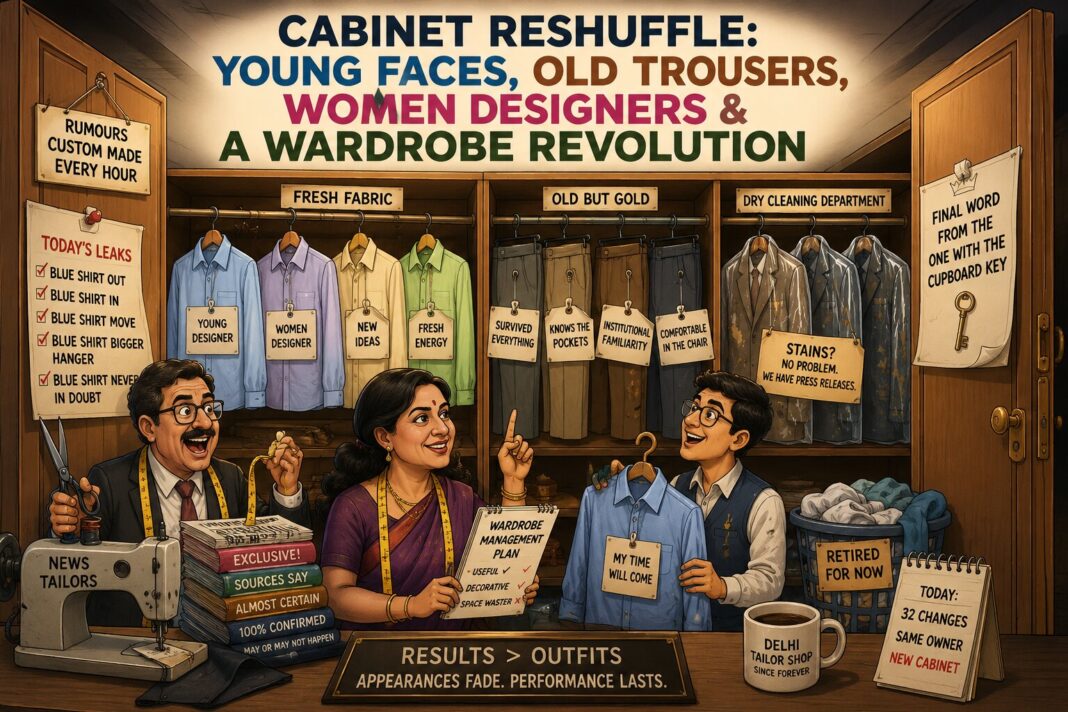
One day the blue shirt is definitely going. The next day it is staying. By evening it is staying but moving to another shelf. By midnight it is being considered for a bigger hanger. By breakfast, somebody has declared that the blue shirt was never under threat in the first place.
The blue shirt, meanwhile, is probably sitting at home wondering whether it should attend its next meeting or simply wait for the official notification.
And then there are the sources. Ah, the sources.
In India, a source is sometimes more powerful than an official document. One source gives you a story. Two sources give you breaking news. Three sources give you a television debate. Four sources give you an exclusive. Five sources give you a dramatic graphic with arrows showing who is moving where. Six sources and you can confidently tell 1.4 billion people that something is ‘almost certain’, provided, of course, it doesn’t happen.
The rumour industry has been working overtime. Every shirt has a future. Every trouser has a past. Every jacket has a lobby. Every hanger has a constituency.
And now the new shirts are being discussed. Fresh fabric. Fresh designs. Fresh measurements. Some are being designed by women.
Excellent.
Perhaps it is finally time to bring some serious wardrobe management into the system. Women understand cupboards. They know that just because something has occupied the same shelf for twenty years does not mean it deserves another twenty. They know which garment is useful, which is decorative and which is simply taking up space because nobody has had the courage to throw it out.
They also understand the importance of pockets. A pocket must hold something. A pocket that exists only for appearance is called bad design. Politics could learn from that.
Then there are the young designers. Fresh talent. New ideas. New cuts. Less baggage. More energy. They have been standing outside the tailoring room for years being told, ‘Your time will come’.
In India, ‘your time will come’ is an extraordinary sentence. It can mean next month, next year, after the next election or after the current occupant of the chair finally decides that retirement is not such a bad idea.
The young designers are praised endlessly as the future. The problem is that the future has a habit of waiting while the past continues occupying the hanger.
Some will finally get their chance. Others will become experienced young leaders, then experienced leaders and eventually simply leaders.
Meanwhile, the old trousers continue. Naturally.
The old trousers have survived everything: elections, scandals, leadership changes, political storms, television trials and social-media outrage. They know the system. They know the pockets. They know the buttons. They know how to sit comfortably in the chair. They have acquired that most valuable political quality: institutional familiarity.
Why replace a trouser that already knows exactly how to occupy the seat?
There are also jackets requiring dry cleaning. Every wardrobe has them. They may once have looked magnificent, but years of political wear and tear have left their mark. Some have ideological stains. Some have administrative stains. Some have electoral stains. Some have stains that nobody wants to identify.
Fortunately, Indian dry cleaning, political or otherwise is world class. You put the garment in looking thoroughly stained and it comes out pressed, polished and ready for another season.
The stain may still be there. But now it has a press release.
Then there are the garments making a comeback. Something declared obsolete yesterday suddenly becomes experienced, seasoned, tested and strategically important.
In fashion, this is called vintage. In politics, it is called continuity. The same old trouser returns with a new belt and everyone suddenly discovers its wisdom. Nobody asks why it was folded away in the first place.

Then comes the rearrangement.
The top shelf becomes the second shelf. The second shelf becomes the top. The jacket moves closer to the shirts. The trousers move further away. Someone gets a bigger hanger. Someone loses one. Someone is told the hanger is temporary. Someone else is told it is permanent.
The person told it is permanent immediately becomes nervous. Because in India, particularly in Delhi, nothing is permanent except speculation.
And behind every movement is political arithmetic.
Why this shirt? Why not that one? Why this colour? Why this fabric? Why this designer? Why now?
The answers are rarely about fashion.
A garment is moved because it performed. Or because it failed. Because an election is approaching. Because a region needs representation. Because a community needs reassurance. Because an ally needs rewarding. Because loyalty needs recognising. Or because somebody more powerful wants the hanger.
This is why the wardrobe is really a map of power.
Every pocket has a calculation. Every button has a constituency. Every hanger has a history. And every missing shirt has a rumour.
But here is the inconvenient truth.
The public doesn’t care how expensive the fabric is. It doesn’t care whether the collar is Mandarin, Italian or politically manufactured.
A new shirt doesn’t build a road. A new jacket doesn’t create a job. A polished trouser doesn’t fix a hospital. A fashionable waistcoat doesn’t improve national security. And no amount of dry cleaning can substitute for performance.
Clothes create appearances. Leadership creates outcomes. Clothes can generate headlines. Results create history.
So, as this week unfolds, the great wardrobe drama continues.
New shirts. Women designers. Young designers. Old trousers retained. Jackets moved. Some garments promoted. Some folded away. Some sent for dry cleaning. Some desperately waiting for the final word from the person holding the cupboard key.
And after all the leaks, rumours, denials, counter-leaks, television debates and political tailoring, everyone is waiting to see what the new Cabinet will look like.
Except there is one small problem.
This isn’t Narendra Modi changing his Cabinet.
It’s me. I am changing my own cabinet this week.
My shirts, trousers and jackets are getting new places. Thirty-two changes. Same owner. New Cabinet.
And thankfully, in my cupboard, there are no political sources, no television debates and no coalition negotiations.
Just one very powerful decision-maker standing in front of the wardrobe saying:
“This shirt stays. That trouser goes. And that jacket definitely needs dry cleaning.”