


Narendra Modi must resign. Yes, you read that correctly. After twelve years of leading India, Prime Minister Narendra Modi must resign and take responsibility for what he has done to this country. He must answer for the transformation of an economy once dismissed by international commentators, for bringing millions of Indians into the formal banking system, for constructing highways and railways at an unprecedented pace, for making digital payments a part of everyday Indian life, and for giving India a voice on the global stage that few world leaders can afford to ignore.
He must resign for making India believe that its aspirations need not be limited by its history, its poverty, its colonial past or the prejudices of those who once regarded this civilisation as incapable of determining its own destiny.
And if these are the grounds upon which Narendra Modi is expected to resign, then perhaps his critics should prepare themselves for the uncomfortable experience of examining the evidence.
Because the story of India over the last twelve years is not merely the story of one political leader. It is the story of a nation rediscovering its economic confidence, institutional capacity and civilisational self-belief.
The numbers deserve to be examined before the slogans are shouted.
He Must Resign for Making India an Economic Powerhouse
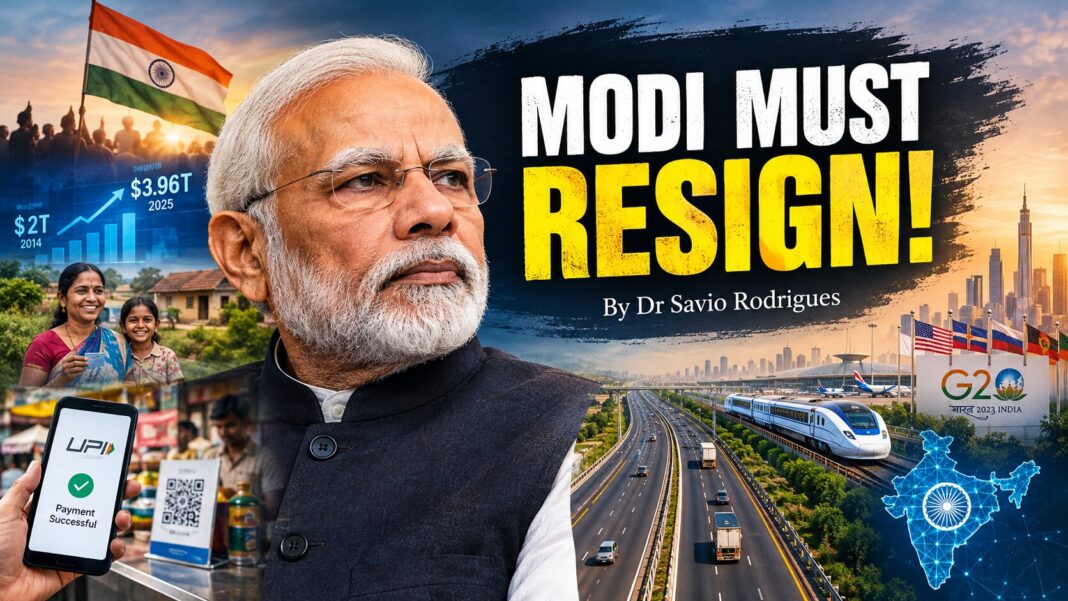
In 2014, India’s gross domestic product stood at approximately $2 trillion. By 2025, World Bank data placed it at approximately $3.96 trillion. In nominal dollar terms, the economy had nearly doubled, despite the devastating COVID-19 pandemic, global inflationary pressures, geopolitical conflicts and disruptions to international trade.
More significantly, in October 2026, the International Monetary Fund raised India’s growth forecast for 2026–27 to 7%, compared with its earlier projection of 6.4%. At a time when the global economy is projected to expand by approximately 3.1%, India continues to demonstrate extraordinary economic resilience.
Surely, Modi must resign for presiding over an economy that international financial institutions increasingly recognise as a major engine of global growth.
Of course, India’s economic transformation did not begin in 2014. Earlier governments, entrepreneurs, workers and reformers laid important foundations. But political leadership must also be judged by what it builds upon those foundations.
And Modi’s twelve years have witnessed an unmistakable acceleration in India’s national ambitions.
He Must Resign for Bringing Millions Out of Poverty
Perhaps the most serious charge against Modi is that millions of Indians have experienced improvements in their living conditions.
According to NITI Aayog’s estimates, approximately 24.82 crore Indians escaped multidimensional poverty between 2013–14 and 2022–23. This measure considers deprivations in health, education and living standards rather than income alone.
The World Bank separately estimated that extreme poverty, measured using its $3-a-day threshold in 2021 purchasing-power-parity terms, declined from 16.2% in 2011-12 to 2.3% in 2022-23.
These figures are not interchangeable, and neither should be presented as proof that poverty has disappeared. But both indicate substantial progress.
Behind the statistics are households gaining access to electricity, sanitation, housing, financial services and opportunities that previous generations could scarcely imagine.
There remain Indians struggling to find secure employment, earn adequate wages and access quality healthcare. Those challenges demand greater attention, not the dismissal of measurable progress.
If improving the material circumstances of millions is a political offence, Modi has certainly accumulated an impressive record.
He Must Resign for Transforming India’s Infrastructure
Consider the highways.
India’s national highway network expanded from approximately 91,287 kilometres in 2014 to 146,560 kilometres by late 2025, an increase of roughly 61%. The network of four-lane and wider national highways more than doubled over the same period.
Railway electrification reached approximately 99.1% by October 2025. Meanwhile, the number of operational airports increased from 74 in 2014 to 164 in 2025.
These are not merely construction statistics. Roads connect farmers to markets, airports connect regional economies to international opportunities, and electrified railways strengthen the foundations of efficient transportation.
Infrastructure is not built simply to impress television audiences. It is built to reduce logistical disadvantages, attract investment and expand economic participation.
India still needs safer roads, more reliable urban infrastructure and better maintenance. Yet denying the scale of construction would require deliberately overlooking the physical transformation visible across the country.
Modi must therefore resign for making infrastructure development a central instrument of national economic strategy.

He Must Resign for Making India a Digital Superpower
In 2016, India launched the Unified Payments Interface, or UPI. During financial year 2025-26, UPI processed more than 24,161 crore transactions valued at approximately ₹314 lakh crore.
The government’s August 2026 assessment also reported that UPI accounted for approximately 84% of India’s digital payment transactions and that the platform was accepted in eleven countries.
A roadside vendor accepting a payment through a QR code represents something far more consequential than technological convenience. It represents the democratisation of financial infrastructure.
India’s digital public infrastructure has demonstrated that technology need not remain the exclusive preserve of wealthy nations or large corporations.
A system operating at this scale required years of institutional collaboration among regulators, banks, technology developers and policymakers. The Modi government deserves credit for supporting and expanding that ecosystem.
Perhaps Modi must resign because India has shown the world that digital innovation can be developed at population scale without making every citizen dependent on expensive proprietary systems.
He Must Resign for Giving India Strategic Confidence
For decades, India was frequently viewed through the narrow prism of poverty, population and regional security challenges. Today, India occupies a far more consequential position in international diplomacy.
India has deepened strategic relationships with the United States while maintaining important ties with Russia. It has expanded engagement with the Gulf, strengthened its participation in the Quad, and positioned itself as an influential voice for the Global South.
India’s G20 presidency in 2023 demonstrated its ability to bring competing international interests to the negotiating table, including facilitating the African Union’s admission as a permanent member of the grouping.
The country is not without diplomatic challenges. Relations with neighbouring states, dependence on imported energy and geopolitical competition with China remain serious concerns. Nevertheless, India’s ability to pursue independent strategic relationships is an increasingly valuable national asset.
Modi must resign, apparently, for refusing to accept that India should remain a spectator in decisions shaping the international order.
The Real Question Is Not Whether Modi Should Resign
Let us be clear. Narendra Modi is not beyond criticism, and neither is his government. Unemployment, rural distress, environmental degradation, educational standards, institutional accountability and social cohesion deserve sustained scrutiny.
A democracy must demand more from its leaders, particularly when those leaders have enjoyed the privilege of governing for twelve years.
But criticism must be intellectually honest. It cannot demand accountability for failures while refusing to acknowledge achievements.
India’s transformation belongs ultimately to its people: the workers who built its infrastructure, the farmers who sustained its food security, the entrepreneurs who created businesses, the scientists who advanced its technological capabilities and the millions of ordinary citizens who believed in a better future.
Leadership matters because it creates the conditions in which collective national ambition can flourish.
So, yes, Narendra Modi must resign.
He must resign for nearly doubling India’s nominal dollar GDP, for the substantial reduction in poverty, for the expansion of national highways, for accelerating railway electrification, for supporting a digital payments revolution and for giving India’s aspirations a more prominent place in international affairs.
And perhaps he should apologise too, for making a generation of Indians believe that becoming a developed nation by 2047 is an ambition worth pursuing.
But there is one difficulty with this extraordinary demand for resignation.
In a democracy, a Prime Minister is not required to resign because his country has progressed. He is required to remain accountable to the Constitution, Parliament and, ultimately, the people.
And when the next electoral judgment arrives, the Indian people will decide whether the achievements of the last twelve years merit another mandate or a different direction.
Until then, those demanding Modi’s resignation would do well to remember that political slogans may capture headlines, but economic data, infrastructure and improvements in people’s lives are considerably harder to dismiss.
If Narendra Modi must resign for all the good that has happened to India, then his greatest political offence has been making Indians believe that their country can achieve far more than the world once expected of it.