


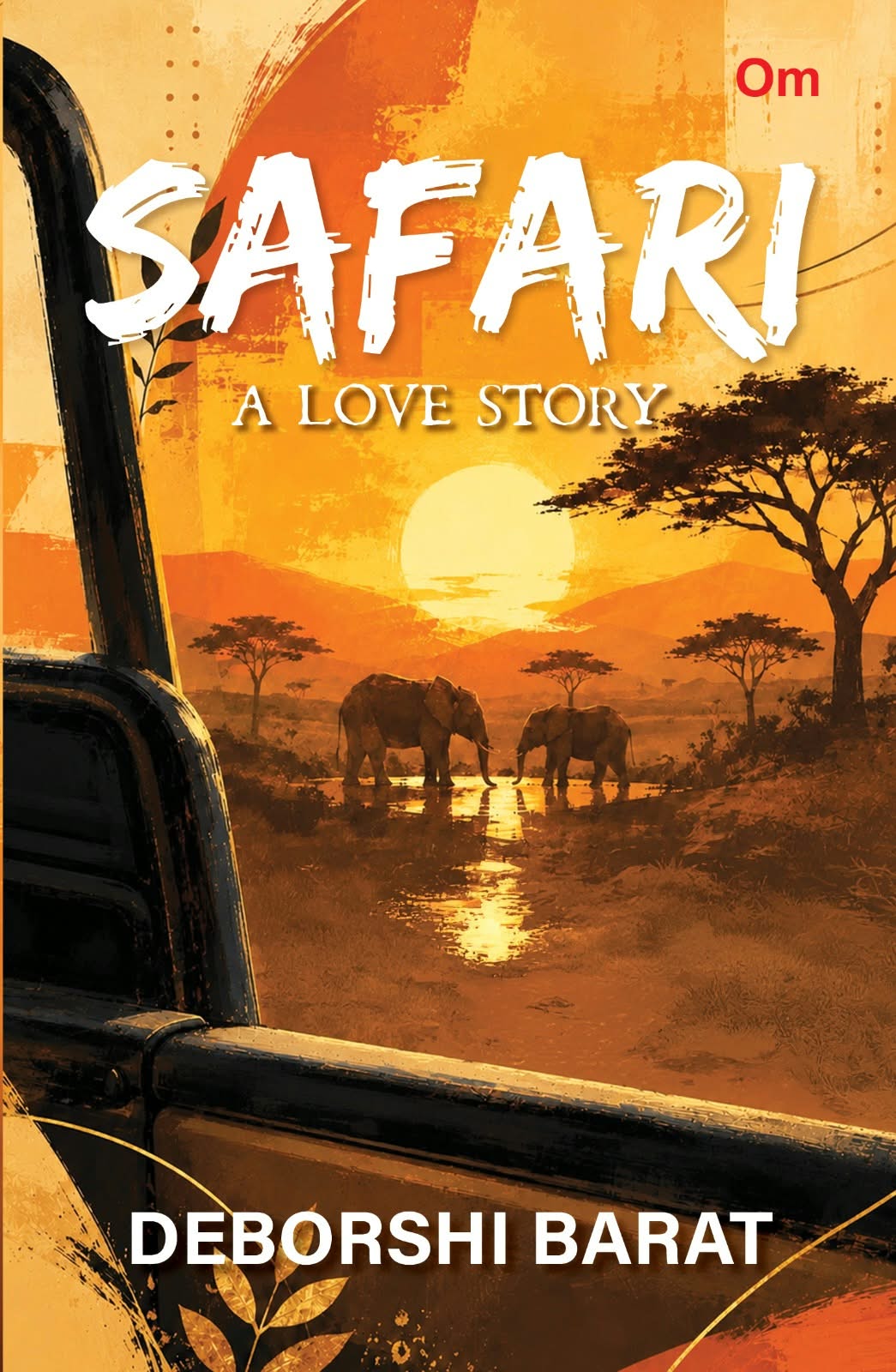

What if losing everything was the beginning of finding yourself?
In ‘Safari – A Love Story’ (Om Books), Deborshi Barat takes readers across the untamed landscapes of East Africa, where heartbreak gives way to unexpected romance, fractured friendships and life-altering choices.
Blending sensual storytelling with themes of love, betrayal, identity and freedom, the novel explores the courage it takes to break free from societal expectations and embrace the unknown.
Through Niharika’s journey, Barat reflects on how moments of personal upheaval can challenge our deepest assumptions and reveal who we truly are. Set against the breath-taking wilderness of Africa, the novel reminds us that sometimes, the most transformative journey isn’t across the wilderness—it’s within.
In the wild, nothing stays buried—not desire, not betrayal, not the truth about who you are.
Niharika Bose has done everything right, until her life falls spectacularly apart. When she catches her fiancé in bed with another woman, the future she had carefully constructed collapses overnight. Enter Vania Vyas—brilliant, magnetic, and impossible to ignore—who whisks Niharika away on an impulsive African safari, promising escape.
But Africa is anything but an escape.
As Vania dives into the moral quagmires of international criminal law in Tanzania, Niharika is left navigating the vast Kenyan wilderness with a stranger: Dr Srinivas Rajan, enigmatic, selfcontained, and intimately tied to Vania’s past. Forced into proximity, their simmering attraction grows against a backdrop of sweeping savannah, fractured friendships, and the distant echoes of war.
Amid a motley group of fellow travellers, shifting loyalties, and the relentless pull of unfinished emotions, Niharika must confront the patterns that have defined her life: obedience, compromise, and silence. When her past resurfaces in the most unexpected place, she is forced to choose between the safety of what she knows and the terrifying freedom of what she truly wants.
Boasting a vivid and unforgettable portrait of the African landscape, Deborshi Barat’s Safari is a haunting, sensual journey through love, friendship, and self-discovery where the wild outside mirrors the wilderness within.
Deborshi Barat is an Indian lawyer, public-policy advisor, academic and writer whose work spans law, governance and literature. He heads public policy and knowledge management at a New Delhi law firm, where he focuses on regulatory issues including data protection, artificial intelligence, clean energy and environmental, social and governance (ESG) matters.
A former Associate Professor at Jindal Global Law School, Barat holds a PhD from The Fletcher School at Tufts University. His doctoral thesis received the Peter Ackerman Doctoral Dissertation Award, while his writing on clean energy has earned thought-leadership awards from Legal 500 and Mondaq.
Barat published his debut novel, The Hunter of Pigeons, in 2014. In addition to his work in law, academia and literature, he has also worked as an actor in theatre, Bengali cinema and television.
With ‘Safari – A Love Story’, Barat brings together his interest in human complexity, cultural histories and the forces that shape individual lives, transporting readers to East Africa for a story of emotional upheaval, unexpected connections and the possibility of beginning again.
To delve deeper into Niharika’s story and to fathom the complexities of life’s journey, Sonakshi Datta of GoaChronicle put up a few questions to Deborshi.

‘Safari- A Love Story’ Author Deborshi Barat
What made you set East Africa, a rather peculiar choice, as the backdrop of Niharika’s story? What made you realise it would be the perfect spatial background for weaving in the complexities of human emotions?
Locating the story in East Africa actually felt like a natural choice for a number of reasons. There was this cloth-bound travel diary in my possession, and some vivid memories that I’d carefully held on to for a long time, both of which were itching to lend themselves to something new and different. Other than the stunning terrain and the glorious fauna of Kenya, my notes had somehow managed to preserve the mood of a different era, from a very different stage of life. Only fifteen years separate 2011 from today, but it seemed like a lifetime ago when I revisited the collection.
Beyond personal geography, what I wanted from East Africa was a sense of scale. In a setting so vast, so indifferent, personal upheavals feel smaller and clearer. In urban setups, we tend to hide behind every day hustle and carefully structured narratives. Stepping into an open, expansive landscape tends to strip away those shields. The raw wilderness forces people into close proximity with their unvarnished selves.
In the middle of the savannah, you watch, you wait, and you learn to accept that what you came for may not appear, while something else does. This, in my mind, is close to how love often works, and how people come to know themselves better. In a way, it mirrors the unpredictable rhythm of emotional healing.
Arusha, in Tanzania, comes from a trajectory I once seriously considered for myself, shortly after my travels through Kenya. At that time, I’d planned long and hard with a friend to work together at the International Criminal Tribunal for Rwanda, which inspired the book’s international law storyline. I wanted to ground the drama within real-world geopolitical realities. So, while Kenya supplied the majestic grasslands and the theatre of a safari, the tribunal and its antecedent genocide offered the ugly side, in the careful language of law. I wanted to place those two different ways of being in Africa side by side, along with the two principal characters.
Via the weight of physical distance alone, transporting these people to faraway places helped me highlight the rootlessness felt by mobile professionals. On the one hand, there’s the visitor who comes to Africa for beauty and escape, and on the other, there’s the professional who deals with its hardest chapters. Both are outsiders in their own way.

A safari is built on ‘looking’ – whether at animals, landscapes, or one another. I thought that suited a novel about people trying to see themselves clearly, perhaps for the first time. Out in the wild, it’s oddly hard to keep things hidden.
What major themes does your novel explore? Why do you think such themes are difficult to discuss and introspect upon?
The book looks at the quiet bargains people make. While dealing with the tricky impermanence of love and desire, as well as the pull between freedom and expectation, Safari explores the friendship shared by two women – the two central protagonists. This is what acts as the structural engine of the plot and serves as its emotional core.
Instead of treating the friendship as merely a device or an idealized avatar of female solidarity, I wanted to parse through its psychological nuances and layers. Within the contours of this friendship, Safari examines subtle power structures, intellectual hierarchies, and the tension between affection and autonomy that exist between modern individuals navigating high-pressure lives.
I think these themes are hard to talk about because they make us admit our own contradictions. We like to view ourselves through sweeping, main-character narratives, but in reality, people can be a lot of things all at once. Most of us would rather not look too closely, and everyone has a script about what they ought to want. Fiction gives us the necessary cover. It is easier to examine a hard truth when it belongs to someone else, and you recognise yourself in it later.
These things rarely look like problems from the outside. Discontent wrapped in achievement and privilege can sound ungrateful, so people stay silent, and silence soon becomes a habit. Introspection is inconvenient too. It threatens the story we’ve told ourselves and others, about why our choices were sensible. It’s easier to keep performing than to ask whether we still want to play the part.
The biggest challenge was to give Niharika and Vania the freedom to be fully themselves, as two complex individuals, rather than trying to depict them through a sanitized or male-gazed lens. Ultimately, confronting the strains within her friendship with Vania becomes an essential stepping stone for Niharika towards reclaiming her own desires and identity.
How would you describe the transformative journey of life?
I’ve never quite trusted the neat version, where a person is broken, but then transforms and returns whole. In my experience, it’s almost never this dramatic in the moment. While we tend to romanticize turning points, real growth is usually an accumulation of small departures: a few mistakes here, some good decisions there – perhaps made for imperfect reasons. You notice the change only when you look back.
Loss is often the trigger, but it’s seldom the whole lesson. Also, I don’t think we can ever become someone absolutely new. At best, we shed what we were carrying on behalf of social expectations, and what remains is a little closer to us. Most of us are changed by the detours rather than the destination itself.
At any rate, true transformation isn’t about forging an entirely new identity. It’s more about shedding the performances and compromises we execute for the benefit of others. When you strip away those external scripts, what remains is perhaps something closer to your authentic self.
Distance lets you look at your own life the way you would look at a stranger’s, and things you’d stopped noticing suddenly seem odd, and then you might decide to do something about it.
The safety of the ‘known’ and the thrill and risk of the ‘unknown’: why do some choose the former while others pluck up the courage to choose the latter? What factors determine the psychology behind these two opposite ways of thinking and acting?
I’d be careful about casting one as timid and the other brave. A tendency to stay with the familiar can be a result of loyalty, duty, or plain good sense. Leaving can arise from courage, but it can also stem from escapism.
Temperament matters, but so does privilege. Risk is seldom evenly distributed, and the cost of leaving is far higher for some people. Social safety nets, and financial or emotional constraints can heavily dictate what feels achievable.
Even when it demands compromise, the ‘known’ offers the comfort of predictable routines and societal approval. That is often hard to trade for something you cannot yet name. Those who embrace the familiar may not necessarily be lacking in courage. Perhaps some are weighing real obligations, and some are simply good at keeping promises, including ones they never made.
Very few people leap into the unknown out of impulse alone; they are usually pushed past a breaking point, or led to a moment where staying costs more than going away. Courage tends to look tidier in hindsight than it feels in real-time.
Ultimately, whether someone stays or leaves, I guess, depends on whether they prioritize external predictability or internal coherence.
What makes ‘Safari – A Love Story’ a must-read for people from different walks of life?
I’m not sure if any book is a must-read – readers themselves can best determine that. People tend to find books when they are ready for them. But what I can tell you about this book is that it tries to bridge a large, continental canvas with an intimate, personal narrative about reclaiming self, identity and desire. If it gives you a few good hours and a change of scenery, that is reward enough.
I wanted to write Safari as a novel that you both read and journey through – feeling the visceral, atmospheric thrill of a sweeping African expedition with the sharp psychological weight of modern life. For anyone interested in travel and wild landscapes, Safari aims to offer an immersive, vicarious getaway.
Whether you’re an armchair traveller craving an itinerary-driven adventure, or a reader drawn to complex female friendships, or someone who knows what it takes to rebuild from scratch, Safari offers both an escape and a mirror.