
Key Takeaways
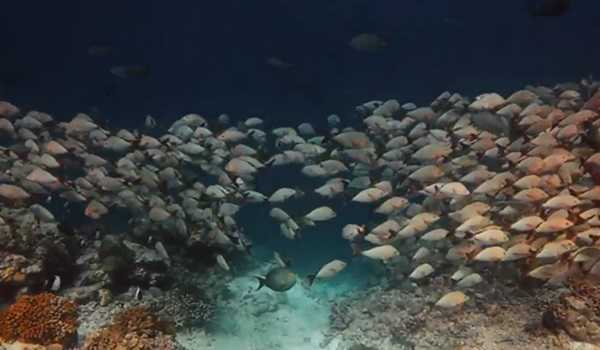
- Lakshadweep’s waters hold an annual fish catch potential of 1 lakh MT, a vital sector for its economy
- The Centre has approved Rs 14.06 crore under Pradhan Mantri Matsya Sampada Yojana to boost the fisheries sector in Lakshadweep
- Lakshadweep has been designated as a Seaweed Cluster and several infrastructure upgrades are underway
Lakshadweep/Kochi: Waters of the Union Territory of Lakshadweep hold an annual fish catch potential of 1 lakh MT, proving that fisheries are the backbone of its economy.
The Centre has approved Rs 14.06 crore under the Pradhan Mantri Matsya Sampada Yojana (PMMSY) to boost the fisheries sector in Lakshadweep.
Lakshadweep has been designated as a Seaweed Cluster also, Union Minister of State for Minority Affairs and Fisheries, Animal Husbandry and Dairying, George Kurian, said on Tuesday.
In the education sector, the minister commended the 91.65% literacy rate in Lakshadweep and the zero school dropout rate. Eleven schools have been selected under the PM SHRI scheme, with high-speed internet, computer labs, and digital libraries enhancing learning experiences.
In the healthcare sector, he said three 30-bedded hospitals are being constructed in Minicoy, Androth, and Kadmat at a cost of Rs 231.96 crore.
The Ministry of Home Affairs has accorded in-principle approval for a nursing and paramedical college project worth Rs 127 crore.

The Ministry of Ports, Shipping, and Waterways (MoPSW) has undertaken major infrastructure upgrades:
Development of eastern and western jetties in Kadmat and Kalpeni and new port facilities in Androth worth Rs 1,664.88 crore.
Proposals under examination for beachfront development, including roads and protection walls in Agatti, Kadmat, Kalpeni, Kavaratti, and Minicoy, at a cost of Rs 2,128.86 crore, he said.
Eco-tourism is getting a major boost with three water villa projects being developed in Minicoy, Kadmat, and Suheli, in consultation with NITI Aayog, with a combined investment of Rs 810 crore. Weekly cruise liner operations are also underway, connecting Mumbai, Kochi, Agatti, and Thinnakara.
To reduce dependence on diesel, an MoU was signed with Solar Energy Corporation of India (SECI). Rooftop solar systems were installed in over 450 homes. Solar plants were commissioned in Agatti (0.3 MW) and Kavaratti (1.4 MW).
To ensure access to drinking water, 1.5 lakh litre/day desalination plants have been established on six islands. Under Jal Jeevan Mission, Rs 268.81 crore has been allocated to provide Functional Household Tap Connections (FHTCs) across all islands, he said.