

Key Takeaways
- The tourism boom in Goa adds millions of water‑intake days each year, stressing existing supplies.
- A 50‑100 MLD desalination plant can act as a strategic buffer during dry seasons and climate‑induced rainfall variability.
- Desalination technology is proven in India, but requires careful cost‑benefit and energy‑use analysis before deployment.
Goa has always been regarded as a water-rich state. The monsoon brings enormous quantities of rainfall, rivers flow through the state, groundwater supports thousands of households and the Arabian Sea stretches along its entire western boundary. Yet the assumption that Goa will always have enough freshwater simply because it receives heavy rainfall is becoming increasingly dangerous. The state’s water challenge is not necessarily one of absolute scarcity today; it is increasingly a question of seasonal availability, distribution, growing demand, groundwater pressure, climate variability and the sheer expansion of the population and economy that depends upon reliable water supplies. Goa therefore needs to begin planning a large-scale seawater desalination plant, not as a replacement for its rivers, reservoirs, groundwater or rainwater harvesting systems, but as an additional strategic source of drinking water that can provide security during periods when conventional sources come under stress.
The numbers demonstrate why this conversation cannot be postponed. Goa’s Department of Tourism reports that the state received 10.40 million tourist arrivals in 2024, rising to approximately 10.80 million in 2025, including more than 10.28 million domestic tourists and 517,802 foreign visitors.
During January‑June 2025 alone, Goa recorded 54.55 lakh tourist arrivals (51.84 lakh domestic, 2.71 lakh international). These visitors create extra daily water demand for hotels, restaurants, airports, hospitals, pools, laundries and other commercial facilities.
The challenge becomes even more significant when Goa’s future water requirements are considered. Goa’s State Action Plan on Climate Change has estimated the state’s total water requirement by 2051 at approximately 8,030 million cubic metres, while identifying around 1,585 million cubic metres of water resources that could potentially be conserved. The significance of this projection is not that Goa is destined to run out of water by 2051. Rather, it demonstrates that the state needs to plan decades ahead because water demand will increase as population, tourism, urbanisation, industry and infrastructure expand. A water-security strategy designed around today’s requirements will inevitably become inadequate tomorrow.
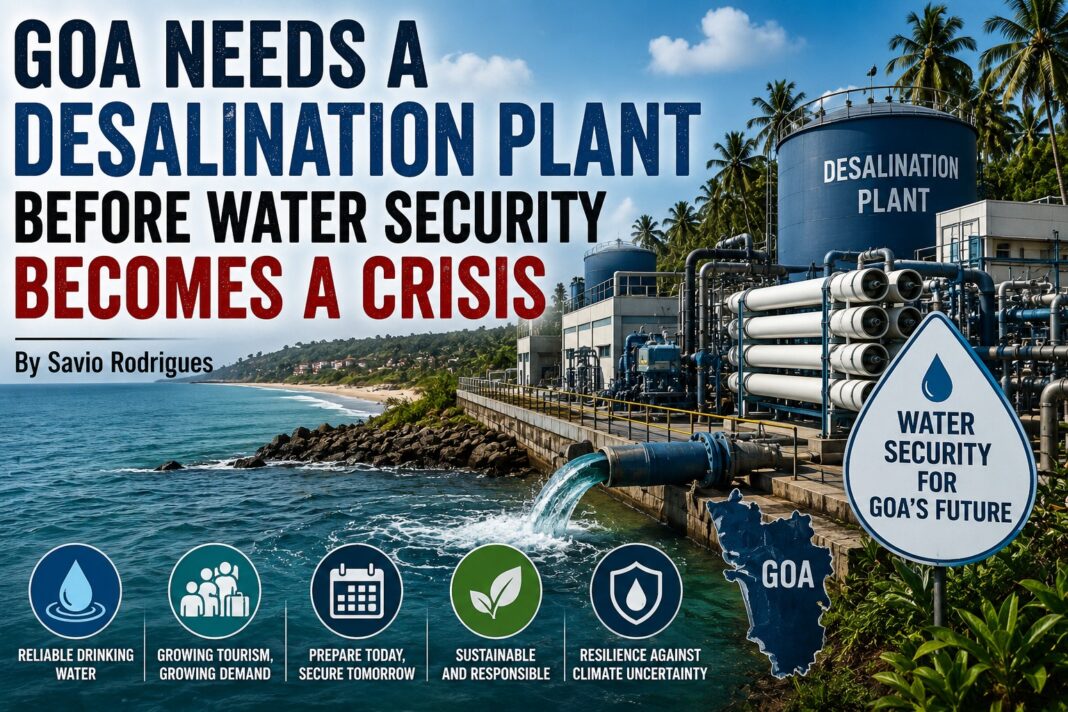
This is where desalination deserves serious consideration. Goa has an extraordinary strategic advantage that many water-stressed regions do not possess: the Arabian Sea is immediately available as a virtually inexhaustible source of raw water. Modern seawater reverse osmosis technology can convert seawater into potable water at industrial scale, and India already has considerable experience with such systems. The Government of India supported a 100-million-litres-per-day seawater reverse-osmosis desalination plant at Nemmeli in Chennai, which was commissioned in 2013 to augment drinking-water supplies and meet industrial demand. Gujarat has similarly used desalination as part of its water-security strategy. A 100 MLD desalination plant at Mandvi in Kutch was designed to provide an additional source of drinking water and complement the Narmada grid, the Sauni network and treated wastewater infrastructure.
The lesson for Goa is therefore not that seawater desalination is some futuristic technology. It is already an established infrastructure option in India. The more important question is whether Goa should develop the capacity before it actually needs it desperately. The answer should be yes.
Goa should consider developing an initial 50 to 100 MLD desalination plant, with the possibility of expansion based on demand. A 100 MLD facility would produce 100 million litres of potable water every day, equivalent to approximately 36.5 billion litres annually if operated continuously. That would not solve all of Goa’s water requirements, nor should it be presented as such. Its real value would be as a strategic buffer that could reduce dependence on freshwater sources during the dry season and provide additional resilience during years when rainfall patterns are abnormal.
The economics, however, must be approached realistically. Desalination requires significant capital investment and consumes substantial energy. The cost of producing desalinated water is therefore generally higher than that of conventional freshwater sources. Goa should not build a desalination plant simply because the technology exists. It should conduct a detailed feasibility study covering capital expenditure, operating costs, electricity requirements, transmission infrastructure, environmental impacts, brine management and the location of the intake and discharge systems. The objective should be to determine the most economical capacity and location rather than announce a politically attractive but poorly designed project.
Energy will be particularly important. Reverse-osmosis desalination requires electricity, and Goa’s future desalination strategy should therefore be integrated with renewable-energy planning. Solar power could partially offset the plant’s electricity consumption, while energy-efficiency improvements and modern membrane technologies could reduce operating costs. The state should also examine whether private-sector participation, long-term water-purchase agreements or public-private partnerships could reduce the burden on public finances. The principle should be straightforward: desalinated water should become part of Goa’s strategic water portfolio without making the state’s water system financially unsustainable.

Environmental considerations are equally important. Desalination does not make the environmental problem disappear; it changes its nature. The process produces concentrated brine that has to be carefully managed, and seawater intake systems must be designed to minimise ecological damage. Any proposed Goa plant should therefore undergo rigorous environmental assessment, establish appropriate brine-diffusion systems and continuously monitor marine conditions around the discharge zone. Goa’s reputation depends upon its coastline, marine ecosystems and beaches, and water security cannot be achieved by damaging the very environment upon which the state’s tourism economy depends.
Desalination should also never become an excuse for wasting freshwater. Goa needs a comprehensive water strategy in which conservation comes first. Leakage from distribution networks must be reduced, groundwater recharge must be strengthened, traditional wells must be protected, rainwater harvesting must become much more widespread and treated wastewater must increasingly be reused for landscaping, construction, industrial applications and other non-potable requirements. Hotels and large commercial establishments should be encouraged, and where appropriate required, to recycle wastewater and reduce their dependence on potable water. Every litre of treated wastewater that can replace fresh drinking water for gardening or flushing is effectively another litre of freshwater available for human consumption.
The state is already thinking about water security. Goa’s Economic Survey 2025-26 describes the objective of the Water Resources Department as ensuring water security through the creation, management, conservation and protection of surface and groundwater resources, while emphasising equitable distribution between water-abundant and water-deficient areas. That is the correct direction, but Goa should expand the definition of water security to include seawater as a strategic resource. In a coastal state, ignoring the ocean when planning for long-term freshwater security would be an unnecessary limitation.
The timing is particularly important because Goa is simultaneously trying to develop a year-round tourism economy. The Tourism Department describes the state as moving toward diversified and regenerative tourism, while visitor numbers continue to grow. More tourism means more employment, investment and economic activity, but it also means greater pressure on basic infrastructure. Water cannot be treated as an invisible input into tourism. A hotel room without reliable water is not a functioning hotel room; a restaurant cannot operate without water; hospitals cannot function without dependable supplies; and urban communities cannot maintain a reasonable quality of life without them.
Goa should therefore look at desalination not as evidence of water failure but as an insurance policy against future uncertainty. Climate change can alter rainfall patterns even when annual rainfall totals remain high. A year of weak or poorly distributed monsoon rainfall can expose vulnerabilities that remain invisible during years of abundance. Similarly, rapid construction and tourism growth can increase demand faster than traditional infrastructure can be expanded.
The real danger is waiting until the crisis becomes visible. A desalination plant takes years to plan, finance, obtain approvals for, construct and commission. If Goa waits until reservoirs are critically low, wells are stressed and cities are facing serious shortages, it will already have lost valuable time. Infrastructure planning has to anticipate demand rather than react to it.
Goa does not have to choose between rivers and the sea, groundwater and desalination, rainwater harvesting and technology. It needs all of them. The state’s future water architecture should combine conservation, groundwater recharge, reservoirs, rainwater harvesting, wastewater recycling and, importantly, desalination. A 50–100 MLD seawater reverse-osmosis facility could be the beginning of that additional layer of resilience.
The Arabian Sea has been part of Goa’s geography for millions of years. The question now is whether Goa will have the foresight to make it part of its water-security strategy for the next 50 years. The objective should not be to wait for a water crisis and then turn to desalination as an emergency measure. Goa should build the capacity before the crisis arrives. In water security, as in every other form of infrastructure planning, preparedness is considerably cheaper than desperation.