



Key Takeaways
- The Golden Global Yatirim Bankasi acted as a conduit, moving tens of millions for Iran’s IRGC‑Qods Force.
- Gold and cash conversions make it harder for sanctions to track the final destination of oil revenues.
- Sanctions enforcement must target not only large banks but also smaller institutions and informal networks.
The global sanctions regime against Iran has always faced one fundamental problem: money finds a way. Sanctions may restrict banks, freeze assets and make international transactions difficult, but they cannot completely eliminate the networks that allow a determined state to move money across borders. The latest action by the United States against a Turkish investment bank offers a revealing glimpse into how those networks operate – and why Iran’s oil revenues remain at the centre of the struggle.
On September 4, 2026, the United States Treasury Department designated Golden Global Yatirim Bankasi, an Istanbul-based investment bank, along with two of its subsidiaries, under Executive Order 13902, the executive authority targeting Iran’s financial sector. According to the Treasury Department, the bank moved tens of millions of dollars for Iran’s Islamic Revolutionary Guard Corps-Qods Force and provided Iranian institutions with correspondent accounts that enabled them to move money abroad.
The designation is significant not simply because another financial institution has been sanctioned. It exposes the increasingly sophisticated financial architecture through which Iranian oil revenues can move from one jurisdiction to another, eventually being converted into forms of wealth that are considerably harder to trace.
At the heart of the matter is China.
Iran remains heavily dependent on oil revenues. China has emerged as a crucial destination for Iranian crude, particularly because Beijing has continued to purchase Iranian oil despite the extensive American sanctions regime. Oil, however, creates a financial problem for Tehran. Selling the commodity is only half the equation. Iran must ultimately receive the proceeds, transfer them through the international financial system and convert them into usable money.
That is where intermediary jurisdictions and financial institutions become critical.
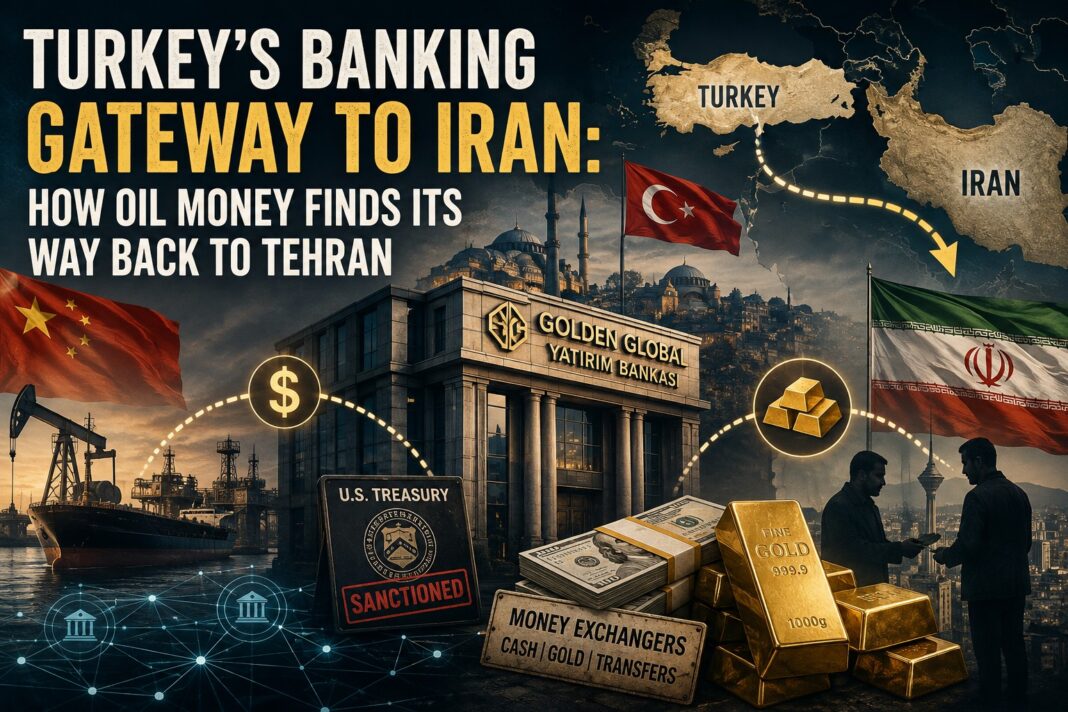
The Treasury Department’s description of Golden Global Yatirim Bankasi is particularly revealing. It states that the bank was established to enable Iran’s “rahbar network” to move oil revenue from China to Turkey, after which money exchangers could convert the proceeds into cash and gold.
This is more than a conventional banking transaction. It represents an alternative financial ecosystem operating alongside the formal international financial system.
The mechanism is straightforward in principle. Iranian oil is sold, the proceeds accumulate through financial channels connected to buyers and intermediaries, and those funds are subsequently transferred through jurisdictions where sanctions enforcement is more complicated. Turkey, because of its geographical position and extensive commercial links with both Europe and the Middle East, can become an important transit point. Once funds arrive, money exchangers and other intermediaries can transform digital or bank-based assets into physical cash or gold.
Gold is particularly important because it represents wealth without the same dependence on conventional correspondent banking relationships. A bank account can be frozen. A transaction can be blocked. A shipment of gold or physical cash is considerably more difficult to monitor once it has entered an informal financial network.
The designation also highlights the importance of individuals who operate between the formal and informal economies.
The Treasury Department said Golden Global Yatirim Bankasi maintained accounts for Sitki Ayan, a Turkish businessman sanctioned by the Office of Foreign Assets Control in 2022. The connection illustrates how sanctions-evasion networks often depend not on a single institution but on a web of businesses, financiers, intermediaries and political relationships.
The bank itself is relatively small. Reuters counted it as Turkey’s 35th-largest bank. Yet size is not necessarily the most important factor when examining sanctions evasion. A relatively small institution can become strategically important if it provides access to financial channels unavailable to a sanctioned country.
This is an important lesson in modern economic warfare.
Financial power today does not operate exclusively through large multinational banks. Smaller institutions, exchange houses, trading companies and individuals can become critical nodes in an alternative financial architecture. The effectiveness of sanctions therefore depends not merely on identifying major banks but on mapping the entire network through which money moves.
Golden Global Yatirim Bankasi has denied the allegations and said it would contest the decision. That response is important because sanctions designations represent serious allegations with potentially significant commercial consequences. But regardless of the bank’s legal response, the broader issue remains.
Iran has developed considerable experience in operating under sanctions.
For Tehran, sanctions are not a temporary inconvenience. They are an economic reality that has existed for decades. The Iranian state has therefore had strong incentives to develop mechanisms for accessing foreign currency, selling oil, moving revenue and maintaining international commercial relationships.
The challenge for Washington is that every time one financial route is closed, another can emerge.
This is why the latest Treasury action should be understood as part of a much larger contest between sanctions enforcement and sanctions adaptation.
The United States possesses enormous financial power because the dollar remains central to global commerce. American sanctions can isolate banks from the international financial system and impose enormous risks on companies that facilitate transactions with sanctioned entities. Yet that power is most effective when countries cooperate in enforcement.

Turkey presents a particularly complicated case.
It is a NATO member and an important strategic partner of the United States, but it also maintains substantial economic and geopolitical relationships with Russia, Iran and other states that Washington frequently regards as adversaries. Turkey’s geographic position makes it almost impossible to separate its economy from the wider Middle Eastern and Eurasian financial system.
This creates a geopolitical paradox.
The same geographical position that makes Turkey strategically valuable to the West also makes it valuable to countries seeking alternative trade and financial routes.
Iran’s relationship with Turkey is therefore not simply about political friendship or hostility. It is also about geography, commerce and financial necessity.
The Chinese dimension makes the equation even more complicated.
If Iranian oil continues moving into China and the resulting revenues can subsequently be routed through third countries, then sanctions become a continuous game of financial whack-a-mole. Washington identifies one channel, sanctions it, and the network adapts.
The emergence of cash and gold as end points is particularly significant. It suggests that sanctions-evasion networks are not merely attempting to disguise transactions inside the conventional banking system. They are also attempting to move wealth beyond the banking system altogether.
That could become an increasingly important feature of the global financial landscape.
The lesson is that economic warfare has changed. In the twentieth century, controlling ports, shipping lanes and physical trade routes was central to economic pressure. In the twenty-first century, controlling financial information, correspondent banking relationships, payment systems and ownership structures has become equally important.
But the system is only as strong as its weakest intermediary.
A small bank in Istanbul can potentially become a bridge between an oil transaction in China and a cash or gold transaction in Turkey. An individual businessman can become an intermediary. A money exchanger can become a conversion point. A network of seemingly ordinary commercial transactions can ultimately serve a sanctioned state’s strategic interests.
The United States Treasury’s action against Golden Global Yatirim Bankasi therefore goes beyond one Turkish bank.
It demonstrates the continuing battle over Iran’s oil money—and the ingenuity of the financial networks designed to keep that money moving.
Iran’s economic survival strategy increasingly depends on its ability to operate in the grey zones of international finance. China provides a critical market for Iranian oil. Turkey can provide geographic and financial connectivity. Intermediaries can facilitate transfers. Money exchangers can convert funds. Gold and cash can provide a degree of insulation from conventional financial surveillance.
Closing one door does not necessarily close the house.
For Washington, the strategic challenge is therefore not simply to sanction institutions after they have been identified. It is to understand the architecture before the money moves: who buys the oil, who receives the payment, which banks provide the accounts, which intermediaries transfer the funds, who converts them, and where the final value ends up.
The Golden Global case illustrates a larger truth about sanctions: financial pressure can constrain a country, but it cannot permanently defeat a financial network that continuously adapts.
Iran’s oil may originate in one country, be purchased in another, move through a bank in a third and eventually emerge as cash or gold somewhere else.
The geography of oil is therefore only half the story. The other half is the geography of money. And increasingly, that geography runs through the banks, intermediaries and financial networks operating in the spaces between the world’s competing geopolitical blocs.