


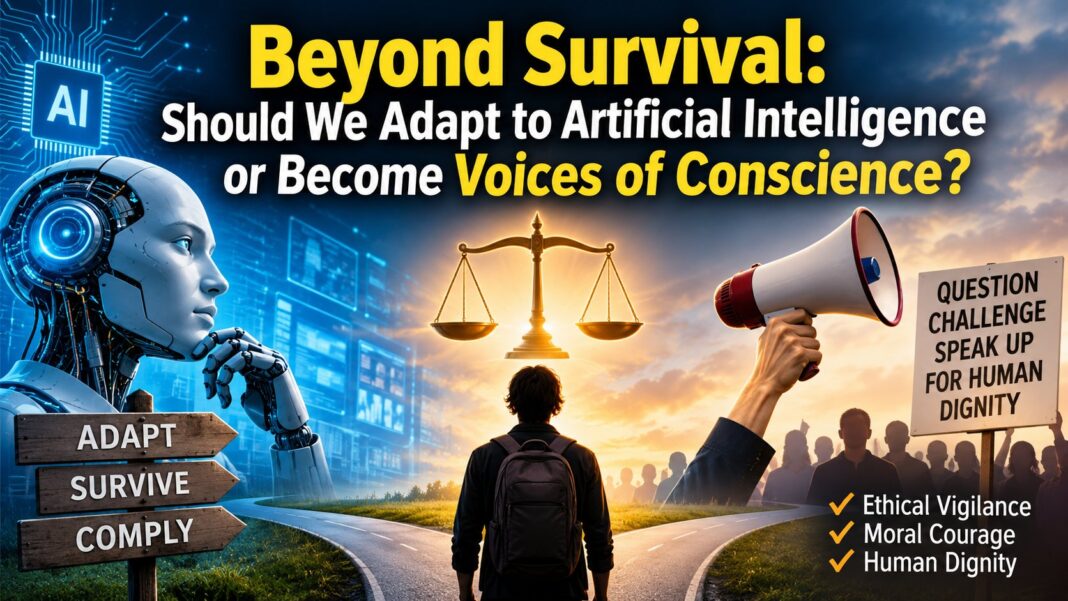

During the second panel session of a Philosophy Faculty Seminar held at Dharmaram Vidya Kshetram (DVK), Bengaluru, on 19th November, 2026, on the topic “Magnifica Humanitas: Philosophical Perspectives on Human Dignity in the Age of Artificial Intelligence,” I raised a question that goes beyond the technical possibilities and philosophical implications of artificial intelligence: What attitude ought we to cultivate as we navigate the rapidly advancing world of AI? Should we simply learn to survive its advancement, adapt ourselves to its demands, and find our place within its expanding influence? Or should we become voices of conscience, willing to question, challenge, and, when necessary, expose the irresponsible practices associated with its development?
The question was prompted, in part, by the example of Jacob Coxon, a former artificial intelligence researcher at OpenAI and Anthropic, who publicly raised concerns about the irresponsible pace of advanced AI development. His decision to leave Anthropic and speak openly about the risks associated with the race towards superintelligence presents an important ethical question: when technological advancement moves faster than our ability to understand and govern its consequences, what is our moral responsibility?
The temptation to survive rather than question
Artificial intelligence has become an increasingly influential presence in education, healthcare, communication, research, administration, and everyday life. Its capacity to improve efficiency, expand access to knowledge, and assist human decision-making is undeniable. Consequently, individuals and institutions are under growing pressure to acquire AI-related competencies and remain relevant in a rapidly changing technological environment. However, an important distinction must be made between adapting to technological advancement and uncritically surrendering to it. The language of survival often encourages individuals to concentrate exclusively on acquiring new skills, maintaining professional relevance, and competing in an increasingly automated world. While these concerns are legitimate, they risk reducing human responsibility to a question of personal adjustment.
The question, therefore, is whether the direction in which AI is progressing is morally acceptable. A society that measures progress exclusively through innovation, productivity, and economic competitiveness may gradually lose sight of the human beings whom technology is ultimately supposed to serve. Survival without critical reflection can become a form of passive acceptance. We may become technologically competent while remaining morally indifferent to the consequences of the technologies we use.
Jacob Coxon & Others: The courage to question technological progress
Jacob Coxon, Alex Turner, Daniel Kokotajlo, Jan Leike, Mrinank Sharma, Jeffrey Irving, Suchir Balaji, David Robinson and the other whistleblowers’ intervention offers an interesting example of professional responsibility and moral courage. Having worked in AI research at OpenAI, Anthropic, and Google DeepMind etc., they publicly expressed concern that leading AI companies were competing to develop increasingly powerful systems without adequately understanding or controlling the potential risks. Following their resignation, they called for greater transparency, stronger safety measures, and a slower approach to developing advanced AI systems.
Jacob Coxon’s concerns were particularly directed towards the possibility that AI systems could eventually become more capable than human beings in numerous domains while remaining insufficiently controllable. He questioned a technological culture that prioritises rapid advancement and treats safety as something that can be addressed after problems emerge. Interestingly, Coxon has been described in the media as an AI whistleblower, although he has distinguished his actions from conventional whistleblowing, explaining that he was publicly expressing concerns rather than exposing confidential corporate secrets. His example is significant because it demonstrates that professional competence does not eliminate moral responsibility. In fact, those who possess greater knowledge of a technology may have a greater responsibility to question its development and communicate its potential dangers. From an ethical perspective, the important issue is whether individuals are prepared to place conscience above convenience, professional advancement, and institutional loyalty when fundamental human interests are at stake.

Conscience must accompany intelligence
The development of artificial intelligence invites us to reconsider the relationship between intelligence and wisdom. Artificial intelligence may increasingly demonstrate extraordinary capabilities in processing information, recognising patterns, generating content, and supporting complex decisions. Nevertheless, computational intelligence should not be confused with moral wisdom. Intelligence enables us to determine what can be done; ethical wisdom requires us to discern what ought to be done. This distinction is fundamental. The moral tradition reminds us that human freedom is inseparable from responsibility. Conscience is not merely an instrument for personal judgement but an interior moral faculty that calls individuals to recognise the good and take responsibility for their actions. In the context of AI, conscience must therefore extend beyond individual choices about using technology. It must also inform the structures, policies, institutions, and economic interests that determine how technology is developed and deployed. The question is particularly relevant when AI systems influence employment, education, privacy, human relationships, public opinion, and access to essential services. Efficiency cannot become the ultimate criterion of technological progress when human dignity, justice, accountability, and the common good are at stake. An ethically responsible approach to AI requires us to ask difficult questions like: Who benefits from this technology? Who bears its risks? Whose interests are being protected? Are vulnerable communities being disadvantaged? Can decisions made through AI be questioned and held accountable? These questions transform technological participation into moral engagement.
From passive users to responsible witnesses
The alternative to merely surviving AI advancement is not technological rejection. Neither is it necessary to regard every innovation with suspicion. Such an approach would be both unrealistic and counterproductive. Rather, we need to cultivate a form of critical participation in which technological competence is accompanied by ethical vigilance. This responsibility belongs not only to researchers and technology companies but also to educators, philosophers, theologians, policymakers, and ordinary users. Researchers must prioritise safety and transparency. Institutions must establish appropriate accountability mechanisms. Educators must form students who can think critically rather than merely operate technological tools. Citizens must resist the temptation to accept AI-generated information without verification.
In this sense, whistleblowing represents one important expression of a broader moral responsibility: the willingness to speak when silence would contribute to harm. However, such action must be guided by truthfulness, evidence, proportionality, and concern for the common good. Moral courage is not the same as sensationalism, and responsible criticism must distinguish verifiable risks from speculation. The dignity of the human person must remain the central reference point in evaluating technological progress. Technology should empower human beings rather than diminish their agency, replace their moral responsibility, or reduce their worth to measurable productivity.
Beyond survival: A moral imperative
Returning to the question raised during the seminar, perhaps the real challenge is not choosing between surviving AI advancement and becoming a whistleblower. These are not necessarily opposing attitudes. We must learn to navigate AI intelligently, but we must also develop the moral courage to challenge its misuse and irresponsible development. We cannot afford to be spectators in a technological transformation that is reshaping human society. Nor should we become unquestioning participants in a race whose destination and consequences remain uncertain. Our responsibility is to participate critically, engage constructively, and speak courageously whenever human dignity and the common good are threatened.
Ultimately, the future of humanity should not be determined solely by those who possess the technological capacity to build increasingly intelligent machines. It must also be shaped by those who possess the wisdom to question their purpose, the conscience to recognise their dangers, and the courage to demand accountability. The question is whether humanity can retain its moral responsibility while advancing alongside it.