


Key Takeaways
- PM Modi announces new initiatives post Seva Teerth inauguration, focusing on empowerment, healthcare access, women-led development, and innovation.
- The PM RAHAT scheme provides cashless medical treatment of up to Rs 1.5 lakh to victims of accidents.
- The Lakhpati Didi scheme aims to enable women to earn sustainable annual incomes of at least Rs 1 lakh.
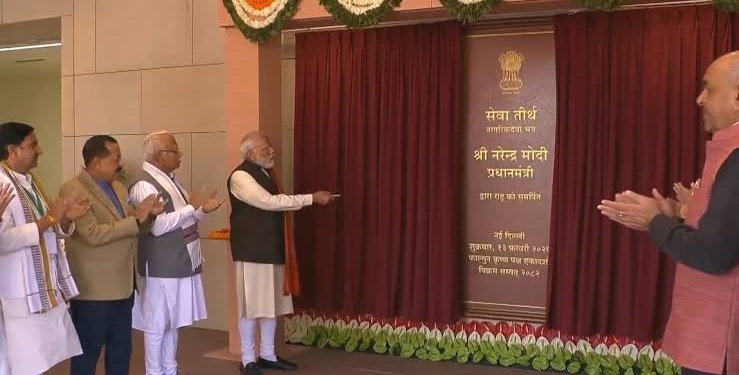
New Delhi: Prime Minister Narendra Modi on Friday announced a series of major welfare and development decisions after inaugurating Seva Teerth and Kartavya Bhavan, underscoring his government’s focus on empowerment, healthcare access, women-led development, agricultural growth and innovation.
Sharing details on X, the Prime Minister said he signed several key files at Seva Teerth aimed at benefiting “the poor, downtrodden, our hardworking farmers, Yuva Shakti and Nari Shakti.”
“At Seva Teerth today, signed files that are connected with the empowerment of the poor, downtrodden, our hardworking farmers, Yuva Shakti and Nari Shakti,” Modi said. “These decisions reaffirm the spirit of Nagrikdevo Bhava and add momentum to our vision of building a Viksit Bharat.”
Among the major announcements was the approval for the launch of the PM RAHAT scheme, under which victims of accidents will receive cashless medical treatment of up to Rs 1.5 lakh.
The Prime Minister emphasized that the PM RAHAT scheme would ensure immediate and accessible medical assistance. This will ensure that immediate medical help is provided to anyone affected, he said, highlighting the government’s continued push to strengthen emergency healthcare response systems.
The initiative is expected to reduce the financial burden on families during medical emergencies and improve survival outcomes through faster access to treatment.
In a significant boost to women-led development, the government doubled the target of the Lakhpati Didi scheme to 6 crore beneficiaries.
The scheme aims to enable women, particularly those associated with self-help groups, to earn sustainable annual incomes of at least Rs 1 lakh. By expanding the target, the government seeks to accelerate financial independence and entrepreneurship among women across rural and semi-urban India.
The Prime Minister also approved doubling the target of the Agriculture Infrastructure Fund from Rs 1 lakh crore to Rs 2 lakh crore.

The fund, designed to finance post-harvest management infrastructure and community farming assets, is expected to improve supply chains, reduce wastage and enhance farmers’ incomes.
“This will be immensely helpful to our farmers and help boost their incomes,” Modi said, reiterating the government’s commitment to strengthening rural infrastructure and agricultural productivity.
In a move aimed at energizing India’s innovation ecosystem, the government approved a Startup India Fund of Funds 2.0 with a corpus of Rs 10,000 crore.
The new fund will focus on supporting early-stage startups and deep-tech research, providing crucial capital to emerging ventures. The initiative builds upon previous efforts to position India as a global startup hub and encourage homegrown technological innovation.
Industry observers said the fresh corpus would enhance access to risk capital and help startups scale more effectively in competitive global markets.
Framing the announcements within a broader national vision, Modi said the decisions reflect the principle of “Nagrikdevo Bhava”, treating citizens as paramount, and strengthen the path toward a developed India.
“These decisions reaffirm the spirit of Nagrikdevo Bhava and add momentum to our vision of building a Viksit Bharat,” he stated.
The announcements signal a coordinated push across social welfare, women’s empowerment, agriculture and innovation, reinforcing the government’s emphasis on inclusive growth and long-term economic transformation.