

Key Takeaways
- Underground taxation is crushing Nagaland’s entrepreneurs, imposing a hidden cost on doing business and stifling economic growth.
- The victim is not merely the businessman, but also the consumer, the worker, and the Naga economy.
- Entrepreneurship is fundamentally an act of optimism, but uncertainty created by underground taxation changes that calculation, making success a liability.
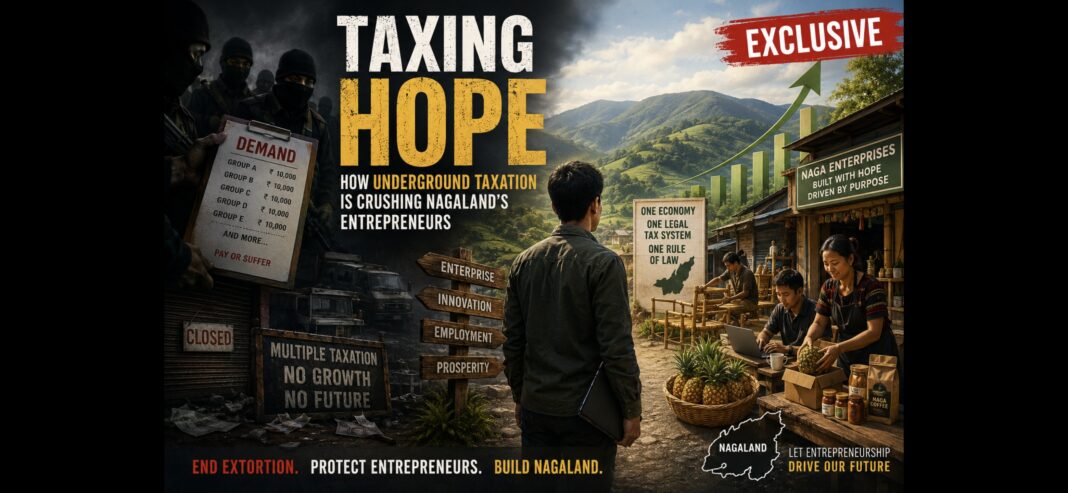
There is a dangerous contradiction unfolding in Nagaland. The state wants its young people to become entrepreneurs, build businesses, create jobs, process its pineapples, package its coffee, market its handicrafts, develop tourism and transform local resources into globally competitive products. Yet, at the same time, an underground taxation system is imposing a hidden cost on doing business that no serious entrepreneur can ignore. When a young Naga entrepreneur opens a shop, starts a construction company, transports goods, runs a restaurant or establishes a small manufacturing unit, the first question should be: “How can I grow?” Increasingly, the fear is that the question becomes: “How many people will come asking me for money?” That is not taxation. That is the taxation of hope.
Nagaland’s own Economic Survey 2025-26 presents an economy with considerable potential. The state’s Gross State Domestic Product is estimated to rise from ₹45,133 crore in 2024-25 to ₹51,014 crore in 2025-26, with real growth estimated at 10.33 percent. But the composition of that economy tells another story: the tertiary sector accounts for 66.64 percent, while manufacturing and other secondary activities contribute only 10.60 percent. The challenge is not just to make Nagaland grow, but to make it produce. This requires entrepreneurs who are willing to take risks, invest capital, and employ people, while remaining in business long enough to succeed.
Underground taxation makes every one of those decisions harder.
For many ordinary entrepreneurs, the burden is not a symbolic contribution but a recurring financial liability. Reports from Nagaland indicate that informal demands can begin at around ₹10,000, while businesses may face payments to several different groups. In one 2024 account, a small-business proprietor said that although the individual demands were not enormous, payments to as many as 25 different parties became overwhelming; another entrepreneur reported paying six different groups, with almost half of her profits going towards these payments. Earlier reporting has documented demands running into lakhs for individual businesses. For larger or more established businesses, the cumulative burden can therefore reach tens of thousands of rupees a month and, in some cases, much more. The tragedy is that the entrepreneur is not paying once; he or she can be paying repeatedly, sometimes to multiple underground tax-collecting groups, simply to keep the business, trucks and supply chains moving. This is not merely a financial cost – it is a tax on ambition, a tax on expansion and ultimately a tax on Nagaland’s economic future
The problem is not a secret. In April 2024, the Naga People’s Front publicly condemned what it described as unabated illegal taxation and extortion of the business community by various Naga Political Groups and anti-social elements. The party acknowledged that businesses had even resorted to shutting their shutters to express their grievances. Around the same period, business organisations in Kohima and Dimapur protested against multiple taxation, while reports documented small business owners describing the pressure created by demands from different groups. This is perhaps the most important point: the victim is not merely the businessman. The final victim is the consumer, the worker and the Naga economy.
Consider a small entrepreneur who earns a modest margin. His costs include rent, electricity, salaries, transportation, GST, licences, raw materials, loan repayments and inventory. Now add an unofficial demand from one group, followed by another demand from another group. The entrepreneur cannot simply increase prices indefinitely because consumers have limited purchasing power and competitors exist. So the unofficial taxation eats into his margin. Investment is postponed. Expansion is abandoned. Employees are not hired. Machinery is not purchased. A second branch is never opened.
And that is how an economy can be strangled without a single factory being physically closed.
What makes the situation even more damaging is the psychology it creates. Entrepreneurship is fundamentally an act of optimism. A young person invests today’s money because he believes tomorrow will be better. He borrows because he believes the business will generate enough cash flow to repay the loan. He hires because he believes demand will grow. But uncertainty changes that calculation. If the entrepreneur believes that success will make him more visible to multiple tax collectors, success itself becomes a liability. That is lethal to entrepreneurship.
In August 2024, thousands participated in a protest in Kohima against multiple taxation by Naga Political Groups, with concerns raised about threats to contractors and the wider business community. The message from ordinary citizens was remarkably clear: Nagaland cannot simultaneously demand economic development and tolerate an environment in which entrepreneurs feel economically vulnerable because they have become successful.
The problem has also reached the level of youth entrepreneurship. In April 2025, the Chakhesang Students’ Union specifically directed organisations and political groups in its jurisdiction to refrain from extortion or collecting taxes from new and existing local businesses. The Union explicitly connected the issue to youth entrepreneurship, self-employment, innovation, economic stability and reducing unemployment. That should be a wake-up call. When students and young people have to demand a tax-free environment simply to begin businesses, something fundamental has gone wrong.

There is an irony here. The legitimate tax paid to government can be understood because citizens know what it is meant to finance – roads, schools, hospitals, security, administration and development. It operates within a legal framework. Underground taxation provides no such social contract. There is no transparent budget, no audited expenditure, no public accountability and no guarantee that the money collected will return to the community as development. It is effectively a parallel fiscal system.
And Nagaland cannot afford parallel fiscal systems.
The state’s Commissioner of Taxes himself acknowledged in 2025 that Nagaland is not a front-runner in GST collection and that revenue leakages through evasion affect the state’s share of GST revenue. He also pointed to geography, infrastructure limitations and political complexities as factors behind the state’s historic difficulty in building revenue-generating industries and enterprises. The state therefore needs more legitimate businesses entering the formal economy, not fewer.
There is some encouraging evidence that when the formal system improves, businesses respond. Nagaland reported GST revenue increases of 43 percent in April 2025, 44 percent in May and an extraordinary 104 percent in June, alongside enforcement and administrative reforms. Imagine what could happen if the same confidence were created across every district, every town and every entrepreneurial community in Nagaland.
Nagaland has the ingredients. It has pineapples, bamboo, spices, coffee, horticulture, forests, tourism, traditional knowledge, creative talent and a young population capable of building businesses around these resources. The question is whether the ecosystem will allow them to flourish.
The people of Nagaland should not have to choose between being patriotic and being entrepreneurial. They should not have to choose between starting a business and protecting themselves from coercive demands. And no political aspiration, however legitimate its historical origins, can justify destroying the economic future of the very people in whose name that aspiration is pursued.
The slogan Nagaland needs today is simple: One economy, one legal tax system, one rule of law.
If Nagaland wants its youth to pick up the tools of entrepreneurship instead of waiting for government employment, then the first responsibility is to protect the entrepreneur. If a young Naga can turn a pineapple into a packaged product, bamboo into furniture, local food into a global brand or a village home-stay into an international tourism business, the state should make that journey easier – not more expensive through invisible taxation.
The future of Nagaland will not be built by taxation without accountability. It will be built by enterprise, innovation, investment and confidence.
The gun may command fear. Extortion may generate money. But only entrepreneurship can generate prosperity. Nagaland must decide which future it wants.