


Key Takeaways
- India’s message at the G7 reflects a growing trend in Indian foreign policy: asserting national interests and defending its citizens.
- Narendra Modi’s remarks at the G7 Summit highlight the importance of maritime security and the safety of Indian seafarers.
- India’s intervention at the G7 Summit reflects its growing role as a voice of the Global South and its commitment to articulating concerns shared by many developing countries.
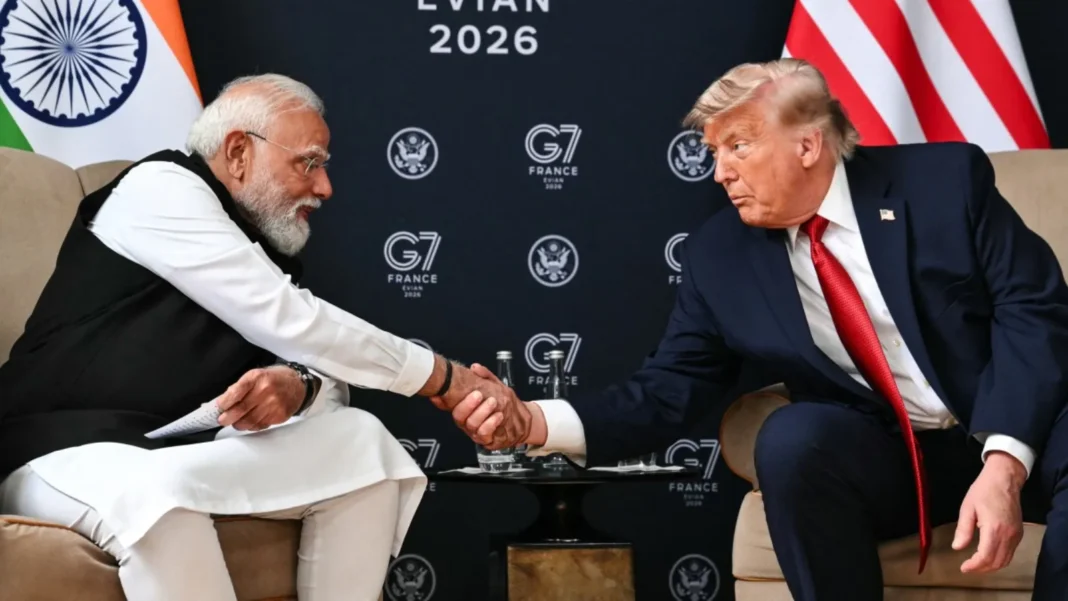
Prime Minister Narendra Modi’s remarks at the G7 Summit, delivered in the presence of U.S. President Donald Trump, were significant not because they constituted a public confrontation with Washington, but because they reflected a larger and increasingly visible trend in Indian foreign policy: the willingness of Bharat to assert its national interests, irrespective of global power dynamics.
In the aftermath of the U.S. military action in the Gulf of Oman that resulted in the deaths of three Indian sailors, Prime Minister Modi chose one of the world’s most influential diplomatic platforms to raise the issue of maritime security and the safety of civilian seafarers. His statement that “several Indian civilians lost their lives” and that ensuring the safety of seafarers was the collective responsibility of the international community was a measured yet unmistakable message.
Bharat’s foreign policy has undergone a significant shift over the past decade. No longer seen as a nation that avoids friction with major powers, Bharat now communicates with confidence, asserting its national interests and defending its citizens.
The significance of Modi’s remarks lies in the context. The United States remains one of Bharat’s most important strategic partners. Cooperation between the two countries spans defence, technology, trade, intelligence sharing, and Indo-Pacific security. Yet New Delhi chose not to remain silent when Indian citizens became casualties of a conflict in which Bharat was not a participant.
This reflects a broader principle that has come to define contemporary Indian diplomacy: friendship does not mean unquestioning agreement.
Bharat has demonstrated this principle repeatedly in recent years. It continued to purchase Russian energy despite intense Western pressure following the Ukraine conflict. It resisted calls to align completely with either the Western bloc or the Russia-China axis. It maintained engagement with Iran while simultaneously strengthening ties with Israel. It expanded defence cooperation with the United States while continuing military-technical cooperation with Russia. In each case, the underlying message was the same: Bharat will make decisions based on its own national interest.
The G7 intervention therefore fits into a larger pattern.
When Prime Minister Modi spoke about the safety of seafarers, he was not merely highlighting the deaths of three Indian sailors. He was reminding the international community that the consequences of great-power rivalries are often borne by ordinary civilians. The global economy depends upon maritime trade. Millions of tonnes of cargo, energy supplies, and essential commodities pass through critical sea lanes every day. Indian seafarers form one of the largest contingents of the global maritime workforce. Any disruption to these routes directly impacts Bharat’s economic and human interests.
By raising the issue publicly, New Delhi signalled that the lives of Indian citizens cannot be treated as collateral damage in larger geopolitical contests.

Equally important is the symbolism of where the message was delivered. The G7 remains a forum dominated by major Western powers. For many developing nations, concerns regarding civilian casualties, maritime disruptions, and economic fallout often struggle to find prominence amid discussions focused on strategic competition and military objectives.
India’s intervention reflected its growing role as a voice of the Global South. Increasingly, New Delhi is positioning itself as a nation capable of articulating concerns shared by many developing countries that are affected by conflicts but are not party to them.
The message was also consistent with Bharat’s long-standing civilisational approach to international relations. While advocating strength and security, Bharat has traditionally emphasised dialogue, stability, and peaceful coexistence. Raising concerns about the safety of seafarers does not contradict strategic partnerships; rather, it reinforces the principle that human security must remain central to international decision-making.
Critics may argue that the statement was diplomatic and restrained. That is precisely what makes it effective. Modern diplomacy is often less about dramatic confrontations and more about carefully calibrated signalling. A direct public attack on the United States would have generated headlines but little practical benefit. Instead, Modi chose a formulation that defended Indian interests, highlighted Indian concerns, and ensured international attention without unnecessarily escalating tensions.
This is increasingly the hallmark of India’s foreign policy: strategic autonomy combined with strategic confidence.
The world is witnessing the emergence of a Bharat that neither seeks approval from global powers nor defines itself in opposition to them. It is a Bharat willing to cooperate, but equally willing to disagree. A Bharat that values partnerships but refuses dependency. A Bharat that recognises its growing economic, demographic, and geopolitical weight and is prepared to use that influence to protect its citizens and advance its interests.
Seen in that light, the remarks at the G7 were about far more than a single maritime incident. They were another example of a nation that has become increasingly comfortable speaking in its own voice on the global stage.
The message was clear: when Indian lives are affected, Bharat will speak up—regardless of who is sitting at the table.