
Key Takeaways
- Indian Army traditions like the Dining Out ceremony showcase the bond of brotherhood and camaraderie among soldiers.
- The Dining Out ceremony originated from the British Army during the colonial period.
- The ceremony is a testament to the strong relationships built among soldiers during their time in the Indian Army.
The military is one of the few institutions where tradition plays a significant role. Despite changes in uniforms, weapons, and technology, traditions remain constant. They are the invisible threads that bind soldiers across generations, reminding each officer of their role in preserving a legacy built over centuries.
The Indian Army, despite being one of the youngest modern armies in terms of national identity, possesses an extraordinarily rich regimental culture. Every regiment, corps, and unit has its own customs, songs, battle cries, mess silver, anecdotes, and rituals. Some traditions commemorate victories won at great cost. Others honour those who never returned. Still others exist simply because they remind soldiers that even amidst hardship, there is room for laughter.
Among these cherished customs is the Dining Out, the ceremonial farewell hosted in the Officers’ Mess when an officer leaves the unit on posting or retirement. It is perhaps one of the finest examples of military tradition blending dignity with affection, protocol with humour, and hierarchy with fraternity.
To an outsider, it may appear to be nothing more than a formal dinner followed by a noisy celebration. But to those who have worn the uniform, it is far more than that. It is the Army’s way of saying, you may be leaving this unit, but you will always remain one of us.
The evening commences with grace and elegance, characteristic of the Officers’ Mess. Regimental silver shines under polished lights, accompanied by medals on ceremonial uniforms. Toasts are proposed with precision and etiquette, as stories from field postings and regimental life are retold, becoming more amusing with each passing year. The stories are a testament to the brotherhood and camaraderie within the Indian Army.
Junior officers recount the mistakes of their seniors.
Senior officers expose the youthful misadventures of those who now consider themselves seasoned veterans.
Every anecdote draws laughter because everyone in the room understands its context. These are stories born not merely from friendship but from shared hardship, of freezing nights in remote posts, endless route marches, difficult operations, separation from families, impossible deadlines, and moments when lives depended entirely upon one another.
That shared experience is what makes military humour unique. It cannot be manufactured.
It must be earned.
Then comes the moment everyone anticipates.
The formalities conclude.
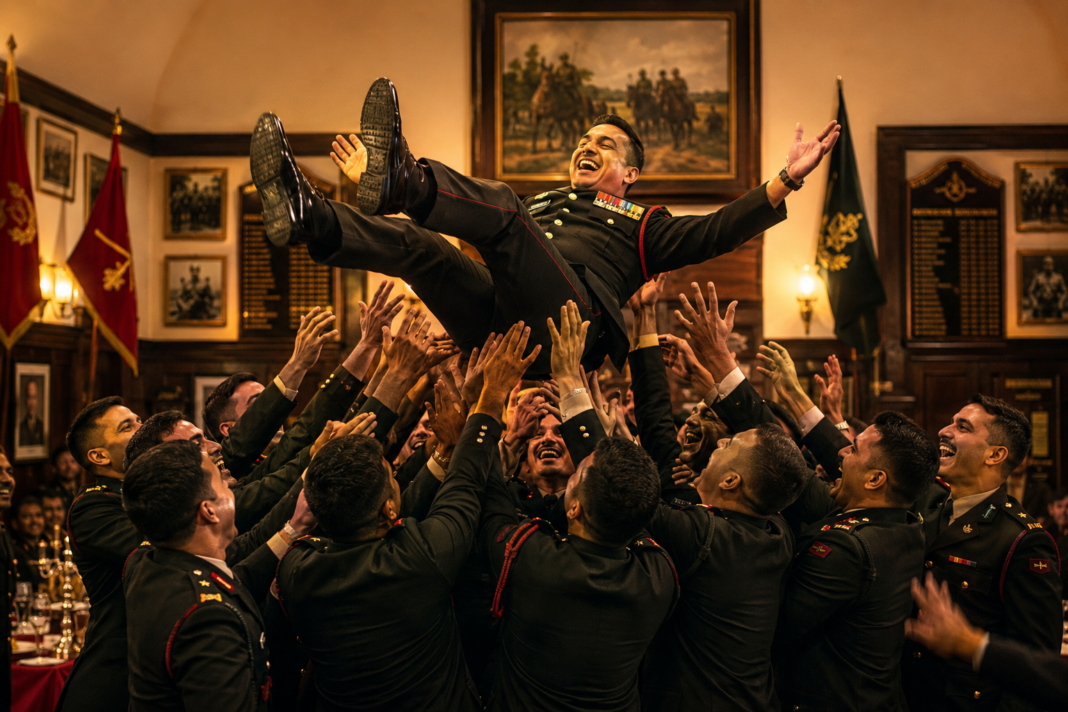
The guest of honour is escorted to the centre of the Mess.
A circle of officers gathers around him.
Someone gives the signal.
Suddenly he is lifted high above everyone’s shoulders.
Then begins the familiar chorus:
“For he’s a jolly good fellow,
For he’s a jolly good fellow,
For he’s a jolly good fellow…
And so say all of us.”
With every verse, the departing officer is tossed higher into the air.
Laughter fills the Mess.
The ceiling suddenly appears far closer than it should.
Young officers cheer louder than anyone else.
Senior officers laugh just as heartily.
For a few unforgettable minutes, rank disappears.
Only brotherhood remains.
To many civilians, such a ritual may appear strange, even reckless. Yet anyone who has experienced it understands its deeper meaning.
For young officers, it is often the only occasion when they can playfully “take revenge” on the senior who once made them run one extra lap, polish their boots again, rewrite a report, repeat an inspection, or endure one more exercise in pursuit of excellence.
No malice exists.
No offence is intended.
The occasional bruise or bumped shoulder is accepted almost with pride. It becomes part of the story that will itself be narrated years later during another Dining Out.
That is how traditions survive.
Not because they are written in manuals, but because they live in memory.
Interestingly, this custom was inherited from the British Army during the colonial period. Like many military traditions, it travelled across continents, adapted itself to local culture, and gradually became part of the identity of armies that once served under the British Crown.
But traditions evolve.
The Dining Out ceremony in today’s Indian Army is no longer British.
It is Indian.
Its soul has been shaped by Indian soldiers, Indian officers, Indian battlefields, Indian victories, and Indian camaraderie over nearly eight decades of independent nationhood.
This distinction is important.
In recent years, India has rightly undertaken a thoughtful process of decolonising many of its institutions. Colonial symbols that represented subjugation have been reconsidered. Outdated practices have been replaced by those reflecting our own civilisational confidence. Military institutions, too, have embraced this transformation, from changes in ceremonial practices to the renaming of establishments and greater emphasis on indigenous traditions.
This process is both healthy and necessary.
But decolonisation should never become synonymous with indiscriminate deletion.
Wisdom lies in distinguishing between practices that symbolised colonial domination and traditions that have, over time, acquired an entirely different meaning.
Not everything inherited is oppressive.
Some inheritances have become our own through decades of lived experience.
The Dining Out tradition belongs firmly in that category.
The song For He’s a Jolly Good Fellow is no longer sung because it is British.
It is sung because it expresses something universal.
Respect.
Affection.
Gratitude.
Brotherhood.
The words themselves are remarkably simple, yet they capture emotions that military life often leaves unspoken. Soldiers rarely express affection through elaborate speeches. The profession values restraint. Emotions are usually conveyed through actions rather than words.
The farewell toss says what speeches cannot.

It tells the departing officer:
“We trusted you.”
“We laughed with you.”
“We served beside you.”
“You will always belong here.”
That message transcends language, nationality, and history.
Military traditions exist precisely because some emotions are too profound to be expressed formally.
The Officers’ Mess itself has always served a purpose much deeper than dining. It is where young officers first learn regimental culture. It is where legends of past battles are narrated by those who fought them. It is where etiquette is taught without classrooms, leadership is observed without lectures, and confidence is built without certificates.
Within those walls, generations meet.
The oldest veterans and the youngest subalterns become part of the same continuing story.
It is perhaps the only profession where a young officer can hear firsthand accounts of wars fought decades before he was born while sitting at the same dining table.
Such continuity cannot be replicated through policy documents.
It survives through tradition.
Around the world, the finest armed forces fiercely protect these customs. Whether it is the mess dinners of the British Army, the Marine Corps Birthday Ball in the United States, the regimental pipes of Scotland, the dining-in ceremonies of Commonwealth armies, or the academy traditions that shape future officers, every professional military understands one simple truth:
Tradition builds cohesion.
Cohesion builds trust.
Trust wins battles.
Modern military psychology repeatedly reinforces this understanding. Soldiers fight not merely for abstract ideas or even for medals. They fight for the comrades beside them. Shared rituals, humour, songs, ceremonies, and customs create emotional bonds that later become operational strength under fire.
The Dining Out ceremony may appear playful.
Its effects are profound.
It humanises leadership.
It softens hierarchy.
It reminds every officer that however high he rises, he will always remain one among his own.
Perhaps that is why even the most decorated generals smile like young lieutenants when they are tossed during their farewell.
For those few moments, decorations become irrelevant.
Only fellowship matters.
As India continues to modernise its armed forces, with artificial intelligence, drones, network-centric warfare, cyber capabilities, and next-generation weapons, it is worth remembering that the human element remains decisive.
Technology changes rapidly.
Human relationships do not.
No machine can manufacture trust.
No algorithm can create camaraderie.
No software can replace regimental spirit.
Those qualities are nurtured over years through shared experiences and preserved through traditions exactly like these.
The Indian Army has never blindly copied traditions, nor has it blindly discarded them. It has always displayed the maturity to evaluate customs on the basis of the values they promote rather than merely their historical origin. That is precisely why our military culture remains both rooted and adaptable.
If a tradition strengthens morale, reinforces humility, celebrates service, and binds generations together, it deserves preservation irrespective of where it first originated.
History should inform us.
It should not imprison us.
Ultimately, For He’s a Jolly Good Fellow is not about a British melody.
It is about an Indian soldier bidding farewell to another Indian soldier.
It is about shared hardships in deserts, mountains, jungles, glaciers, and battlefields.
It is about friendships forged under circumstances few civilians will ever experience.
It is about knowing that wherever one’s next posting may be, a part of one’s heart will forever remain with the regiment left behind.
As we continue to build a modern, self-confident and future-ready military, let us not mistake heritage for baggage. Some customs deserve retirement because they no longer serve a purpose. Others deserve preservation because they continue to strengthen the very character of the institution.
The Dining Out ceremony belongs unmistakably in the latter category.
Its laughter carries memory.
Its song carries gratitude.
Its farewell carries brotherhood.
And in that joyous moment, when one officer is lifted skyward by the very comrades with whom he has shared years of service, every soldier is reminded that while postings may separate them, the regiment never truly lets go.
Some traditions are not relics of the past.
They are the heartbeat of an institution.
They deserve not merely to survive, but to be cherished by every generation that follows.
Because armies are built not only on discipline, courage, and sacrifice, but also on friendship, humility, shared memories, and an unbreakable sense of belonging.
And so say all of us.