
Key Takeaways
- Hybrid warfare has become a new reality for India, where information, perception, and narratives are used as strategic weapons.
- Cognitive warfare is a key component of hybrid warfare, where the goal is to influence an adversary’s perception and decision-making process.
- Ideological subversion is a gradual process of undermining a nation’s confidence in itself, often through the manipulation of information and narratives.
“The next war may not begin with tanks crossing borders. It may begin with ideas crossing minds.”
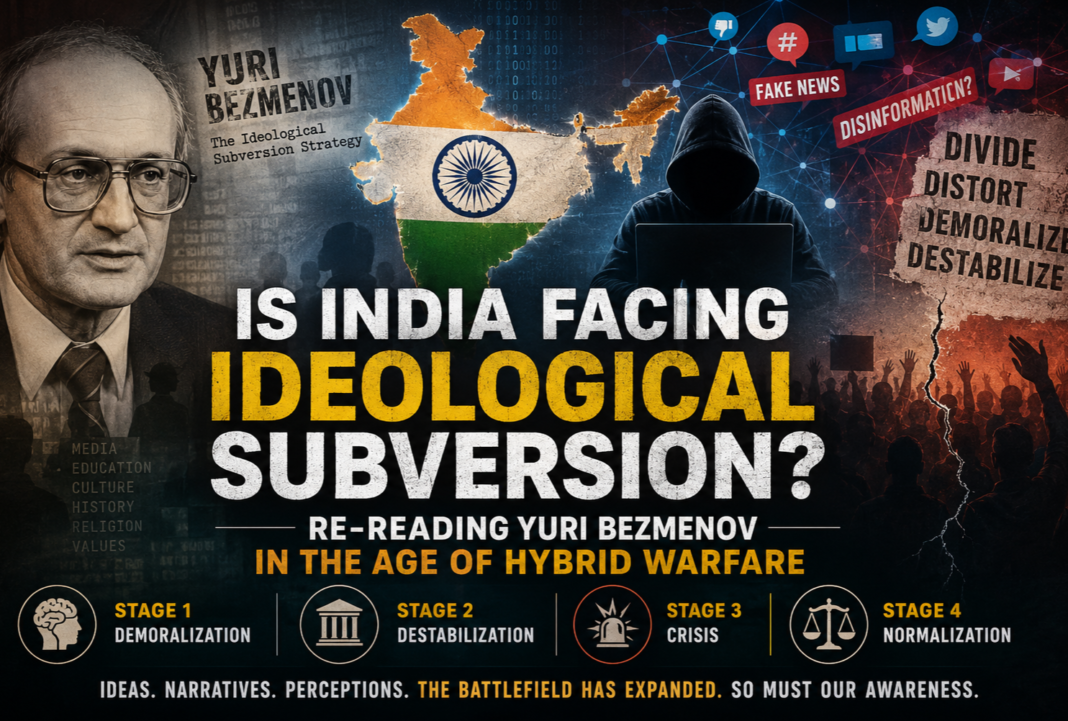
When former Soviet defector Yuri Bezmenov spoke about ideological subversion during the Cold War, many dismissed his warnings as relics of a bygone era. Four decades later, however, nations across the world are confronting a new form of conflict, one in which information, perception, and narratives have become strategic weapons.
Whether one agrees entirely with Bezmenov or not, one fact is undeniable: the battlefield of the 21st century is as much cognitive as it is physical.
India, a rising global power with unmatched demographic diversity, naturally finds itself at the centre of this contest.
Stage One: Demoralization – Winning the Battle for the Mind
Bezmenov argued that the first objective of ideological subversion is not to conquer territory but to erode a nation’s confidence in itself.
Look around us.
Relentless contestation has become the norm. Religion, caste, language, region, history, and even national symbols are being questioned and contested. This has led to a breakdown in social cohesion.
Debate is the lifeblood of democracy. But when disagreement evolves into permanent distrust, and when citizens begin viewing each other as adversaries rather than compatriots, social cohesion starts to weaken.
Digital platforms have accelerated this process. Algorithms reward outrage over nuance, emotion over evidence, and speed over verification.
Stage Two: Destabilization – Attacking the Pillars of Stability
Modern conflicts rarely begin with artillery. They begin with hashtags.
India today faces coordinated misinformation campaigns, cyber operations, deepfakes, bot networks, and attempts by hostile state and non-state actors to shape domestic and international narratives. Cross-border propaganda, terrorist ecosystems, and influence operations increasingly complement conventional security threats.
India’s adversaries understand a simple truth: A divided society is easier to weaken than a united nation.
Religious tensions, caste divisions, regional aspirations, linguistic differences, and political polarization become strategic opportunities for those who seek to undermine national resilience.
This does not mean every protest, criticism, or disagreement is externally orchestrated. Democracies thrive on dissent. However, genuine grievances can be amplified, manipulated, or exploited by actors pursuing geopolitical objectives.
Stage Three: Crisis – When Narratives Become Weapons
Every nation experiences crises.
India has faced terrorist attacks, border confrontations, pandemics, communal disturbances, economic shocks, and periods of intense political contestation.
What has changed is the speed with which information travels.
Within minutes of a major incident, thousands of posts, edited videos, fabricated documents, AI-generated images, and coordinated campaigns compete to shape public perception.
Today’s battle is not merely about what happened. It is about who controls the first narrative.
Public opinion has become a strategic objective.
Stage Four: Normalization – A New Strategic Reality
Following every major crisis, societies adapt.
Governments strengthen laws, enhance intelligence capabilities, improve cyber security, modernize institutions, and revise national security doctrines.
Citizens, too, gradually accept new realities.
Bezmenov described this as “normalization”, the emergence of a new equilibrium after prolonged instability.
India’s Challenge Is Bigger Than Bezmenov
India’s security environment cannot be explained solely through a Cold War framework.
Today’s threats are multidimensional.

Information warfare merges with cyber warfare.
Economic coercion complements diplomatic pressure.
Proxy terrorism intersects with digital propaganda.
Artificial intelligence amplifies disinformation.
Foreign influence operations exploit domestic fault lines.
The result is what strategists now describe as hybrid warfare and cognitive warfare.
The Real Question
The issue is not whether India perfectly fits Bezmenov’s four stages.
The real question is whether India is prepared for an era in which the target is not merely territory, but the collective consciousness of its people.
Can Indians disagree without becoming enemies?
Can political competition remain democratic without becoming destructive?
Can citizens distinguish authentic information from manufactured narratives?
Can national unity withstand sustained attempts at polarization?
These questions will define India’s security far more than any individual military exercise.
The Way Forward
India’s greatest strength has never been uniformity.
It has been civilizational unity amidst extraordinary diversity.
The answer to ideological subversion is not censorship.
It is an informed citizenry.
It is institutional credibility.
It is media literacy.
It is social cohesion.
It is national confidence rooted in facts rather than propaganda.
Military power protects borders.
Economic strength builds prosperity.
But an aware, united, and resilient society protects the nation itself.
As India rises on the global stage, attempts to influence its internal discourse are likely to become more sophisticated.
The challenge before us is not to fear every disagreement or dismiss every criticism as a conspiracy.
The challenge is to ensure that our differences remain democratic, our debates remain informed, and our national interest remains paramount.
Because in the wars of the future, victory may belong not only to the nation with the strongest armed forces, but to the nation whose people cannot be divided, manipulated, or demoralized.