



History teaches us that wars are rarely fought over a single reason. Religion, ethnicity, nationalism, ideology, territory, security and political power can all ignite a conflict. But beneath these visible layers, there is often another force operating quietly – the economy. Behind the battlefield lies the balance sheet. Behind the strategic alliance lies a supply chain. Behind the struggle for territory lies access to land, water, minerals, energy, trade routes or markets. And behind the devastation of war, there are invariably those who gain economically even as millions lose their homes, livelihoods and futures.
This does not mean every conflict is manufactured for profit, nor that economic interests alone explain war. Human beings do not go to war merely because a spreadsheet tells them to. But to understand the persistence, intensity and strategic geography of modern conflicts, one cannot ignore the economics of conflict.
The numbers are revealing. Global military expenditure reached an extraordinary $2.718 trillion in 2024, according to the Stockholm International Peace Research Institute (SIPRI), rising 9.4 percent in real terms in a single year and increasing for the tenth consecutive year. Military expenditure represented 2.5 percent of global GDP, while the world’s military spending per person reached $334.
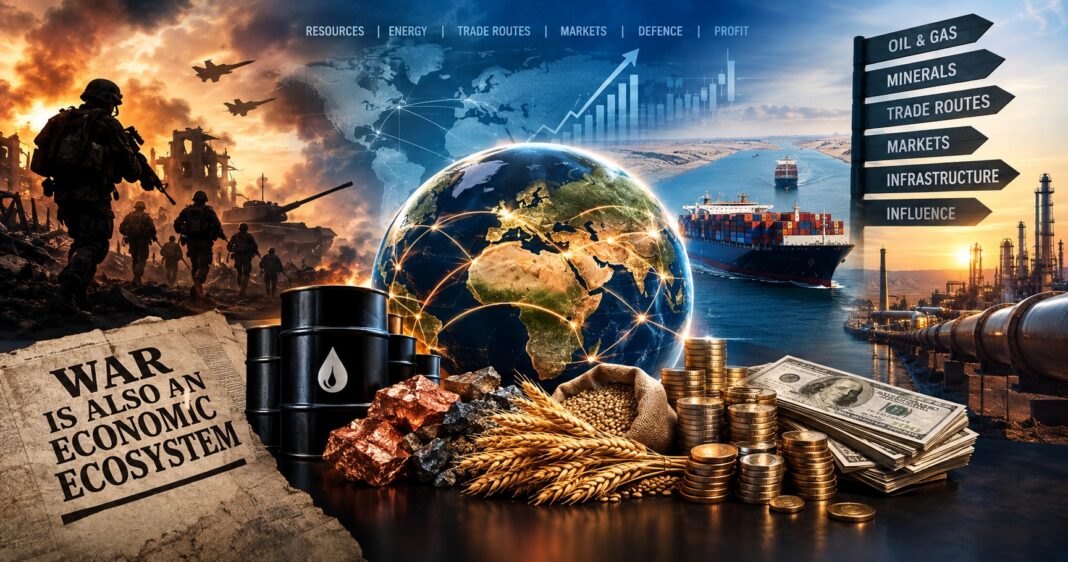
War, therefore, is not merely destruction. It is also an enormous economic ecosystem.
Every missile fired has a manufacturer. Every aircraft destroyed has a replacement contract. Every artillery shell consumed has to be produced. Every battlefield requires fuel, communications equipment, surveillance systems, drones, logistics, maintenance and ammunition. When governments perceive a rising threat, defence budgets expand. When defence budgets expand, industries expand with them.
That is one of the great paradoxes of modern conflict: what is economically catastrophic for a country can simultaneously become economically lucrative for particular sectors within and outside that country.
The Russia-Ukraine war illustrates the point. Europe responded to the deterioration of its security environment with major increases in defence spending. SIPRI reported that European military expenditure rose dramatically in 2024, while military spending also increased in the Middle East and other regions. The economic consequences extend far beyond the battlefield – from energy markets and fertiliser prices to arms production and infrastructure investment.
But the economic dimension of conflict goes much deeper than weapons.
Energy has always been strategic power. Oil and gas are not simply commodities; they are instruments of geopolitical influence. Countries that control energy reserves possess leverage over countries that depend upon imports. Countries that control pipelines, ports and maritime chokepoints possess another form of leverage.
The Strait of Hormuz demonstrates this perfectly. In 2026, the World Bank noted that the strait handles roughly 35 percent of global seaborne crude-oil trade. Disruption there produced an enormous energy shock, with the World Bank reporting an initial reduction in global oil supply of about 10 million barrels per day and sharply higher oil prices. The consequences moved rapidly from energy markets into food, inflation, interest rates and economic growth.
That is how economics becomes geopolitics.
A conflict does not have to destroy a factory to damage the global economy. It merely has to threaten the route by which the factory receives its raw materials or sells its products.
The Red Sea crisis demonstrated this with remarkable clarity. Attacks on commercial shipping forced vessels to divert around the Cape of Good Hope. UN Trade and Development reported that Cape of Good Hope vessel capacity surged by 89 percent, while longer routes increased fuel, insurance, crew and operating costs. On some routes, shipping costs multiplied dramatically.
A missile launched in one part of the world can therefore increase the price of a product thousands of kilometres away.
This is the hidden geography of modern conflict.
The same logic applies to minerals. The Democratic Republic of Congo possesses enormous deposits of minerals critical to modern industry, including cobalt and copper. Yet resource wealth has existed alongside prolonged conflict and political instability. The lesson is not that minerals automatically cause war. It is that when valuable resources exist in territories where institutions are weak, the economic value of controlling those resources can intensify competition among states, armed groups, businesses and political elites.
The same principle can be seen in Africa’s oil-producing regions. Where governments, armed groups and communities compete over who controls resource-rich territory, economic deprivation can become both a cause and a consequence of violence.
And then there is the economics of deprivation. Sometimes the question is not, “Who wants the resource?” but “Who has been denied the opportunity?”
Youth unemployment, poverty, food insecurity, inequality, exclusion from economic opportunity and the absence of upward mobility can create environments in which political extremism and armed mobilisation become easier. Economic deprivation does not automatically produce terrorism or civil war. Millions of poor people never choose violence. But persistent deprivation can weaken social cohesion and make populations more vulnerable to movements promising dignity, identity, income or political power.
This is why development is not merely an economic objective. It is also a security instrument.

The World Bank’s research on conflict makes the economic cost brutally clear. Its 2025 Global Economic Prospects reported that high-intensity conflicts are associated with cumulative losses in per-capita GDP of about 20 percent five years after conflict begins. Across a broader group of conflicts, the cumulative loss was about 9 percent.
War therefore creates an economic paradox. It may generate profits for selected industries, but it destroys productive capacity for society as a whole.
Factories close. Ports become inaccessible. Roads and bridges are destroyed. Human capital disappears through death, displacement and migration. Governments borrow more. Inflation rises. Investment falls. Insurance becomes expensive. Tourism collapses. Education is interrupted. Healthcare systems deteriorate.
The poor ultimately pay the highest price.
The economics of conflict also explains why geography matters so much. Whoever controls a port, canal, strait, pipeline, railway corridor or mineral corridor can influence commerce far beyond the boundaries of that territory.
The Suez Canal is not merely a waterway. It is an artery of global commerce. When geopolitical tensions disrupt it, shipping routes change, freight rates rise and delivery times increase. UN Trade and Development has warned that disruptions at maritime chokepoints can raise costs, reshape trade patterns and threaten food and energy security, particularly in vulnerable economies.
In other words, today’s battlefield may be a desert, a mountain or a city – but the real strategic objective may be a supply chain.
This brings us to perhaps the most uncomfortable question: who benefits from prolonged instability?
There are governments seeking strategic advantage. There are defence manufacturers selling weapons. There are commodity traders responding to price volatility. There are energy producers benefiting from supply shortages. There are construction companies waiting for reconstruction contracts. There are shipping companies benefiting from higher freight rates in certain circumstances. There are investors positioning themselves around commodities, infrastructure and defence.
None of this proves that these actors caused a particular war. That distinction is essential. Correlation is not causation, and economic beneficiaries should not automatically be described as the architects of conflict.
But economic incentives influence the strategic choices made during conflict, and sometimes influence how quickly peace becomes economically attractive.
That is why peace itself needs an economic architecture.
If war destroys $100 billion worth of infrastructure but peace creates $200 billion worth of trade, investment and reconstruction opportunities, then peace becomes more than a moral proposition. It becomes a strategic economic proposition.
Perhaps this is where the world needs to rethink conflict prevention.
Diplomacy cannot focus only on political grievances. It must examine resource distribution, trade corridors, employment, energy security, water, food systems, investment and economic exclusion. Peace agreements that ignore the economics of peace may merely pause the conflict.
Because behind many conflicts lies an economic equation: who controls, who receives, who is excluded, who pays and who profits.
The tragedy is that ordinary citizens almost always pay the largest bill.
They pay through inflation. They pay through taxes. They pay through lost jobs. They pay through destroyed homes. They pay through displaced families. They pay through the opportunity cost of schools that were never built, hospitals that were never equipped and businesses that never opened.
The world spent $2.7 trillion on its militaries in 2024. The question humanity must eventually confront is not simply whether nations can afford war. It is whether civilisation can afford to keep making war economically rational. Because the ultimate battle is not merely over territory. It is over resources, access, opportunity and economic power.
And until the economics of conflict is understood, the politics of conflict will remain only half the story.