


Key Takeaways
- The India-Russia joint statement outlines nine focus areas for economic cooperation, including trade, energy, and digital economy.
- The target trade volume for India-Russia is more than 100 billion USD by 2030.
- The Russian-Indian Intergovernmental Commission will study the identified priority areas and assess the progress at its next meeting.
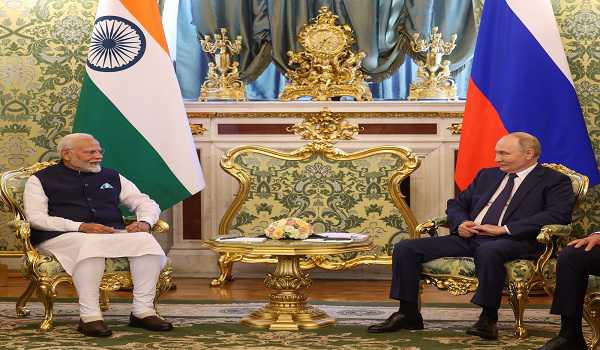
Moscow/New Delhi: India and Russia released a Leaders Joint Statement on economic cooperation for the period up to 2030, following the summit between Prime Minister Narendra Modi and President Vladimir Putin in Moscow on July 8-9.
Seeking to give additional impetus to the deepening of bilateral interaction by promoting Russia-India trade and economic cooperation, the two sides declare the following:
The two sides declare the following nine key areas for bilateral economic cooperation:
1. Elimination of non-tariff trade barriers related to bilateral trade between India and Russia.
2. Development of a bilateral settlement system using national currencies.
3. Increase of cargo turnover with India through the launch of new routes of the North-South International Transport Corridor, the Northern Sea Route and the Chennai-Vladivostok Sea Line.
1. Aspiration for elimination of non-tariff trade barriers related to bilateral trade between India and Russia. Continuation of dialogue in the field of liberalization of bilateral trade, including the possibility of the establishment of the EAEU-India Free Trade Area. Achievement of a mutual trade volume more than 100 bln USD by 2030 (as mutually agreed), including increased supplies of goods from India to achieve balanced bilateral trade. Reinvigoration of investment activities of the Parties, i.e. within the framework of the special investment regimes.
2. Development of a bilateral settlement system using national currencies. Consistent introduction of digital financial instruments into mutual settlements.
3. Increase of cargo turnover with India through the launch of new routes of the North-South International Transport Corridor, the Northern Sea Route and the Chennai-Vladivostok Sea Line. Optimization of customs procedures through the application of intelligent digital systems for barrier-free movement of goods.

4. Increase of the volume of bilateral trade in agricultural products, food and fertilizers. Maintenance of an intensive dialogue aimed at removing veterinary, sanitary and phytosanitary restrictions and prohibitions.
5. Development of cooperation in key energy sectors, including nuclear energy, oil refining and petrochemicals and expanded forms of cooperation and partnership in the field of energy infrastructure, technologies and equipment. Facilitation of mutual and international energy security, i.e. taking into account the prospects of global energy transition.
6. Strengthening of interaction in the fields of infrastructure development, transport engineering, automobile production and shipbuilding, space and other industrial sectors. Facilitation of entry of Indian and Russian companies in each other’s markets by creating subsidiaries and industrial clusters. Convergence of approaches of the Parties in the fields of standardization, metrology and conformity assessment.
7. Promotion of investments and joint projects across various sectors of digital economy, science and research, educational exchanges and internships for employees of high-tech companies. Facilitation of the creation of new joint (subsidiary) companies by providing them with favourable fiscal regimes.
8. Promotion of systematic cooperation in the development and supply of medicines and advanced medical equipment. Studying of the possibility of opening branches of Indian medical institutions in Russia and recruiting qualified medical personnel as well as strengthening of coordination in the field of medical and biological safety.
9. Development of humanitarian cooperation, consistent expansion of interaction in the fields of education, science and technology, culture, tourism, sports, healthcare and other areas.
The President of Russia and the Prime Minister of India instructed the Russian-Indian Intergovernmental Commission on Trade, Economic, Scientific, Technical and Cultural Cooperation to study the identified priority areas and to assess the progress at its next meeting.