

Key Takeaways
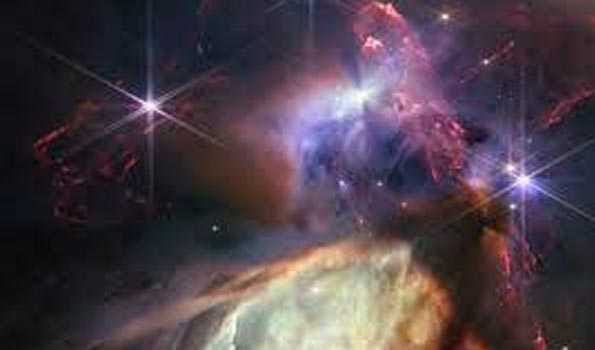
- The James Webb Space Telescope delivered a new image of the nearby Rho Ophiuchi cloud, marking its first year of science.
- The region hosts about 50 young stars similar in mass to the Sun, providing insight into early stellar development.
- NASA Administrator Bill Nelson emphasizes that each new JWST image is a “new discovery” that expands humanity’s view of the cosmos.
Los Angeles: NASA released a new image of a small star‑forming region captured by the James Webb Space Telescope on Wednesday.
The release celebrates the telescope’s first year of science and highlights the detailed view of the nearby region.
The new image features the nearest star-forming region in the Rho Ophiuchi cloud complex. Its proximity at 390 light-years allows for a highly detailed close-up, with no foreground stars in the intervening space.

The region contains approximately 50 young stars, all of them similar in mass to the Sun, or smaller, according to NASA.
“Webb’s image of Rho Ophiuchi allows us to witness a very brief period in the stellar lifecycle with new clarity. Our own Sun experienced a phase like this, long ago, and now we have the technology to see the beginning of another’s star’s story,” said Klaus Pontoppidan, Webb project scientist at the Space Telescope Science Institute in Baltimore, Maryland.
“In just one year, the James Webb Space Telescope has transformed humanity’s view of the cosmos, peering into dust clouds and seeing light from faraway corners of the universe for the very first time. Every new image is a new discovery, empowering scientists around the globe to ask and answer questions they once could never dream of,” said NASA Administrator Bill Nelson.