

Key Takeaways
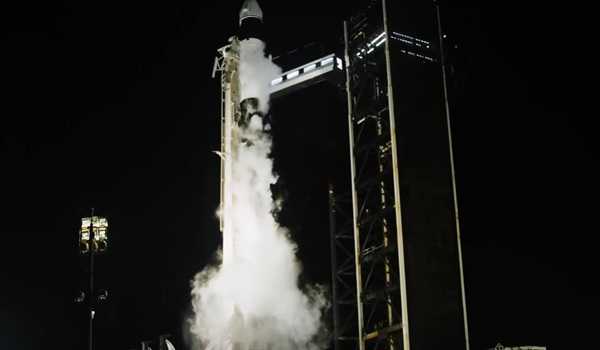
- The US launched its first human spaceflight mission to Earth’s polar regions aboard a SpaceX Dragon spacecraft and a Falcon 9 rocket.
- The crew will conduct 22 experiments aimed at advancing human health and performance in space, particularly for future long-duration missions.
- The mission will study unusual light emissions resembling auroras and observe Earth’s polar wilderness through Dragon’s cupola.
Los Angeles: The United States on Monday launched the world’s first human spaceflight mission over the Earth’s polar regions.
A SpaceX Dragon spacecraft carrying a four-member crew lifted off aboard a Falcon 9 rocket at about 9:46 p.m. Eastern Time (0146 GMT Tuesday) from the Kennedy Space Center of the National Aeronautics and Space Administration (NASA) in the state of Florida.
Following stage separation, Falcon 9’s first stage landed on the A Shortfall of Gravitas droneship stationed in the Atlantic Ocean.
The crew of the “Fram2” mission includes Mission Commander Chun Wang, Vehicle Commander Jannicke Mikkelsen, Mission Pilot Rabea Rogge, and Mission Specialist and Medical Officer Eric Philips.

The crew will spend three to five days observing Earth’s polar wilderness through Dragon’s cupola. They will study unusual light emissions resembling auroras, leveraging insights from space physicists and citizen scientists. 22 experiments will be conducted during the mission to advance human health and performance in space.
The crew will conduct 22 experiments aimed at advancing human health and performance in space, particularly for future long-duration missions. Key highlights include capturing the first human X-ray images in space, studying blood flow restriction exercises to preserve muscle and bone mass, and growing mushrooms in microgravity as a potential space crop.
Additional studies will explore sleep and stress patterns using wearable tech, continuous glucose monitoring, women’s hormonal health, motion sickness, and brain imaging immediately after landing using a portable magnetic resonance imaging device.