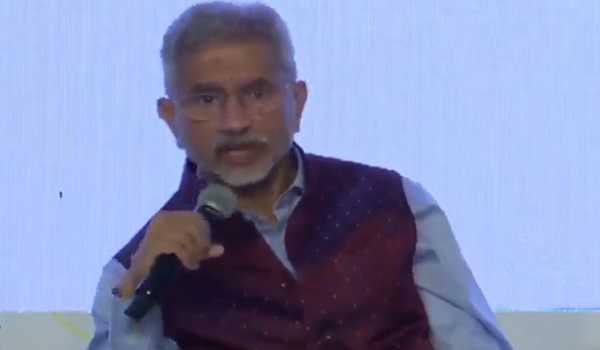

New Delhi: External Affairs Minister S Jaishankar said today that India is engaging with the Taliban regime in Afghanistan because New Delhi wants to help the Afghan people and to keep the relationship with them going.
Answering a question on India’s engagement with the Taliban regime in Kabul, during a talk at the Raisina Young Fellows Alumni, on Wednesday evening, he said:
“Yes, we engage with the Taliban, but there are two points here; one the Taliban is in control in Afghanistan, and two, we would like to do something to help the Afghan people.
“And to help the Afghan people we obviously engage with whoever is in control. Since 2021 they (Afghanistan) went through a huge food crisis, we gave 500,000 tons of wheat; during Covid they had a vaccine crisis, we basically supplied the vaccines; they actually had a locust invasion, we gave the chemicals to deal with the locusts. There is a hospital in Kabul and other places, there are requirements of medicine.
“So there is a practical proposition– if we have goodwill towards the Afghan people do we just stand by and watch them go through a very difficult phase and say ‘well, sorry, there is nothing we can do about it’, or are we both humane and sympathetic and practical about it, and say let’s find a way of helping them.

“I would say we have taken the second course. We would like to keep the relationship with the Afghan people going and that’s really what is driving us.”
In January this year, Foreign Secretary Vikram Misri met the Taliban’s acting foreign minister Amir Khan Muttaqi in Dubai, in what was the first high-level contact between the two sides. India pledged to provide support to Afghanistan for the health sector and for rehabilitating refugees, during the meeting. India has not formally recognised the Taliban regime in Kabul, though India provides humanitarian aid.
On Armenia and Azerbaijan finalising the text of a peace agreement last week, in an effort to end decades old hostilities, the EAM said:
“We have taken the position that if countries have disputes they should try and sort it out through negotiations, without bloodshed; and if they have indeed reached an understanding then we would intuitively, as with any other situation of dispute, we would rather that people discuss and resolve things, than to sort it out on the battlefield. We do stand in favour of peaceful resolution.”