



Key Takeaways
- Saudi Arabia’s nuclear program is sparking controversy due to concerns about nuclear double standards.
- Israel’s nuclear concerns are centered around the potential for a Saudi enrichment capability to trigger a wider regional reaction.
- The implications of a Saudi enrichment capability for the region are significant, with potential consequences for regional security and the emergence of threshold nuclear states.
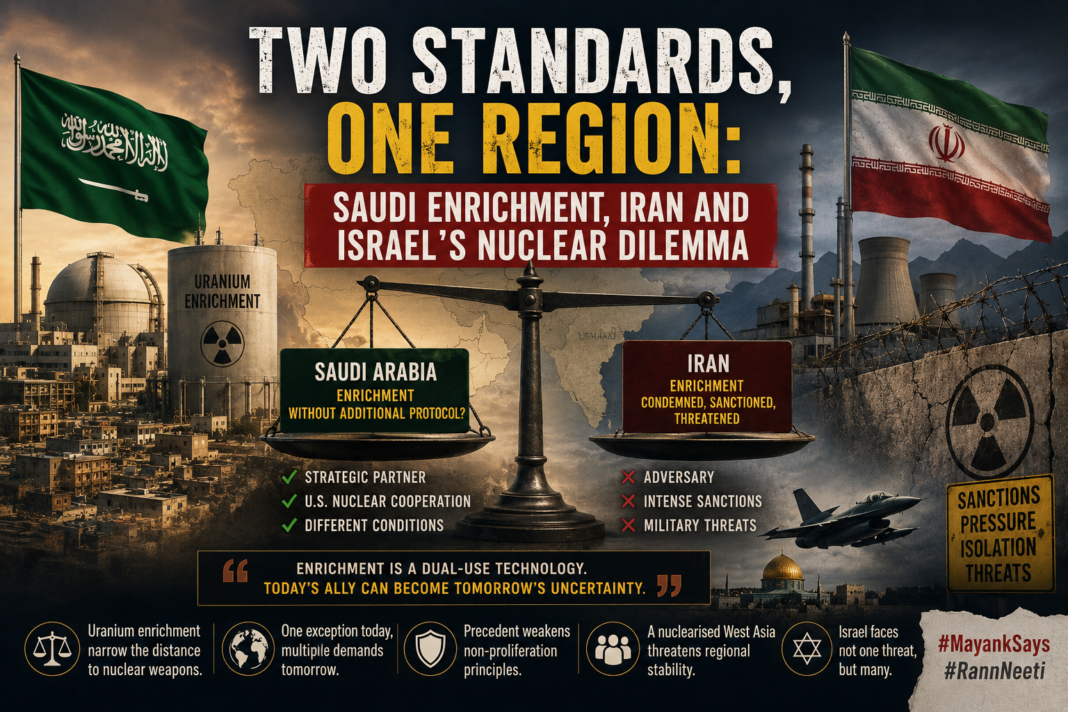
On 19 February 2026, the Trump administration formally notified the U.S. Congress of its intention to pursue a civil nuclear cooperation agreement with Saudi Arabia that would permit domestic uranium enrichment without requiring Riyadh to adopt the International Atomic Energy Agency’s (IAEA) Additional Protocol, the enhanced inspection regime long regarded as the “gold standard” for nuclear safeguards. The move marked a significant departure from previous U.S. non-proliferation policy and immediately reignited debate over whether Washington applies different nuclear standards to allies and adversaries.
The US has raised questions about consistency in global nuclear policy by permitting Saudi Arabia to pursue domestic uranium enrichment without adopting the IAEA’s Additional Protocol.
The issue becomes even more significant when compared with the treatment of Iran.
For years, Iran’s uranium-enrichment programme has been at the centre of sanctions, diplomatic confrontation, covert operations and repeated threats of military action. Israel has consistently argued that Iran must not be allowed to acquire the capability to produce nuclear weapons. The United States, too, has maintained intense pressure on Tehran over the scale of its enrichment, restrictions on inspections and concerns regarding undeclared nuclear activities.
Saudi Arabia, however, appears to be receiving a different kind of consideration.
The reported arrangement does not mean that Riyadh would operate entirely outside international safeguards. Saudi Arabia would continue to remain subject to its basic obligations under the Nuclear Non-Proliferation Treaty (NPT) and IAEA safeguards. The controversy lies in the possibility that it may not be required to adopt the Additional Protocol, which gives the IAEA wider access and stronger verification powers.
This creates an obvious perception of double standards.
Iran is told that enrichment represents a grave proliferation risk. Saudi Arabia may be allowed a similar technological pathway under a politically negotiated framework. The distinction being drawn is therefore not merely between enrichment and non-enrichment, but between an adversary and a strategic partner.
Washington argues that the two cases are fundamentally different. Iran has enriched uranium to levels far beyond normal civilian requirements, has faced longstanding questions over undeclared nuclear material and facilities, and has maintained a deeply adversarial posture towards both the United States and Israel. Saudi Arabia, in contrast, would theoretically operate under a civilian nuclear cooperation agreement with American involvement and international oversight.
Yet the strategic difficulty remains.
Uranium enrichment is a dual-use technology, producing low-enriched uranium for civilian reactors, but also capable of being used to produce weapons-grade material if safeguards weaken. Once a country develops the technical knowledge, trained manpower and industrial base for enrichment, the distance between civilian capability and military potential is significantly reduced.
This is where Israel’s concerns become particularly complex.
In the immediate term, Iran remains Israel’s principal security challenge. Tehran possesses an advanced enrichment programme, a substantial missile arsenal and a network of armed partners and proxies across the region. Its hostility towards Israel has been explicit and sustained. For Israeli planners, the Iranian threat is therefore not theoretical; it is linked to military capability, political intent and an existing regional confrontation.
Saudi Arabia does not pose the same immediate threat.
Riyadh and Tel Aviv have, over the years, found areas of strategic convergence, particularly in countering Iran’s regional influence. There has also been sustained discussion about the eventual normalisation of relations between Saudi Arabia and Israel. From an Israeli perspective, a Saudi nuclear programme linked to a broader security arrangement with the United States could therefore be viewed differently from Iran’s programme.
But that does not eliminate the long-term danger.

A Saudi enrichment capability could trigger a wider regional reaction. Türkiye, Egypt and other regional powers may seek similar rights and technological concessions. Once one major Arab state is permitted to enrich uranium under less demanding verification conditions, it becomes more difficult to deny comparable arrangements to others.
The result could be the gradual emergence of several threshold nuclear states across West Asia, countries that may not possess nuclear weapons but have the infrastructure and expertise to develop them relatively quickly.
For Israel, which has traditionally sought to prevent the emergence of hostile nuclear capabilities in its neighbourhood, such a development would fundamentally alter the regional strategic balance.
The larger danger is not necessarily that Saudi Arabia will immediately seek a nuclear weapon. The real danger is the precedent being created.
If enrichment becomes acceptable for allies but unacceptable for adversaries, non-proliferation policy begins to lose its legal and moral coherence. Countries may conclude that nuclear restrictions are determined not by universal rules but by strategic alignment with Washington.
Iran will undoubtedly use this argument.
Tehran can claim that its nuclear programme is being opposed not because enrichment is inherently unacceptable, but because Iran lies outside the American strategic camp. Such an argument may strengthen hardliners within Iran, weaken advocates of renewed diplomacy and make future nuclear negotiations even more difficult.
For Israel, therefore, the Saudi question presents a strategic dilemma.
On one hand, Israel may see value in a stronger U.S.-Saudi partnership, especially if it contributes to regional alignment against Iran and eventually leads to formal Saudi-Israeli normalisation. On the other hand, accepting Saudi enrichment could weaken the very non-proliferation principles Israel has invoked for decades in opposing Iran.
Israel may therefore seek strict limitations: low enrichment levels, intrusive monitoring, American oversight of sensitive technologies, restrictions on fuel stockpiles and automatic penalties if Saudi Arabia violates the agreement.
Even with such safeguards, however, the political message would remain difficult to contain.
The United States cannot easily argue that enrichment is intolerable in Iran but acceptable in Saudi Arabia without appearing to apply different standards to friends and foes. Strategic circumstances may explain the distinction, but they do not erase the perception of inconsistency.
In the short term, Iran will remain the greater threat to Israel because of its capability, intent and hostile regional posture. In the long term, however, a Saudi enrichment programme could open the door to a broader nuclear competition across West Asia.
That would leave Israel facing not one nuclear challenge, but an entire region moving closer to nuclear threshold status.
The real question, therefore, is not merely whether Saudi Arabia can be trusted today. It is whether the rules being rewritten for Riyadh will still protect regional stability tomorrow.
#MayankSays #RannNeeti