


Key Takeaways
- Lazy comedy is not only lazy but also has a negative impact on audiences.
- The show’s focus on humiliation and public aggression is not only degrading but also sets a bad example for younger audiences.
- We need to talk about the kind of comedy that India’s Got Latent is promoting and how it’s affecting our digital culture.
Look, I get why millions of people hit play on Samay Raina’s India’s Got Latent. In a world filled with heavily scripted TV shows, overly polished YouTube vlogs, and sanitized celebrity interviews, there is something undeniably dynamic about raw, unscripted internet chaos. You tune in, you genuinely have no idea what is going to happen next, and for a few fleeting minutes, it feels like sitting around in a hostel room or a local chai tapri with a bunch of friends just messing about. It is no surprise that the show has completely taken over the Indian internet. Clips are everywhere on Instagram Reels and YouTube Shorts, the viewership metrics are through the roof, and with Season 2 expanding its footprint across major streaming platforms, it feels like the show has become an inescapable pillar of contemporary digital pop culture.
But every single time I try to sit through a full episode, I find myself cringing for all the wrong reasons. After a point, the initial shock value wears off, and you have to pause and ask yourself a serious question: Are we actually laughing at clever, well-crafted humour, or are we just being fed lazy provocation wrapped in a non-stop barrage of curse words? For anyone who actually appreciates the art of comedy or simply values basic conversational decency, the series has become increasingly frustrating to watch. Here is my honest breakdown of why we desperately need to talk about what India’s Got Latent is doing to our digital entertainment culture.
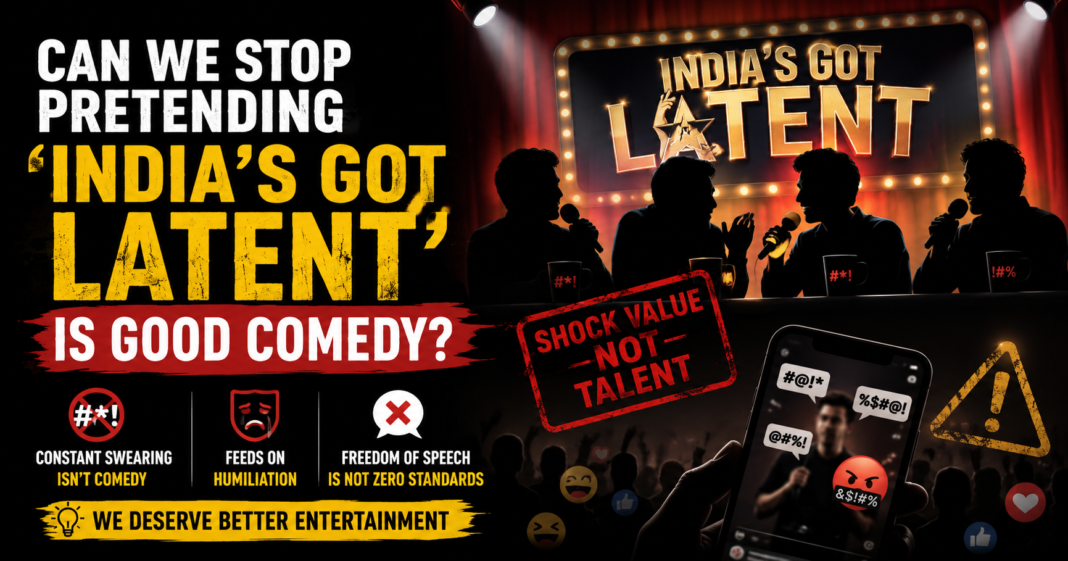
Constant Swearing Isn’t a Punchline; It’s Just Lazy Writing
Let me be clear off the bat: I am no prude. I live in the real world; I know people swear (which one shouldn’t), and I fully recognize that a strategically placed expletive in a stand-up routine can be hilarious when it hits the exact emotional beat of a story (I don’t think it is really necessary). Comedy history is full of brilliant artists who used adult language to punch up against authority or shatter absurd social taboos. However, on India’s Got Latent, cursing isn’t being used as a surgical tool to make a great joke land better. The cursing IS the joke.
Almost every second sentence on that stage is packed with expletives, used almost like filler words by hosts, panelists, and contestants alike because nobody has an actual punchline ready. When you strip away all the aggressive profanity, what is actually left of the comedy? In most segments, absolutely nothing.
Where is the actual craft? Real comedy requires genuine effort. It requires keen observation of human behaviour, sharp scriptwriting, clever wordplay, precise timing, and the ability to subvert an audience’s expectations. Replacing all of that hard work with a stream of unedited verbal abuse feels like an insult to hard-working comedians who spend years honing their craft in quiet comedy clubs.
It becomes utterly exhausting. When every single dialogue is laced with hostility and vulgarity, it loses its edge. Instead of feeling rebellious or cool, it becomes noisy and exhausting. This kind of comedy is not only lazy but also has a negative impact on audiences. Worse yet, as these clips circulate endlessly among teenagers’ feeds, it normalizes verbal aggression as a default conversational tone for younger audiences who copy what they see online. If a performer needs to shout five expletives in ten seconds just to coax a nervous reaction out of the room, that isn’t unfiltered artistic freedom; it is simply a lack of comedic writing.
The Show Feeds on Humiliation, Not Genuine Talent
The show’s premise is to give ordinary people a platform to showcase their talents. However, the reality is that the show focuses on humiliation and public aggression rather than genuine talent. But let’s be completely honest with ourselves: virtually nobody is tuning into this show to witness genuine artistic talent. Instead, the structure functions much more like a modern, digital arena where everyday individuals walk onto a stage, only to be verbally torn apart or encouraged to say something completely unhinged for fifteen fleeting seconds of internet fame. We have essentially created a content ecosystem that rewards the worst instincts of human nature:
1. An auditionee steps up and delivers a bizarre, toxic, or offensive statement.
2. The celebrity panel reacts with dramatic shock, disgust, or ruthless roasts.

3. The show editors slice that interaction into a bite-sized ragebait clip for Instagram and YouTube.
4. The video accumulates millions of views, the creator gets his engagement metrics, and the internet community becomes just a little bit more cynical.
It feels like we are actively encouraging people to behave like their worst, most disrespectful selves on camera purely so the audience can laugh at them rather than with them. When did publicly mocking and degrading strangers become our primary form of weekend relaxation?
Freedom of Speech Is Not an Excuse for Zero Standards
Whenever anyone raises legitimate concerns about content like this, the standard internet response is predictable: “If you don’t like it, just don’t watch it!” or “Stop being soft, it’s just freedom of expression!”
To be clear, Samay Raina and his fellow creators have every legal right to make whatever content they choose within platform guidelines. Nobody is calling for censorship, bans, or government intervention. But having the right to say whatever you want does not automatically mean that what you are saying is good, clever, or worthy of applause.
The Media Reality: Entertainment never exists in a vacuum. The media we consume on a daily basis actively shapes our social norms, our patience levels, and our empathy for others. When the most popular show on the Indian internet relies heavily on screaming profanities, mocking contestants’ backgrounds, and promoting shock value, it subtly sets the tone for how people interact in real life. It sends a message that being unnecessarily aggressive and vulgar is the easiest way to sound interesting.
We Deserve Better Entertainment
At the end of the day, my critique isn’t born out of hatred for the creators. They are obviously smart marketers who understand exactly how modern social media algorithms work. But as audiences, we have a responsibility to hold the media we consume to higher standards. Indian internet culture is overflowing with brilliant, witty, and deeply creative minds. We have proven that we can produce comedy that is bold, raw, and completely unscripted without letting it degenerate into a shouting match of cheap insults and endless curse words.
Spontaneity does not have to mean vulgarity, and authenticity does not require hostility. It is entirely possible to create hilarious, groundbreaking content while still maintaining a basic level of respect for the audience’s intelligence. The next time one of those sensationalized clips pops up on your feed, maybe it is time to just scroll past. By refusing to give our clicks to cheap shock value and choosing to support creators who put actual thought into their craft, we send an unmistakable message: true comedic talent never needs a crutch of crude swearing to make an impact.