


Key Takeaways
- ISIS and Al Qaeda are using online platforms to recruit and radicalise individuals in India.
- The National Investigation Agency (NIA) is playing a crucial role in countering online radicalisation in India.
- Online radicalisation is a significant threat to national security in India.
There was a time when India looked towards its borders to identify the next terrorist threat. Today, the border is no longer geographical. It is digital.
The latest findings of the National Investigation Agency (NIA) should concern every Indian. Intelligence agencies have identified a growing pattern of online radicalisation by both the Islamic State (ISIS) and Al Qaeda in the Indian Subcontinent (AQIS), with recruitment efforts concentrated across Karnataka, Kerala, Tamil Nadu, Telangana, Andhra Pradesh and parts of Maharashtra. Despite being global rivals, both organisations have converged on one strategy – turn the internet into India’s newest recruitment ground.
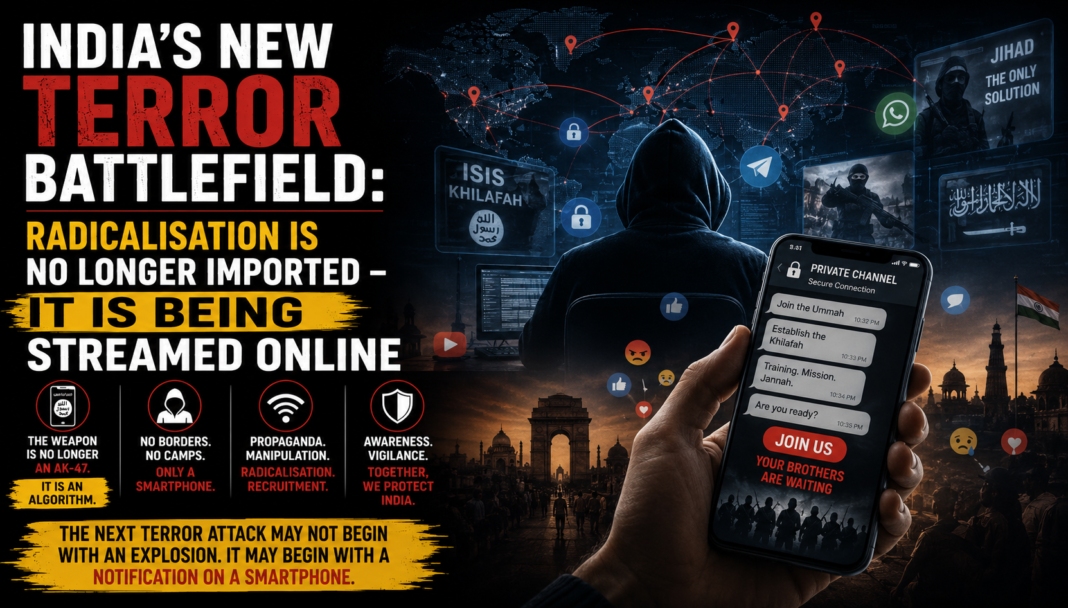
The weapon is no longer an AK-47.
It is an algorithm.
The most compelling example is the Shahnawaz Alam-Arshad Warsi ISIS module, busted by the Delhi Police Special Cell in 2023 before the investigation was transferred to the NIA. Shahnawaz Alam, an engineer by profession, along with Mohammad Arshad Warsi and Mohammad Rizwan Ashraf, allegedly pledged allegiance to ISIS and came under the influence of ISIS India chief Saquib Abdul Hamid Nachan. Investigators recovered IED-making material, explosives manuals, extremist literature and digital evidence showing extensive online communication with ISIS handlers. According to the NIA, the accused were consuming and distributing ISIS publications such as Voice of Hind, Dabiq, Rumiyah and Khilafat, while planning terrorist attacks and scouting hideouts across Maharashtra, Karnataka and Gujarat.
This was not a group that travelled to Syria.
Syria came to them through Telegram, encrypted chat rooms and digital propaganda.
The Shahnawaz case is not an isolated incident.
In Kerala’s Omar Al-Hindi module, one of India’s earliest major ISIS investigations, the NIA uncovered a conspiracy involving radicalised youth from Kerala and Tamil Nadu who allegedly planned attacks on important public places in South India. The module operated through Telegram, Facebook and WhatsApp, proving nearly a decade ago that ISIS had already shifted its focus from physical recruitment to online indoctrination.
The Nagpada ISIS case in Mumbai revealed another disturbing trend. According to the NIA, young men were allegedly indoctrinated into extremist ideology by individuals from Kerala and members associated with radical networks before being motivated to join ISIS. Again, investigators found that digital communication and online propaganda played a central role in the recruitment chain.
Then came the Padgha ISIS module in Maharashtra.
The NIA alleges that Saquib Nachan and his associates attempted to establish what they described as a “liberated zone” or “Al Sham” in Padgha, where recruits allegedly took bayath – an oath of allegiance to ISIS. Raids uncovered weapons, cash, digital devices and propaganda material, while investigators found evidence that the module was recruiting, training and preparing members for violent jihad.
The internet was not merely facilitating communication.
It had become the organisation.
Tamil Nadu has witnessed similar patterns.
The NIA’s investigation into the ISIS radicalisation network linked to Coimbatore found that extremist ideology was allegedly disseminated through Zoom lectures, WhatsApp groups and Telegram channels masquerading as religious education. Former students were allegedly radicalised through online classes before moving further into extremist networks.
In another Tamil Nadu case, the NIA chargesheeted A. Alfasith, alleging that he downloaded ISIS propaganda from Telegram channels and redistributed it through WhatsApp and encrypted groups such as “Islamic State” and “Black Flag Soldiers” to radicalise young Muslims.
Even overseas employment has become a recruitment opportunity.
The NIA investigation into Hamraz Worshid Shaikh found that he was allegedly radicalised through an Instagram account while working in Saudi Arabia. According to investigators, he returned to India with instructions to recruit vulnerable youth for Taliban-linked organisations and facilitate their movement for terrorist training.
The pattern is unmistakable.
No training camp.
No border crossing.
No physical recruiter.

Only a smartphone.
Even Al Qaeda has adopted the same strategy.
In January 2026, the NIA chargesheeted five accused in Gujarat for allegedly operating an AQIS online radicalisation network. According to investigators, they used social media to circulate videos, speeches and propaganda calling for armed revolt against India and the establishment of a Caliphate. One accused allegedly maintained contact with a Pakistani national while another distributed extremist literature through private online groups.
This is why the latest intelligence warning is so significant.
For years, analysts believed ISIS and Al Qaeda competed for recruits.
Today, both are fishing in the same digital waters.
The targets are remarkably similar – educated youth, engineering students, software professionals, medical graduates and technologically skilled individuals. Contrary to popular assumptions, radicalisation is rarely driven by poverty. Many of those arrested in recent years were well educated and came from stable families.
What they shared was prolonged exposure to extremist narratives online.
India’s security agencies have adapted admirably. The NIA, Intelligence Bureau, Delhi Police Special Cell, state ATS units and cyber-forensic teams have repeatedly dismantled ISIS and AQIS modules before they could execute attacks. Their success has undoubtedly prevented countless tragedies.
But every arrest also exposes a failure.
Someone had already been radicalised.
Counter-terrorism can no longer begin with an arrest.
It must begin with prevention.
Parents should know what encrypted platforms their children are using. Schools and universities must teach digital literacy alongside civic responsibility. Religious scholars must continue exposing the theological fraud of ISIS and Al Qaeda. Technology companies must cooperate with lawful investigations while preserving legitimate privacy.
Because today’s terrorist recruiter no longer knocks on a door.
He sends a link.
He shares a video.
He invites someone into a private Telegram channel.
And by the time the family notices, the indoctrination may already be complete.
India has successfully built fences along its borders.
It is now time to build intellectual and digital firewalls around its young minds.
The next terror attack may not begin with an explosion.
It may begin with a notification on a smartphone.