
Key Takeaways
- Gen Z expects authenticity, not authority.
- BJP needs credible young leaders who understand the aspirations and anxieties of their own generation.
- Gen Z leadership is becoming politically essential for the BJP’s success.
The Bharatiya Janata Party (BJP) has built the world’s largest democratic political organisation. It has transformed India’s political landscape through governance, organisation and communication. Yet, if there is one challenge that demands urgent introspection, it is this: the BJP is fighting a Generation Z information war with a Millennial communication strategy. That is a strategic mistake.
India is no longer just a young country; it is becoming a country where young voters will increasingly determine political outcomes. During the 2024 General Election, India had 96.88 crore registered voters, including more than 2 crore newly enrolled voters aged 18-29, while 1.84 crore were first-time voters aged 18-19.
More importantly, nearly 210 million voters between 18 and 29 years of age accounted for around 22% of the electorate. That is a voting bloc larger than the population of most countries in the world. Ignoring this demographic is not an option. Misunderstanding it is even more dangerous.
Generation Z is fundamentally different from Millennials. Millennials witnessed India’s digital revolution. Gen Z was born into it. Their political education is shaped less by newspapers and television debates and more by Instagram Reels, YouTube Shorts, podcasts, gaming communities and online creators.
According to Digital 2024, India had over 751 million internet users at the beginning of 2024, with a median age of 28.4 years, making India one of the youngest and most digitally connected societies in the world. Political communication has therefore changed forever. Narratives today are not built over weeks.They are built in minutes.
A viral reel often reaches more young Indians than a political rally. A meme can shape public opinion more effectively than a press conference. An influencer with credibility can outperform a seasoned television spokesperson.
The Opposition has recognised this transformation much faster than many within the BJP.
Across social media, a persistent narrative is being pushed that the Modi Government does not understand the aspirations of Gen Z. Whether the issue is employment, examinations, artificial intelligence, student concerns or the cost of living, individual grievances are quickly amplified into a broader political story that claims the government has failed young India.
The strength of this narrative does not necessarily lie in facts. It lies in relatability.
The BJP often responds with experienced spokespersons who communicate exceptionally well to television audiences. But television is no longer where political opinions are formed among first-time voters.
Gen Z expects authenticity, not authority. This is where the BJP needs a strategic reset. The party does not require more social media campaigns. It requires more Gen Z leadership. Not symbolic youth appointments. Not carefully scripted influencers. Not token representatives.
It needs credible young entrepreneurs, engineers, startup founders, AI researchers, creators, sportspersons, policy professionals and student leaders who naturally understand the aspirations and anxieties of their own generation.

Young Indians do not merely want to hear about GDP growth.They want to know how India’s economic transformation creates opportunities for them. Ironically, the BJP has an impressive governance story to tell.
India has become one of the world’s fastest-growing major economies. The country has expanded its digital public infrastructure, become the third-largest startup ecosystem globally, accelerated semiconductor manufacturing, promoted AI innovation, expanded infrastructure and strengthened manufacturing through initiatives like Make in India.
Yet these achievements are often communicated as government programmes rather than as stories of young Indians succeeding because of them. Communication is no longer about information. It is about identification.
Data from post-election analyses of the 2019 Lok Sabha election showed that youth voters were instrumental to the BJP’s electoral success, with an estimated 41% of young voters supporting the BJP, contributing significantly to its national lead. That support cannot be taken for granted.
Every political generation rewrites its priorities.
Today’s 20-year-old has little memory of pre-2014 India. Their political benchmark is not the past; it is their expectation of the future.This is why governance alone is insufficient.
Governance must be translated into a language that resonates with those who will inherit India’s future.
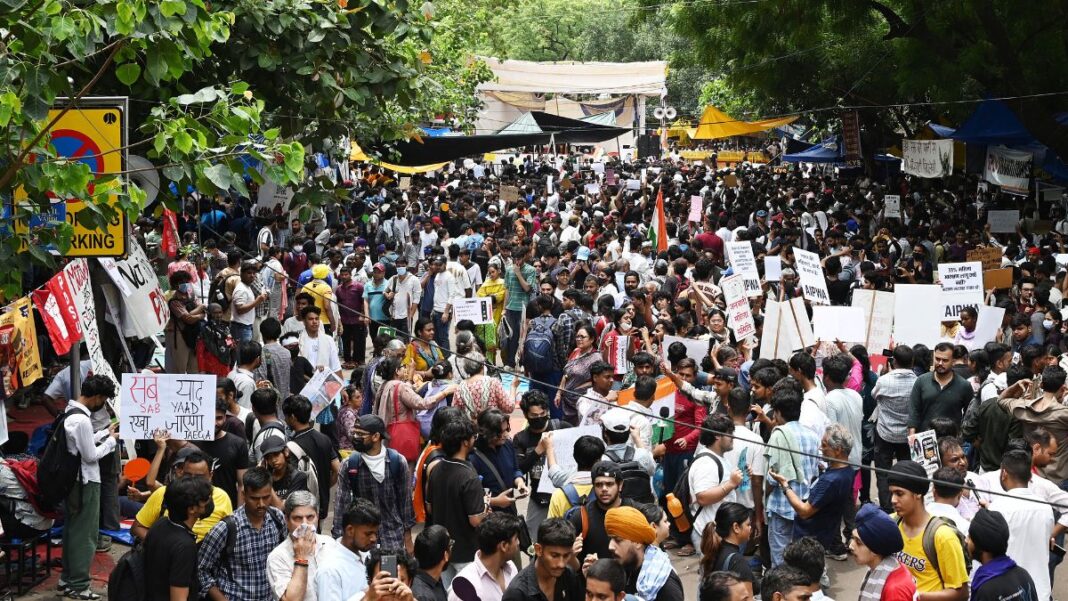
The recent rise of youth-led digital protest movements, regardless of one’s opinion of them, demonstrates how rapidly Gen Z can mobilise online and shape the national conversation. Even within the BJP, there is increasing recognition that stronger youth outreach and Gen Z engagement are becoming politically essential.
The BJP should therefore create a structured Gen Z leadership ecosystem across campuses, startups, creator communities and professional networks. Young leaders should not merely campaign during elections; they should become year-round ambassadors explaining public policy, innovation, entrepreneurship and governance in the language of their generation.
Prime Minister Narendra Modi has often described India’s youth as the nation’s greatest strength. The next phase must be to trust that generation with leadership.
Because Gen Z does not want politics delivered to them. They want it discussed with them. And in the digital age, the most persuasive voice is rarely the loudest. It is the one that sounds like your own.