
Key Takeaways
- FCRA is a battleground for India’s sovereignty.
- The proposed amendments to FCRA have sparked a global discussion.
- Representative Riley Moore has criticised the proposed amendments, warning of potential consequences for India-US relations.
- Transparency is key to protecting India’s sovereignty from foreign influence.
- Foreign funding can be an instrument of geopolitical influence if not regulated.
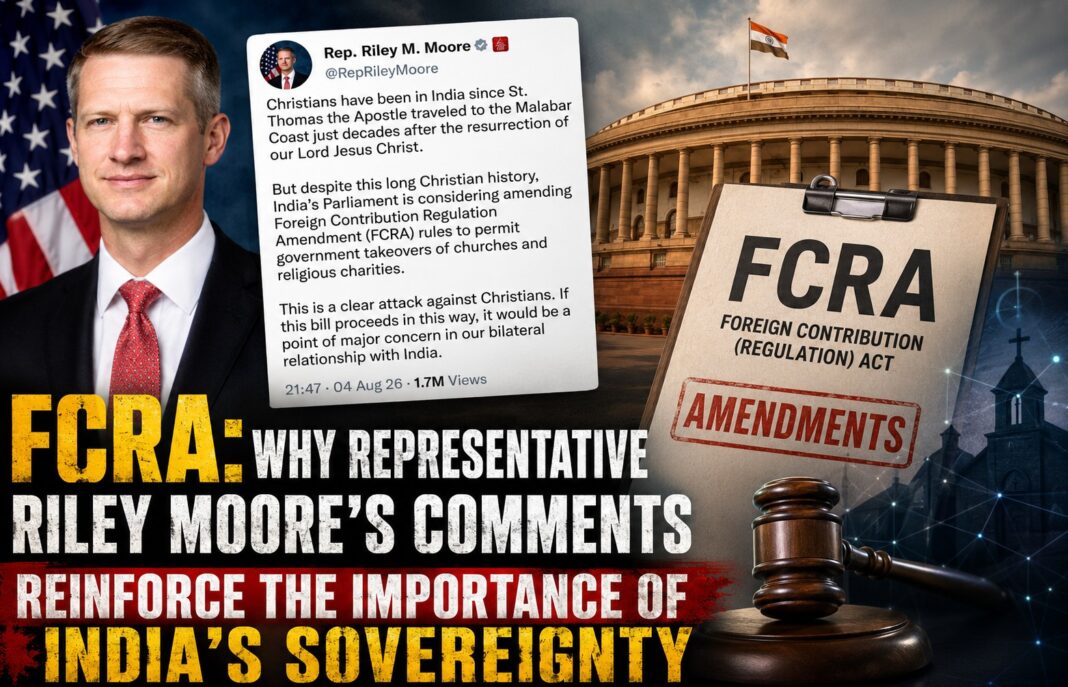
The debate surrounding India’s proposed amendments to the Foreign Contribution (Regulation) Act (FCRA) has now crossed India’s borders. What is supposed to be viewed primarily as a domestic legislative issue has entered the arena of international politics. That reality became unmistakably clear when US Representative Riley Moore publicly criticised the proposed amendments, describing them as “a clear attack against Christians” and warning that, if enacted, they “would be a point of major concern in our bilateral relationship with India.”
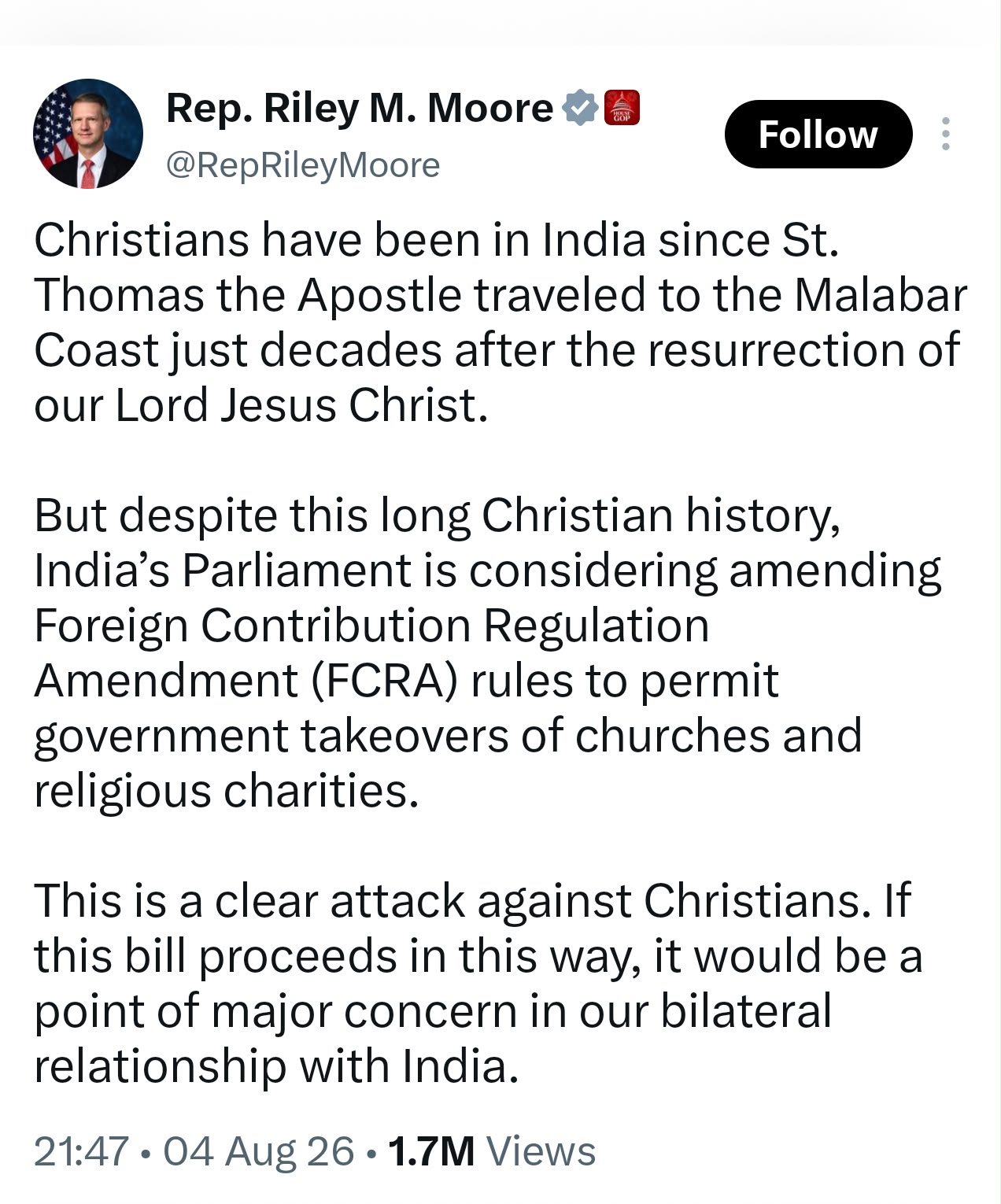
Whether one agrees with Representative Moore’s characterisation of the legislation is beside the point. What is significant is that a sitting member of the United States Congress has publicly commented on India’s sovereign legislative process and linked it to the future of India-US relations. For me, this vindicates an opinion I have consistently held for years: the FCRA is not merely a regulatory law – it is one of the principal battlegrounds on which India’s sovereignty is being tested.
Every sovereign nation has both the right and the responsibility to regulate foreign financial influence within its borders. The United States has the Foreign Agents Registration Act (FARA). Australia has the Foreign Influence Transparency Scheme Act. Several European democracies regulate foreign political funding and external influence in various forms. India is no different. The FCRA exists to ensure that foreign contributions entering the country remain transparent, accountable and consistent with India’s constitutional framework and national security interests.
Contrary to the narrative often presented internationally, the FCRA is not a law designed to suppress charitable work or legitimate civil society activity. It is a law intended to ensure that foreign money is not used to influence India’s political processes, public discourse, religious harmony or democratic institutions in ways that are inconsistent with Indian law.
Representative Moore’s comments demonstrate precisely why this legislation matters. His criticism did not merely express concern over the functioning of NGOs or religious organisations. He went further by suggesting that India’s proposed amendments could affect bilateral relations between two sovereign democracies.That raises an important question.
Why should India’s Parliament be expected to shape domestic legislation based on the political preferences of foreign lawmakers?
Every democracy is entitled to debate its laws internally. Parliament exists to represent the will of the Indian people – not foreign governments, foreign legislatures or international advocacy groups. Constructive dialogue between nations is healthy and necessary. However, linking India’s domestic legislative choices to diplomatic consequences inevitably creates the perception of external political pressure. It is precisely to insulate India’s institutions from such influence that the FCRA assumes strategic importance.
For years, India has strengthened compliance under the Act. Thousands of FCRA registrations have expired, been cancelled or not renewed because organisations failed to meet statutory requirements or regulatory standards. Some of these decisions have been challenged in court. Others remain politically contested. That is entirely consistent with how democratic systems function.
What often receives far less attention is the broader principle underlying these actions. The issue is not whether foreign funding is inherently good or bad. The issue is whether the India has the ability to know who is funding organisations operating within its territory, what those funds are intended to achieve, and whether those funds are being used in ways that influence public policy, political mobilisation or social stability.
Transparency is not the enemy of democracy. It is one of its foundations.
History offers numerous examples of major powers pursuing strategic objectives beyond their borders through diplomacy, development assistance, media engagement, financial support and civil society partnerships. None of this automatically implies wrongdoing. International cooperation has produced extraordinary benefits in education, healthcare, disaster relief and poverty alleviation.
At the same time, history also demonstrates that foreign funding can become an instrument of geopolitical influence if transparency and accountability are absent.
India would be naive to assume that it is immune from such realities.
As India emerges as one of the world’s fastest-growing major economies and an increasingly influential geopolitical power, it is only natural that external actors seek to shape developments within the country. That is not unique to India; it is a reality faced by every nation with strategic significance.

This is why I have often drawn attention to broader regional developments.
In Bangladesh, political unrest unfolded amid allegations by former Prime Minister Sheikh Hasina regarding foreign interests and external influence. Those allegations remain disputed, and I do not present them as established fact. However, the sequence of events illustrates how domestic politics and international geopolitics can become intertwined.
Nepal offers another example. Constitutional debates, foreign-funded development programmes and competing geopolitical interests have repeatedly shaped public discourse and political outcomes. Analysts continue to debate the extent of external influence, but few would deny that Nepal has become an arena of strategic competition among larger powers.
India should study these developments carefully – not because the circumstances are identical, but because they demonstrate how domestic political issues can acquire geopolitical dimensions.
Representative Riley Moore’s intervention is another reminder that India’s FCRA is being watched far beyond its borders.
Some people will disagree about the proposed amendments. Some will believe the legislation is necessary to strengthen transparency. Others will fear that it places excessive restrictions on religious or charitable organisations. Such disagreements are both inevitable and healthy in a democracy.
What should concern every Indian, however, is the principle that India’s sovereign legislative choices must ultimately be determined by India’s constitutional institutions – not by external political pressure.
Foreign governments are entitled to express opinions. India is equally entitled to legislate in accordance with its own national interest.Those two principles are not contradictory. They are fundamental to the concept of sovereign equality between nations.
For me, the FCRA debate has never been solely about NGOs, churches or foreign donations. It is about whether India retains the sovereign authority to determine the rules governing foreign financial influence within its own borders. That authority belongs to the people of India through their elected Parliament. No democracy worthy of the name can surrender that responsibility.
Representative Riley Moore’s comments, whether intended as advocacy or diplomacy, have inadvertently reinforced why the FCRA occupies such an important place in India’s national security architecture. The fact that proposed amendments to a domestic financial transparency law have become the subject of political debate in Washington demonstrates that the legislation carries significance well beyond regulatory compliance.
India should not respond with hostility to international criticism. Democracies benefit from open debate and differing viewpoints. But neither should India dilute legislation designed to safeguard transparency, accountability and sovereignty merely because it attracts criticism abroad.
The stronger India’s institutions become, the greater the scrutiny they will face. That is the price of becoming a consequential global power.
For that very reason, India must remain confident in defending laws that protect the integrity of its democratic institutions while ensuring they are implemented fairly, transparently and within the framework of the Constitution.
The FCRA is not simply another Act of Parliament. It is one of the instruments through which India asserts that decisions affecting its democracy, its society and its future will ultimately be made in New Delhi – not anywhere else.