


Baghdad: The Iraqi federal government and the semi-autonomous Kurdistan regional government signed an agreement on Tuesday to resume Kurdish oil exports via Türkiye after a hiatus of several days.
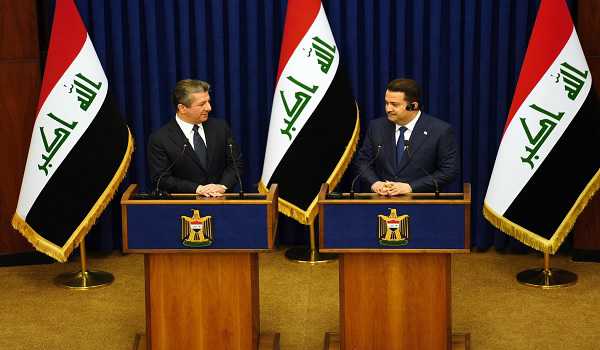
Iraqi Prime Minister Mohammed Shia’ al-Sudani held a meeting with the Kurdistan regional Prime Minister Masrour Barzani and his accompanying delegation, during which the two sides expressed the desire to find solutions for all outstanding problems in a professional spirit, al-Sudani’s office said in a statement.
After the meeting, the Iraqi Federal Oil Ministry and the Kurdistan regional Ministry of Natural Resources signed the agreement under which the export of crude oil from the region and Kirkuk province will be resumed.
Later at a joint press conference with Barzani, al-Sudani said that the agreement is a temporary deal until the approval of the draft federal budget by the parliament.

“The budget draft law is clear and solves all pending problems between Baghdad and Erbil. The budget draft will include a fair distribution of wealth to all of Iraq,” al-Sudani said.
For his part, Barzani said that the deal is a decisive step toward ending the long-running dispute between Erbil and Baghdad and “creating a positive and safe atmosphere for the final approval of the national oil and gas law.”
“I would like to reassure all parties that this agreement is a prelude to reaching a good comprehensive agreement between the federal government and the Kurdistan government,” Barzani said.
Last month, Iraq stopped sending nearly half a million barrels of oil through the pipeline via Türkiye after winning an arbitration case against Türkiye over a long dispute on the independent export of oil by the Kurdish regional government.