


Baghdad: Iraqi lawmakers elected Abdul Latif Rashid as the new president of Iraq, marking a crucial step toward forming a new government for the country, the parliament said.
Rashid received 162 votes in the second round of voting, defeating Barham Salih who gained 99 votes, while eight votes were considered invalid, according to the media office of the parliament on Thursday.
In the first round of voting, none of the 39 presidential candidates garnered two-thirds of the votes of the total 329 parliament members, but Rashid got 156 votes and Salih came in second with 99 votes.
According to the Iraqi constitution, the president-elect needs to gather at least two-thirds of the votes of the 329 parliament members. Failing that, the two candidates with the highest number of votes shall compete with each other in a second round, and the one receiving the majority of votes shall be declared the president of Iraq.
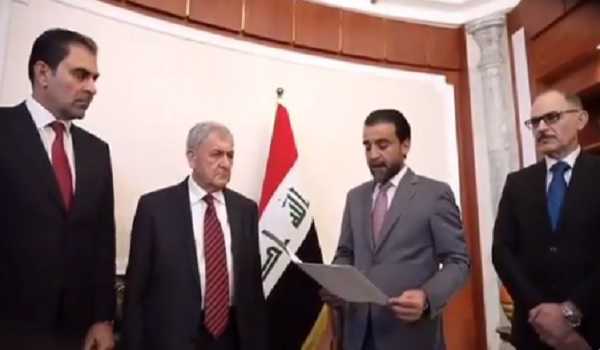
The newly-elected Rashid was later sworn in as the President of Iraq, the fifth president of the country since 2003.
After the parliament session, Rashid tasked Mohammed Shia’ al-Sudani with forming a new government as al-Sudani was nominated by the Coordination Framework (CF), the largest parliamentary alliance and an umbrella group of Shiite parliamentary parties.

Al-Sudani, now as the prime minister-designate, will have 30 days to form the new government, according to the constitution.
Abdul Latif Rashid, 78, is a veteran Kurdish politician born in the city of Sulaimaniyah in northeastern Iraq. He worked as Minister for Water Resources from September 2003 to December 2010.
He is an active member of the Patriotic Union of Kurdistan (PUK) under the leadership of Jalal Talabani, who became president of Iraq in 2005.
Rashid was formerly a spokesperson for the PUK in Britain, where he received a bachelor’s degree in civil engineering in 1968 from Liverpool University, a master’s degree in 1972, and a doctorate in Engineering from Manchester University in 1976.
Rashid’s election as president came as political tensions have been rising in the past months between the Shiite cleric Moqtada al-Sadr’s Sadrist Movement, the biggest winner in the parliamentary elections in 2021, and its rivals in the CF alliance.
Al-Sadr demanded to dissolve parliament and hold early elections, but it was rejected by the CF parties, which became the largest bloc after al-Sadr ordered his followers to withdraw from the parliament in June.