


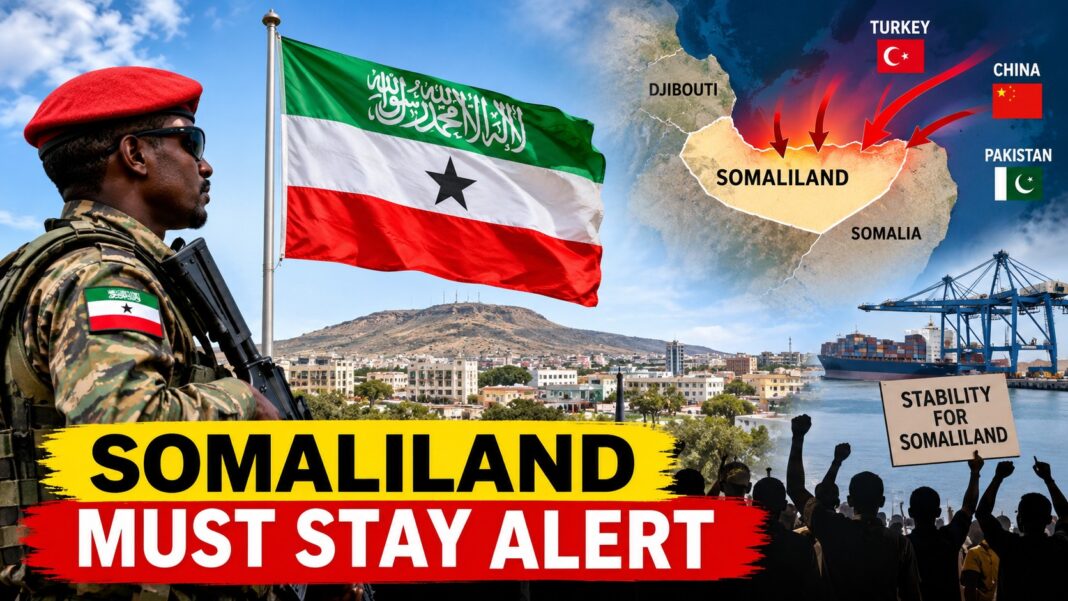

As Somaliland presses for wider recognition as a sovereign nation, outside actors may seek to foment trouble within its borders and use the resulting instability to stall its diplomatic and economic progress. In my assessment, the first signs could emerge in contested border areas before the political fallout reaches major towns and Hargeisa. A local confrontation can become a national crisis if civilians are harmed, rumours outrun verified information and communities lose confidence in the government’s ability to respond fairly.
Israel’s recognition of Somaliland on 26 December 2025 changed the diplomatic stakes. Hargeisa now has a precedent to build on. Somalia and its supporters moved quickly to oppose the decision, and the African Union Assembly condemned it in February 2026. Governments considering their own position will be watching how Somaliland manages its internal disputes. Those seeking to delay recognition could point to recurring unrest as a reason to keep the question off the table.
Somalia, Djibouti and Turkey warrant particular attention. In August 2026, Somaliland’s interior minister, Abdalle Mohamed Carab, publicly accused all three of external interference linked to the conflict in Awdal and Salal.
Mogadishu has the clearest political incentive to prevent further recognition. It convened support through the Organisation of Islamic Cooperation after Israel’s decision and has recognised the North-East State as Somalia’s sixth federal member state. That move gave its competing claim to territories in Somaliland’s east a formal place in Somalia’s federal system. I expect Mogadishu to keep pressing its case abroad while cultivating political ties in disputed areas. The risk for Hargeisa is that local disputes become harder to settle once competing authorities see political advantage in keeping them open.
On the western flank, Djibouti’s proximity to Awdal and its cross-border ties make its role especially consequential. An Austrian country report published in November 2026 cites assessments alleging that some local groups received foreign funding to stir unrest and names Djibouti among the outside actors reported to be active. Djibouti’s government denied an earlier Somaliland allegation that it supported an anti-Hargeisa movement in Awdal. Those claims need to be weighed alongside documented local disputes, including clashes around Zeila and Lughaya and a deadly confrontation between protesters and security forces in Borama. Any serious effort to restore calm must reckon with the grievances of the people who live there.

Turkey’s influence comes from the depth of its relationship with Somalia. Ankara chaired the January 2026 OIC meeting that condemned Israel’s recognition. Under a ten-year defence and economic cooperation agreement, it has undertaken to help build, train and equip Somalia’s navy. That partnership gives Turkey a direct interest in how authority over the coastline is contested and settled. Somaliland’s interior minister accused Turkey of interfering in the western regions of Awdal and Salal and exploiting local tensions to undermine peace efforts
China and Pakistan are part of the diplomatic pressure. Beijing publicly rejected Israel’s decision and reaffirmed its support for Somalia’s territorial integrity. Islamabad signed the December statement opposing recognition and reiterated its position at the January OIC meeting.
The risk of unrest spreading from contested districts to towns is already visible in the record. The European Union Agency for Asylum, citing ACLED, recorded 64 security incidents and 96 fatalities in Awdal between April 2025 and March 2026. If fresh clashes claim civilian lives and the authorities fail to establish what happened, anger can travel well beyond the communities directly affected. An outside actor seeking to weaken Somaliland could exploit that distrust. Hargeisa’s response in the first days of a crisis could determine whether the dispute stays local or draws the rest of the country into it.
The economic cost may become apparent before trade is visibly disrupted. Berbera’s first expansion raised annual container-handling capacity from 150,000 to 500,000 twenty-foot equivalent units, according to DP World. The wider gains depend on businesses putting money into transport, warehousing and related services. A shipping terminal can remain open while lenders tighten terms, companies postpone site visits and investors defer decisions. Those delays mean fewer jobs and less revenue, particularly for communities still waiting to see what economic growth will deliver for them.
Somaliland must investigate credible allegations of foreign interference, protect civilians and keep dialogue open with communities in contested areas. It must also hold its own institutions to account when their actions deepen a crisis. The most damaging outcome would be for a local dispute to harden into a national rupture while investors quietly withdraw and potential diplomatic partners decide to wait. Somaliland can protect its case for sovereignty by showing, under pressure, that it can resolve disputes, govern fairly and give its people a stake in the prosperity it seeks.