


Key Takeaways
- Bollywood personalities and celebrities often align themselves with anti-establishment campaigns, which can slip into anti-state narratives.
- Information warfare and cyber operations play significant roles in strategic competition in the age of hybrid warfare.
- Digital mobilisation and public perception are shaped rapidly in the age of hybrid warfare, often within hours.
The appointment of a new police chief is a significant event in the national security architecture, reflecting the State’s assessment of threats that lie ahead. These appointments are rarely routine, and instead, they often signal the State’s response to emerging challenges. It is against this backdrop that the appointment of Mr Anurag Kumar, former Special Director of the Intelligence Bureau, as the new Commissioner of Delhi Police deserves careful examination.
The appointment assumes even greater significance because it comes at the expense of Mr Satish Golcha, who was relieved of his responsibilities nearly nine months before his scheduled retirement, an unusually early transition for a police chief heading one of the world’s most sensitive policing jurisdictions. The Ministry of Home Affairs has offered no official explanation for the change, and therefore any definitive conclusion would be speculative. Nevertheless, governments seldom make such leadership changes without weighing the strategic environment in which the officer will function.
Delhi is unlike any other city in Bharat.
It houses Parliament, the Supreme Court, Rashtrapati Bhavan, the Prime Minister’s Office, the residences of constitutional authorities, over a hundred diplomatic missions, strategic military establishments, and the headquarters of numerous national institutions. A disruption in Delhi is never merely a local law-and-order issue. It carries diplomatic, economic and geopolitical consequences.
The Commissioner of Delhi Police plays a critical role in India’s internal security architecture, overseeing a complex and sensitive policing jurisdiction. Delhi’s policing is a key component of India’s internal security, with significant implications for national stability.
Over the last decade, Delhi has repeatedly emerged as the epicentre of prolonged public mobilisations, from the Shaheen Bagh protests and the farmers’ agitation to more recent demonstrations by the Cockroach Janta Party. Each differed in origin, leadership and demands. Yet each also demonstrated how rapidly a local issue can evolve into a national political narrative.
For any democracy, peaceful protest remains a constitutional right. That principle must remain inviolate.
Equally, every constitutional democracy carries the responsibility of ensuring that legitimate dissent is not exploited by unlawful actors seeking violence, disruption or destabilisation. The challenge for the State is therefore not to suppress dissent but to identify when legitimate democratic mobilisation is being manipulated for objectives beyond those originally articulated by protesters themselves.
This distinction has become increasingly difficult in the twenty-first century.
Today’s battles are no longer confined to borders.
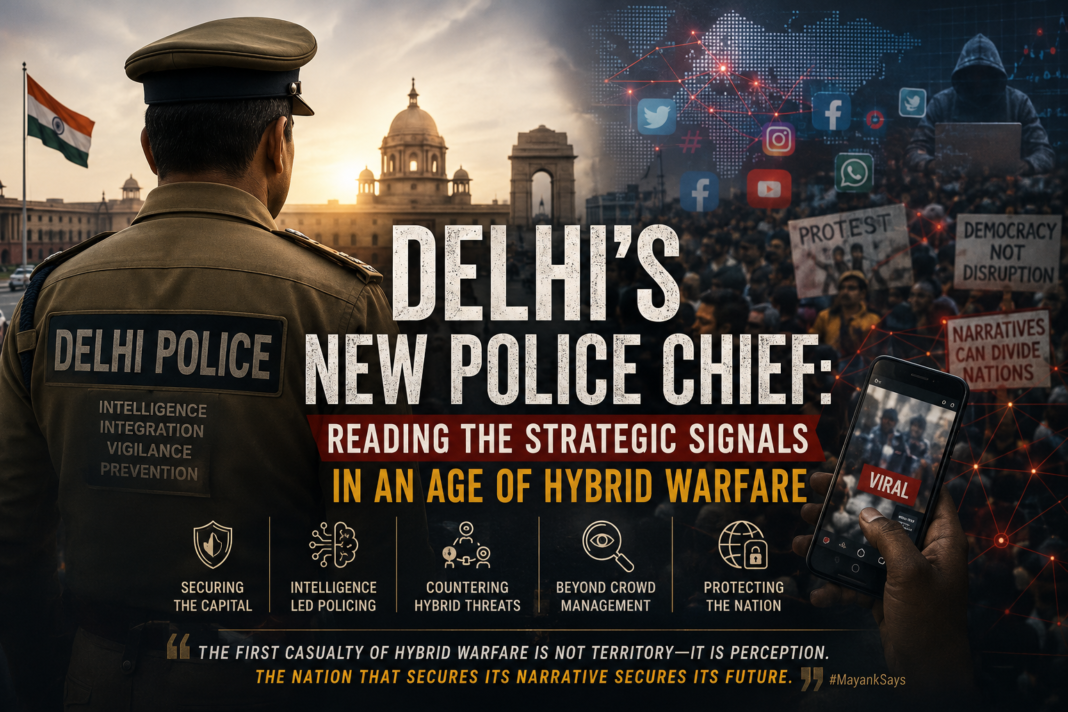
Military strategists across the world increasingly describe the present era as one of hybrid warfare, where military power is only one component of national competition. Information warfare, cyber operations, economic coercion, psychological influence, narrative manipulation and social polarisation have become equally potent instruments of strategic competition.
The objective is no longer necessarily territorial conquest.
The objective is to weaken institutions, diminish public confidence, polarise society and compel governments to expend enormous political and administrative resources in managing internal crises.
South Asia itself offers compelling illustrations.
Bangladesh’s political upheaval demonstrated how sustained street mobilisation, digital communication and public narratives combined to reshape the country’s political trajectory. Nepal has repeatedly witnessed periods of prolonged street agitation in which social media became a powerful organising tool. While every country’s domestic circumstances are unique, security professionals study these developments because they reveal how rapidly political momentum can accelerate when digital ecosystems reinforce physical mobilisation.
This is precisely where Delhi’s experience assumes significance.
Every major agitation today unfolds simultaneously in two domains.
The first is physical.
The second, and perhaps the more consequential, is digital.
The modern battlefield is the smartphone.
Within minutes of an incident, carefully edited videos circulate globally. Selective clips replace comprehensive context. Hashtags become international campaigns. Algorithms reward outrage. Emotion overtakes verification. Narratives crystallise long before investigations conclude.
Public perception is no longer shaped over weeks.
It is shaped within hours.
This information ecosystem introduces another important dimension.
One of the most visible patterns observed during several recent agitations has been the rapid participation of sections of Bollywood personalities, celebrities, social media influencers and digital opinion-makers who frequently align themselves with anti-establishment campaigns which seamlessly slips into anti state narratives. Some undoubtedly do so out of genuine conviction. Others may view it as civic engagement. Some may simply respond to prevailing public sentiment.
Protest, by itself, is neither illegal nor undemocratic.
Democracy requires citizens, including public figures, to retain the freedom to criticise governments.

However, national security professionals cannot ignore another reality.
Influence has become a strategic resource.
Across the world, governments, academic researchers and technology companies have documented coordinated influence operations, bot networks, commercial amplification firms, disinformation campaigns and foreign information operations designed to manipulate public discourse.
Paid influence is today an established global industry.
Political consulting firms, coordinated digital campaigns and commercial influencer networks operate across ideological lines in many democracies. In such an environment, determining whether a narrative has emerged organically or has been artificially amplified becomes an increasingly complex intelligence challenge.
This does not imply that every influencer, celebrity or activist participating in a protest is knowingly involved in organised influence operations.
Such a conclusion would be both unfair and unsupported.
Nevertheless, from the perspective of national security, the cumulative effect of influential voices repeatedly amplifying emotionally charged narratives can significantly accelerate mobilisation, deepen political polarisation and complicate the State’s ability to distinguish spontaneous public sentiment from coordinated narrative warfare.
This is precisely why intelligence-led policing has become indispensable.
The challenge today is not merely to deploy barricades or manage crowds.
It is to understand networks. It is to identify patterns. It is to detect coordinated mobilisation. It is to monitor foreign influence where evidence exists. It is to separate authentic democratic participation from unlawful manipulation. It is to anticipate crises before they become national emergencies.
An officer shaped by decades within the Intelligence Bureau is uniquely positioned for precisely such responsibilities.
His role extends beyond maintaining public order.
It encompasses intelligence fusion, inter-agency coordination, strategic threat assessment and preventive security.
This may well explain why an intelligence professional has now been entrusted with policing India’s most sensitive city.
To be clear, the Government of India has not officially stated that Anurag Kumar’s appointment was linked to any specific protest movement, foreign influence campaign or intelligence assessment. Such a claim would exceed the available evidence.
Yet national security is often understood as much through institutional signals as through official statements.
Leadership choices communicate priorities.
The selection of an Intelligence Bureau veteran suggests that Delhi’s future security challenges are increasingly expected to emerge not merely from the streets but from the intersection of physical mobilisation, digital influence, information warfare and hybrid threats.
The battles of the future may not begin with bullets. They may begin with hashtags.
They may not commence with infiltrators crossing borders. They may begin with narratives crossing timelines.
The first objective of any adversary seeking to weaken a democracy is not necessarily to defeat its armed forces.
It is to divide its society, erode trust in its institutions and persuade citizens to unknowingly fight one another.
If that is indeed the character of modern conflict, then Delhi’s newest Police Commissioner has inherited responsibilities that extend far beyond policing.
He now stands at the frontline of Bharat’s cognitive and internal security battles.
#MayankSays: The first casualty of hybrid warfare is not territory—it is perception. The nation that secures its narrative secures its future.