
Key Takeaways
- The U.S. Embassy in New Delhi issued a Demonstration Alert for American citizens three days before massive protests took place around Parliament.
- The Embassy had detailed advance knowledge of the planned mobilisation before it unfolded.
- History shows that foreign governments closely monitor political developments in strategically important countries.
Three days before Delhi witnessed massive protests around Parliament, the U.S. Embassy in New Delhi appeared to know exactly what was coming.
On 17 July 2026, the Embassy issued a Demonstration Alert for American citizens. This was not a generic travel advisory. It contained remarkably specific operational details.
The advisory identified Central Delhi, specifically Jantar Mantar, Parliament House and Kisan Ghat, as the locations where demonstrations would take place.
It stated that large crowds of politicians and activists would gather on 20 July, coinciding with the opening day of Parliament’s Monsoon Session. It further noted that on 21 July, an alliance of approximately 250 national farmer organisations would ride into Delhi on motorcycles and assemble at Kisan Ghat.
The Embassy also anticipated strict security measures, traffic disruptions across Central Delhi and advised U.S. citizens to avoid these areas altogether.
This raises a straightforward question.
How did the U.S. Embassy know so much before the protests took place?
Embassies routinely issue security advisories. That is standard diplomatic practice. What is unusual here is the level of operational detail. The Embassy knew the dates, the locations, the expected participants, the mobilisation of nearly 250 farmer organisations, and even anticipated the scale of the security response.
Where did this information come from?
Was it gathered from publicly available announcements? Was it obtained through diplomatic channels? Or did the Embassy have access to information shared by organisers or other sources?

An equally important question follows.
If the U.S. Embassy had such detailed advance knowledge of events that had the potential to disrupt the national capital during Parliament’s Monsoon Session, was that intelligence also shared with the Government of India or the Delhi Police? If the information came through diplomatic or intelligence channels rather than public announcements, did the Embassy alert Indian authorities about the possibility of escalation or simply advise its own citizens? If it did share such information, when was it shared and through what mechanism? If it did not, why not? These are legitimate questions, particularly when public safety is involved.
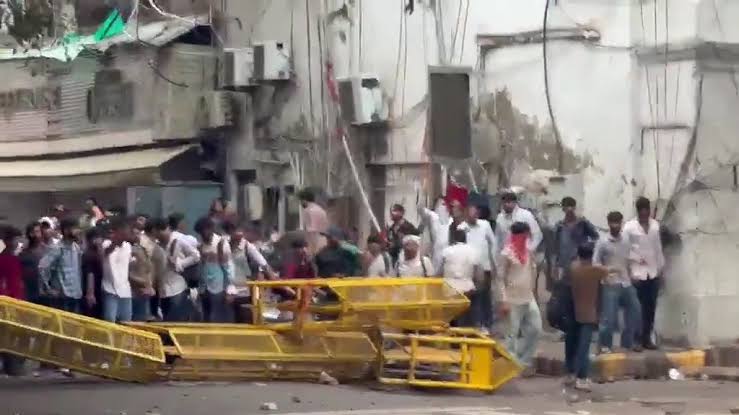
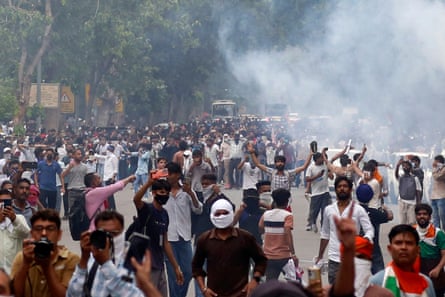
The importance of these questions increased when the protests reportedly turned violent, with stones allegedly being hurled at Delhi Police personnel. If stones were brought to the protest site beforehand, that points to preparation rather than spontaneous violence. Any investigation must establish who organised the logistics, who coordinated the violent elements and whether there was prior intelligence indicating such a possibility.
To be clear, the Embassy advisory itself is not evidence that the United States organised, supported or influenced the protests. Nothing in the document establishes that.
However, it does establish that the Embassy possessed detailed advance knowledge of the planned mobilisation before it unfolded.
History shows that foreign governments closely monitor political developments in strategically important countries. India, as one of the world’s leading geopolitical powers, is no exception. But there is a distinction between monitoring events and possessing detailed operational knowledge of a major political mobilisation days before it occurs.
The U.S. Embassy document records that it accurately anticipated where the protests would take place, when they would occur, who would participate and how security would likely respond.
That is why the document deserves closer public scrutiny.
The issue is not whether embassies should issue security advisories – they should. The issue is whether the information they relied upon was also made available to the host nation – India – responsible for maintaining law and order.
That is a question only the U.S. Embassy and the Government of India can answer. And it is a question worth asking.