



Key Takeaways
- Marital violence and psychological cruelty are significant issues in Indian marriages.
- Consent is essential in marriage to ensure that both partners are on the same page.
- Dowry harassment is a form of domestic abuse that can lead to serious consequences.
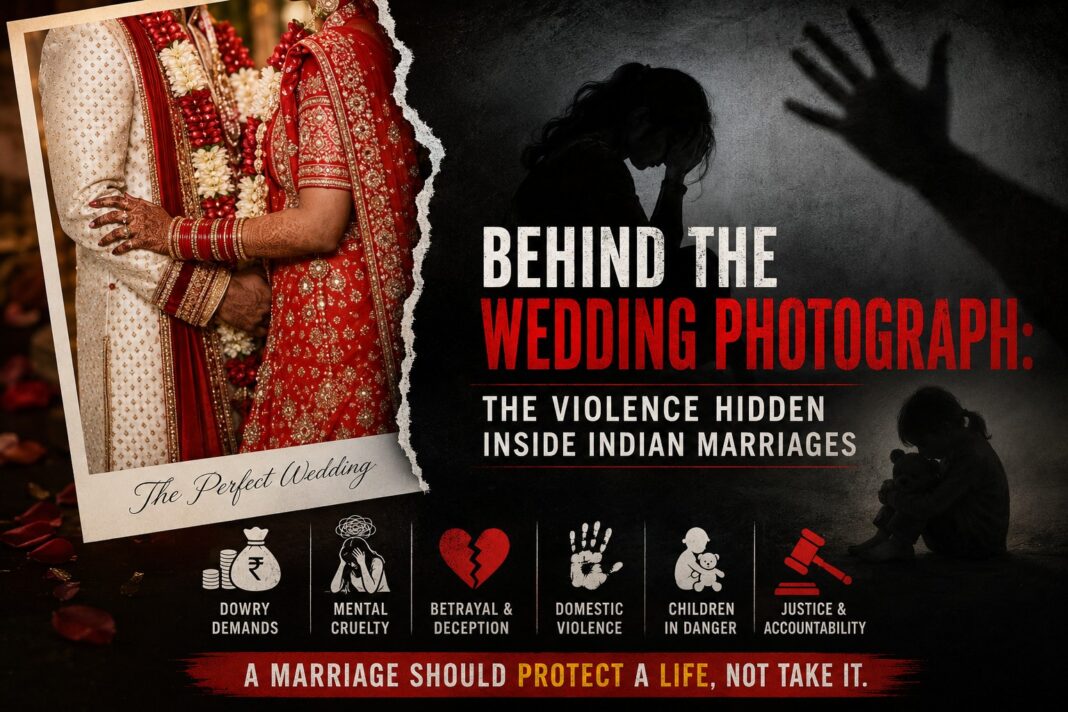
Abhinandan and his four-year-old son are found dead inside their Bengaluru home. Police arrest the wife, Harini and her alleged lover, Vinay Kumar. In Bhopal, a 34-year-old woman, Twisha Sharma, dies after what the CBI describes as sustained mental cruelty, with her husband, Samarth Singh, and mother-in-law, Giribala Singh facing charges. In Pune, a young man, Ketan Agarwal, who went trekking with his fiancée, Siya Goyal, falls to his death, only for police to allege that the romantic outing concealed a murder plot involving her and another man, Chetan Chaudhary. Three cases, three different circumstances, what happens to marriage when love is replaced by possession, pressure, resentment or fear?
The Bengaluru case is particularly disturbing because the alleged violence did not stop with the husband. Police say Harini and her alleged lover are accused of killing husband and later killing their young son, who may have witnessed the first crime. Investigators are examining allegations that CCTV was switched off and digital evidence was erased. Guilt must ultimately be determined by the court. But the reported sequence exposes a terrifying possibility: a marital conflict can move from emotional estrangement to calculated violence when one person begins to see another person not as a human being with rights but as an obstacle to a desired future.
A child is not glue holding two adults together or an extension of either parent. Children have the right to safety, even in the midst of a marital crisis. It’s crucial to consider the impact of marriage on children and prioritize their well-being.
The Twisha Sharma case exposes another layer of the crisis. The CBI has filed a chargesheet against her husband, Samarth Singh, and mother-in-law, Giribala Singh, alleging dowry harassment, sustained mental cruelty and abetment to suicide. The chargesheet reportedly reconstructs her final hours through messages, CCTV, medical records and financial evidence. Twisha’s family has disputed the conclusion, alleging that she was murdered. The court must determine the facts, yet the case forces an important question: how much psychological violence can occur inside a marriage before society takes it seriously?
Psychological cruelty is often invisible. A person can be systematically humiliated, isolated, financially controlled, threatened, insulted or accused of infidelity without receiving a single visible injury. When such behaviour is normalised as a domestic quarrel, the home becomes a place where suffering can remain invisible until it reaches a point of irreversible damage.
The Pune case presents yet another disturbing possibility. Ketan Agarwal’s death at Lohagad Fort was initially treated as an accident. Police later arrested his fiancée Siya Goyal and her alleged lover Chetan Chaudhary, accusing them of plotting his death. Investigators have pointed to digital evidence and inconsistencies in the original account. Reports suggest the couple were engaged for an arranged marriage and that Goyal allegedly did not want to proceed. These remain allegations. Yet the case raises an uncomfortable question about the social pressure surrounding marriage: why can saying “I do not want this marriage” sometimes appear more frightening than contemplating its consequences? That question takes us beyond crime and into culture.
India has modernised weddings faster than its understanding of marriage. Ceremonies, photography and matchmaking platforms have transformed, but many families still approach marriage through inherited ideas of honour, obedience, property, status and family reputation. A wedding may celebrate two individuals while decisions are made by families, communities and social expectations.

This is where consent becomes crucial. Consent is not merely the moment when two people stand before a priest, registrar or gathering and say yes. Marriage requires continuing consent to shared life. People change. Affection can disappear. Priorities can diverge. A relationship can become unbearable. The moral response to such a situation is conversation and counselling. It cannot be coercion, revenge or murder.
Dowry reveals the opposite distortion. In a dowry-centred marriage, the bride can be reduced to the economic value her family is expected to provide. The demand may be cash, gold, property, a vehicle or something as ordinary as livestock. The object changes; the logic does not. Marriage becomes a transaction, and the woman becomes accountable for fulfilling its financial terms. When expectations are not met, harassment can follow.
The answer cannot be a competition over which gender suffers more. The real question is whether marriage is being understood as a relationship between persons or as a system of entitlement. A woman does not own her husband. A man does not own his wife. Neither owns the child.
Society teaches people how to enter marriage but not how to live in it responsibly, with dignity. Young people are often prepared for weddings, but not for disagreement, financial stress, and betrayal. Families may spend months arranging a ceremony and barely spend an evening teaching couples how to communicate when they are angry. Religious institutions have a responsibility here. Marriage cannot be preached as sacrifice or endurance. Sacrifice without mutuality can become exploitation. Forgiveness without accountability can become permission for abuse. Marriage has meaning only when the people within it retain their dignity.
These cases should not be consumed as sensational crime stories and forgotten when the next headline arrives. They should provoke questions in homes and families. Are young people genuinely free to refuse a marriage? Are spouses able to seek help without shame? Do families recognise psychological cruelty before it becomes physical? Do communities protect victims or pressure them to preserve appearances? Are children treated as persons rather than possessions? Marriage itself is not on trial. Our understanding of it is. The institution becomes dangerous when love is confused with ownership, sacrifice with submission, family honour with control, and permanence with the denial of freedom. A healthy marriage does not eliminate individuality. It protects it. It does not demand silence. It creates space for truth. It does not make leaving impossible. It makes staying meaningful.
The lesson from these cases is therefore not that marriage has failed. It is that marriage fails when the human person disappears from the centre of it. A marriage should never become a place from which a person has to escape with their life. The wedding may last a day. Marriage is supposed to shape a lifetime. Perhaps it is time we became far more concerned with the life than just the wedding.