
Key Takeaways
- The a Chakravyuh metaphor captures how each US move in the Iran conflict creates new strategic challenges.
- American involvement ties together military, energy and diplomatic stakes, making withdrawal extremely costly.
- Differences between Israel’s nuclear focus and the US’s global security concerns shape policy options.
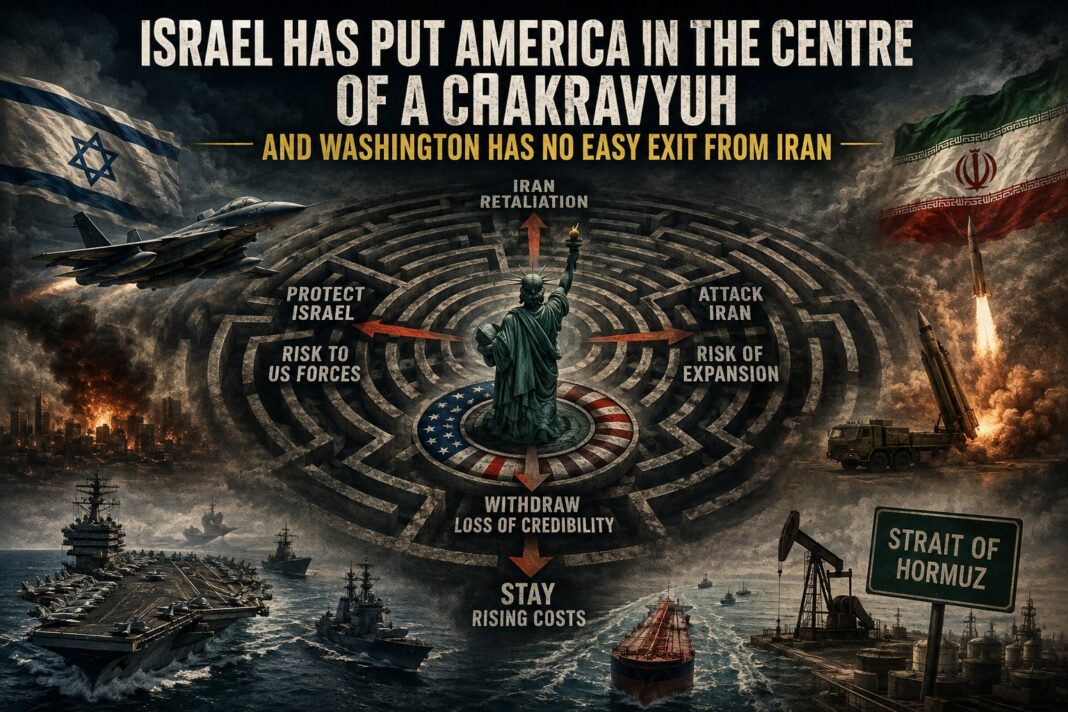
There is a word in the Indian strategic imagination that captures the predicament facing the United States in the Middle East better than almost any Western military expression: Chakravyuh.
A Chakravyuh is not simply a battlefield formation. It is a strategic trap. Once a warrior enters it, every attempt to break out creates another confrontation. The path forward becomes as dangerous as the path backward.
That is increasingly the position in which America finds itself in the Iran war.
Israel did not necessarily set out to trap the United States. But the strategic consequences of Israel’s confrontation with Iran have placed Washington in precisely that position: America is now too deeply invested to walk away, yet the longer it remains, the greater the cost of staying.
The war that began with US and Israeli strikes against Iran on February 28 has evolved into a much larger confrontation involving American military forces, Iranian missile attacks, the Strait of Hormuz, Gulf security, global energy markets and the credibility of American power.
A ceasefire and memorandum temporarily reduced the intensity of the conflict, but the fundamental disputes remained unresolved.
And now the Chakravyuh is tightening.
On September 5, American forces struck three Iranian oil tankers after Iran fired ballistic missiles at US naval vessels. The United States says its aircraft carrier and destroyer were targeted; Iran’s response has been part of an increasingly dangerous cycle of retaliation.
This is no longer simply Israel versus Iran. It is increasingly America versus the consequences of an Israel-Iran confrontation. That distinction is critical.
Israel possesses formidable military capabilities. It has demonstrated extraordinary intelligence penetration and airpower. But Israel cannot indefinitely control every strategic dimension of a war against Iran. Iran is geographically vast, possesses substantial missile capabilities and can threaten American forces, Gulf infrastructure and maritime commerce.
Most importantly, Iran can make the United States pay a price for Israel’s war. And that is precisely what Tehran is attempting to do.
Iran has already targeted American military installations in Kuwait and the United Arab Emirates, according to the Institute for the Study of War. Tehran’s objective appears to be raising the costs of continued American military operations.
This creates the first layer of the American Chakravyuh. If Washington protects Israel, it becomes directly exposed to Iranian retaliation.
If Washington reduces its involvement, however, it risks weakening Israeli security and signalling that American commitments can be challenged through sustained military pressure.
The second layer is even more complicated. Israel’s strategic objectives and America’s strategic objectives are no longer necessarily identical.
Israel’s overriding concern is Iran’s ability to threaten Israel, particularly through its nuclear programme, ballistic missiles and regional military networks. America, meanwhile, has to think about the entire global system: American troops, oil prices, shipping, Gulf allies, China, Russia, European security and the readiness of the US military. That divergence is already visible.
The Atlantic Council has argued that the gap between Washington and Jerusalem over how the war should end has widened significantly, with Israel prioritising the permanent dismantling of Iran’s nuclear infrastructure while Washington has increasingly had to consider the economic and strategic costs of continuing the conflict.
That is the paradox. Israel can afford to think primarily about Israel. America cannot. America has to think about the world.
The Strait of Hormuz illustrates the problem perfectly. Approximately one of the world’s most important energy corridors has become part of the military contest. Iran can threaten maritime traffic; America cannot allow the Strait to become effectively controlled by Tehran; Gulf states cannot tolerate prolonged disruption; and the global economy cannot absorb an indefinite energy shock without consequences.
The United States therefore finds itself fighting not merely for Israel’s security but also for freedom of navigation, global energy stability and the credibility of American power.
That is how a regional conflict becomes a global strategic liability. And once America assumes those responsibilities, withdrawal becomes extraordinarily difficult.
This is the essence of the Chakravyuh.
Every American move creates another obligation.
Protect Israel – and Iran may attack American forces.
Attack Iran – and the conflict can expand.
Withdraw – and Israel may be exposed and America’s credibility questioned.
Stay – and the economic, military and political costs increase.
Seek negotiations – and Washington must persuade both Israel and Iran to accept a settlement neither may consider sufficient.

There is no clean exit. This is why the argument that America can simply “end the war” underestimates the complexity of the situation.
The United States may have enormous military power, but military power does not automatically produce strategic outcomes.
Iran is demonstrating precisely this distinction. Iran does not necessarily need to defeat America militarily. It only needs to make the continuation of the war sufficiently expensive, unpredictable and politically uncomfortable that Washington begins looking for an exit.
That is the logic of asymmetric warfare. And America is particularly vulnerable to it because Washington has global commitments.
Recent reporting indicates that US military leaders have warned that prolonged large-scale operations against Iran are putting pressure on American military capacity elsewhere. More than 50,000 US troops have remained on alert in the region, while forces and equipment have been diverted from other theatres.
That creates another strategic danger.
While America is concentrating enormous military resources on Iran, China is watching. Russia is watching. India is watching. Europe is watching.
America’s adversaries are studying how much military capacity Washington can sustain in one theatre while maintaining deterrence everywhere else. This is therefore not simply about Tehran. It is about the architecture of American power.
And Israel’s dilemma is equally profound. Israel may have succeeded in pulling America deeper into the Iranian confrontation, but that does not necessarily mean Israel has won the strategic argument. Because the deeper America enters the war, the more Washington will eventually demand a definition of victory.
What exactly constitutes victory? The destruction of Iran’s nuclear capability? Regime change? The elimination of Iran’s missile capability? The permanent weakening of the Islamic Revolutionary Guard Corps? A new regional security architecture? Or simply an agreement that stops the shooting?
These are fundamentally different objectives. A war can achieve tactical victories while failing strategically. That is the danger confronting both Israel and America.
The United States may destroy Iranian military infrastructure. Iran may lose aircraft, missiles, bases and commanders. But if Iran retains the capacity to regenerate its military power, rebuild its nuclear knowledge and maintain political resistance, the war may produce destruction without producing resolution.
And that is perhaps the most dangerous possibility of all: a war that America can win militarily but cannot finish politically.
The Chakravyuh therefore is not simply an Israeli trap for America. It is a trap created by the interaction of Israeli security imperatives, Iranian resistance and American global responsibilities.
Washington entered the conflict with the enormous advantage of military superiority. But superiority is not the same as freedom of action.
Today, America must consider Israel’s security, Iran’s retaliation, Gulf stability, the Strait of Hormuz, global energy prices, American casualties, military readiness and domestic political consequences simultaneously. That is an extraordinary strategic burden. And there is a final irony.
The more America tries to demonstrate that it cannot be pushed out of the Middle East, the more deeply it becomes tied to the Middle East.
The more Washington tries to prove that Iran cannot challenge American power, the more American forces become targets.
And the more America commits itself to Israel’s ultimate security objective, the harder it becomes to define an American exit independent of Israel’s calculations.
That is the Chakravyuh.
America entered believing that overwhelming power would determine the outcome.
It is discovering that wars are ultimately decided not only by who can destroy more, but by who can endure longer and who can define the terms of the exit.
Israel may have brought America into the centre of the battlefield. Iran is now trying to make America feel the cost of remaining there. And Washington has reached the most uncomfortable strategic position of all:
It may have no choice but to continue fighting – not because it wants an endless war with Iran, but because every exit route now carries its own strategic price.
The real question is therefore no longer whether America can defeat Iran.
The real question is:
Can America find its way out of the Chakravyuh without allowing either Iran or Israel to determine what the American exit looks like?
That will ultimately determine whether this war becomes a demonstration of American power – or the moment when American power discovers its limits.