
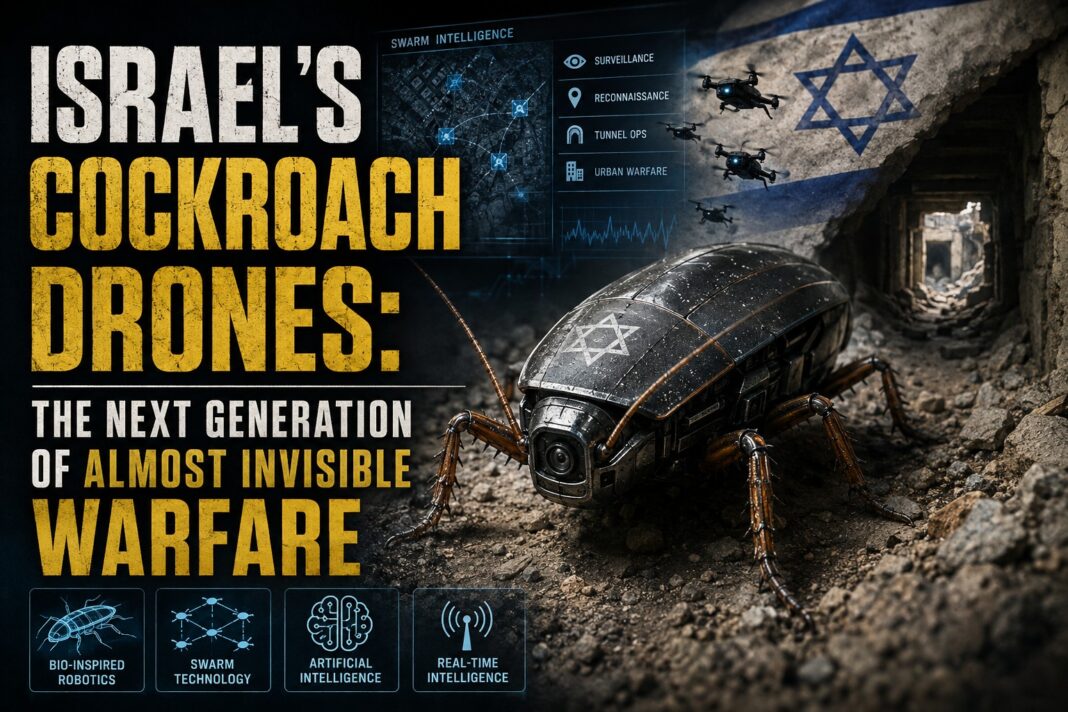

The next revolution in warfare may not come in the form of a fighter aircraft, missile or conventional drone. It could come from machines so small that they resemble insects. Israel’s growing interest in bio-inspired robotics, micro-drones and autonomous systems points towards a future battlefield in which surveillance and intelligence gathering are conducted not only by aircraft in the sky, but also by tiny machines capable of crawling, flying and operating inside environments inaccessible to conventional platforms.
The idea of a “cockroach drone” sounds futuristic, but research into cockroach-like robots is already part of a broader network of military research involving Israel, its Ministry of Defense and American universities. According to the material examined for this article, at least 70 research projects involving at least 30 U.S. universities have been conducted in collaboration with Israel’s Ministry of Defense since reportedly 2009. These projects cover a remarkably broad range of technologies, including artificial intelligence, drone swarms, missile guidance, quantum sensing, autonomous systems and bio-inspired robotics.
Among the most intriguing areas is the development of robotic cockroaches and insect-like crawlers.
The attraction of the cockroach is not its appearance but its extraordinary ability to operate in environments that are difficult for conventional machines. Cockroaches can navigate confined spaces, move across irregular surfaces and survive in environments that would be challenging for delicate robotic systems. Engineers attempting to reproduce these characteristics in machines are effectively looking at a new category of unmanned system: one that does not need a runway, open airspace or even a conventional road.
Research involving Carnegie Mellon University, for example, has explored cockroach-like robots with and for the Israeli military, while researchers at the University of Maryland have worked on inchworm-like crawling robots in collaboration with an Israeli Ministry of Defense scientist. Such systems could eventually have applications in reconnaissance, search and rescue, tunnel exploration and military operations in confined urban environments.
The significance becomes clearer when this research is considered alongside Israel’s work on other bio-inspired machines. Research at the University of Maryland and Brown University has examined micro-drones inspired by hummingbirds and bats, including potential applications for searching caves and demolished buildings. These systems represent an important shift away from the traditional assumption that every unmanned aircraft has to resemble a miniature airplane or helicopter.
Nature provides engineers with designs that have evolved over millions of years. Birds offer highly efficient flight; bats provide models for manoeuvrability and operation in darkness; insects offer extraordinary mobility at very small scales; and crawling organisms provide solutions for navigating spaces where wheels and conventional tracks become ineffective.
The military implications are considerable, particularly in urban warfare.
A large drone can provide high-resolution surveillance over a battlefield, but its usefulness diminishes when the target environment consists of buildings, tunnels, caves or rubble. A small flying robot could potentially enter through a window or other opening, while a crawling robot could move beneath obstacles and into confined spaces. Instead of sending soldiers immediately into a potentially dangerous environment, commanders could first deploy robotic systems to establish what lies inside.
The more important development, however, is not the individual micro-drone but the possibility of large numbers of autonomous machines working together.
The research described in the document includes work on human-robot interaction involving a single operator controlling many robots, as well as research at MIT on trajectory optimization for groups of quadrotors. This reflects the emerging concept of swarm robotics, in which a human does not necessarily operate every machine individually. Instead, the operator establishes objectives while software coordinates the movement and behaviour of multiple autonomous platforms.
This could dramatically change the economics and structure of military operations.
Traditional military platforms concentrate capability into expensive systems. A fighter aircraft, large surveillance drone or sophisticated armoured vehicle represents a substantial investment in a single platform. A swarm reverses that logic by distributing capability across many relatively inexpensive machines. Losing one or several systems does not necessarily compromise the mission if the remaining machines can continue operating.
This is particularly important as counter-drone technology becomes more sophisticated. Military planners increasingly have to confront the possibility that conventional air-defence systems could be overwhelmed by large numbers of inexpensive unmanned platforms. The objective of future drone warfare may therefore be to combine affordability, autonomy and numbers rather than simply maximise the sophistication of each individual drone.
Israel is particularly well positioned to pursue this model because of its established ecosystem of military technology, artificial intelligence, robotics and unmanned aerial systems. Israeli defence companies and research institutions have decades of experience developing drones for intelligence, surveillance and reconnaissance, while the country’s defence establishment has a close relationship with its technology sector and universities.
The research described in the document also reveals another crucial component: artificial intelligence.
Israel has developed systems designed to collect enormous amounts of surveillance information and use machine-learning technologies to process imagery, identify objects and accelerate military decision-making. One project described in the research involved an Israeli military prototype called “Tell You What’s Happening in a Video,” which was designed to generate descriptions of battlefield video. Another project at the Massachusetts Institute of Technology involved research into identifying people and objects in video using artificial intelligence.

This suggests that micro-robots should not be considered in isolation. Their greatest value could come from their integration into a larger intelligence architecture.
A tiny drone equipped with a camera has limited value if its imagery must be manually examined by an operator. Thousands of tiny drones would generate an overwhelming volume of information. Artificial intelligence changes the equation by allowing machines to process, classify and prioritise information far faster than humans can.
The combination of micro-robots, swarm technology, sensors, artificial intelligence and communications networks therefore has the potential to create a highly distributed battlefield intelligence system.
Consider a complex urban environment. A larger drone could monitor the surrounding area while smaller aerial systems investigate buildings. Crawling robots could explore corridors, tunnels or rubble. Each machine could contribute data to a common operational picture, allowing commanders to obtain a much more detailed understanding of an environment without relying exclusively on soldiers physically entering it.
The same architecture could eventually extend beyond surveillance and reconnaissance. The research material refers to technologies designed to accelerate military “kill-chains”—the sequence from identifying a potential target to taking action against it. As artificial intelligence becomes increasingly integrated with sensors and autonomous platforms, the time between detection, identification and decision-making could become dramatically shorter.
That development raises significant ethical and strategic questions.
The military advantage of autonomous systems lies partly in their ability to process information and operate faster than humans. But speed also creates risks. When surveillance, identification, classification and engagement become increasingly automated, the role of human judgment becomes more difficult to define. The more autonomous the machine becomes, the greater the importance of maintaining clear human responsibility for decisions involving the use of lethal force.
There is also the question of scale. If micro-drones become sufficiently inexpensive, militaries could potentially deploy them in enormous numbers. Surveillance that once required a small number of expensive aircraft could eventually be distributed across thousands of relatively cheap sensors.
That would fundamentally alter the concept of battlefield visibility.
The traditional battlefield contains areas that commanders cannot see. The future battlefield could contain far fewer such spaces if small autonomous machines are able to continuously explore buildings, tunnels, caves and other concealed environments.
This is ultimately why Israel’s research into cockroach-like robots and bio-inspired micro-drones deserves attention. The real innovation is not simply creating a machine that looks like an insect. It is the development of a new philosophy of warfare in which size, numbers, autonomy and networking become as important as speed, range and payload.
The conventional drone transformed warfare by allowing militaries to project surveillance and weapons without placing pilots directly over the battlefield. The micro-drone could take that transformation much further by bringing autonomous intelligence into spaces where conventional drones cannot operate.
Israel’s research ecosystem suggests that the next generation of unmanned warfare may therefore involve an entire hierarchy of machines: large platforms providing strategic surveillance, tactical drones supporting frontline operations, micro-drones entering buildings and confined spaces, and insect-inspired robots navigating environments inaccessible to humans and conventional vehicles.
The “cockroach drone” is consequently more than a provocative technological concept. It represents the convergence of robotics, artificial intelligence, miniaturisation and swarm warfare. If these technologies mature together, the future battlefield may be populated by machines that are considerably smaller, cheaper and more numerous than today’s drones, while simultaneously becoming more autonomous and interconnected.
The military power of the future may not depend only on who possesses the most advanced aircraft or the largest missile arsenal. It may increasingly depend on who can manufacture, coordinate and intelligently deploy thousands of small autonomous systems at scale.
And that is where the cockroach becomes an unexpectedly useful metaphor for the next generation of warfare: not because it is dangerous by itself, but because it represents a machine designed to survive, navigate and gather information in places where larger systems struggle to operate.