
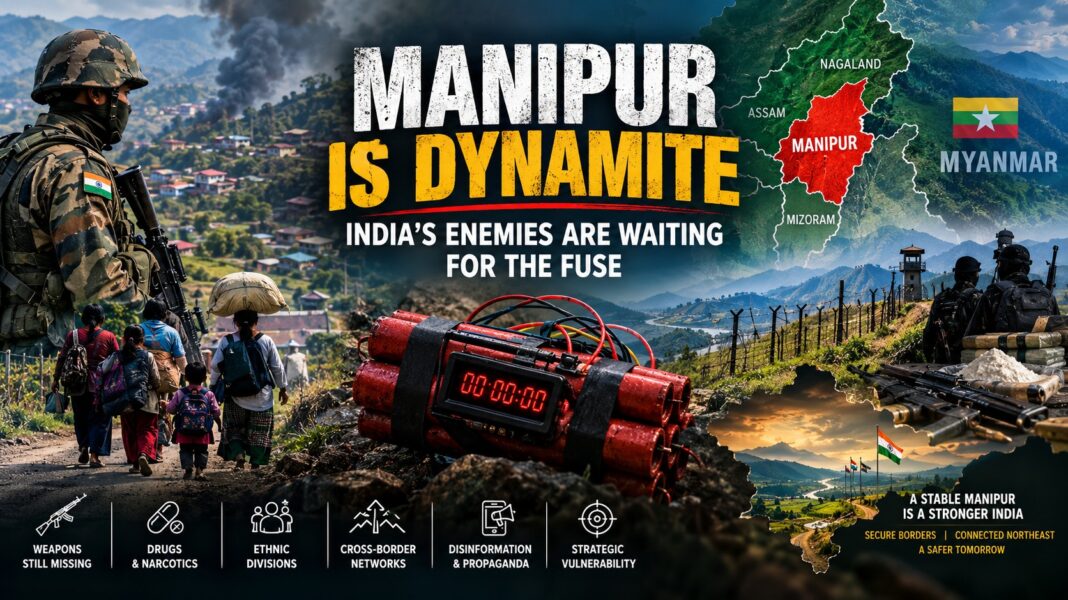

Manipur today is not merely an ethnic conflict that India must somehow contain until tempers cool. It is becoming a strategic vulnerability on India’s eastern frontier, and every month that distrust hardens, weapons circulate, communities remain physically separated and armed groups retain the ability to operate, that vulnerability becomes more dangerous. Manipur is dynamite. The explosive material has accumulated over years; the danger now is that forces hostile to India need not manufacture the crisis themselves. They only need to understand its fault lines, penetrate them and wait for an opportunity to exploit them.
The latest violence should therefore disturb New Delhi deeply. In September 2026 alone, at least 13 people were reported killed in separate gun attacks across Tamenglong, Kangpokpi, Noney, Kamjong and Senapati districts. On September 25, four Tangkhul Naga civilians were killed in Pilong village in Kamjong district in an attack police attributed to suspected Myanmar-based KNA-B militants. Two more Naga civilians were killed in Senapati district the following day. Earlier in September, four people were killed in attacks on Kuki settlements in Tamenglong.
This is particularly alarming because the security problem is no longer confined neatly to the Meitei–Kuki-Zo confrontation that erupted in May 2023. Human Rights Watch reported this month that violence involving Naga and Kuki-Zo communities had killed at least 34 people since February 2026, while the wider conflict since 2023 has killed more than 260 people and displaced more than 60,000. Armed groups have been accused of burning homes, taking hostages, blocking highways and exchanging gunfire.
That evolution changes the strategic calculation.
When violence spreads across multiple communities, geographical zones and armed formations, Manipur risks moving from an ethnic confrontation towards a fragmented security environment in which several conflicts overlap. Historical grievances become intertwined with territorial claims, insurgent networks, criminal economies, political narratives and cross-border dynamics. In such an environment, one assassination, one village attack, one inflammatory rumour or one misidentified armed group can ignite retaliation far beyond the location of the original incident.
The enormous quantity of weapons circulating in Manipur makes this volatility considerably more dangerous. In March 2026, the Manipur government told the Legislative Assembly that around 1,000 weapons looted from state armouries remained unrecovered. Security operations continue to discover firearms, grenades, improvised explosive devices and ammunition. In August alone, police reported significant weapons recoveries in Imphal West, Bishnupur and Senapati.
This means Manipur is not simply politically polarised. Parts of its social landscape remain militarised.
That distinction matters enormously. Political anger can be negotiated. Social mistrust can eventually be reconciled. But political anger combined with communal segregation, sophisticated weapons, armed organisations and contested territory creates an entirely different security challenge. It creates the infrastructure through which provocations can become battles.
Then there is Myanmar.
India shares a 1,643-kilometre border with Myanmar, passing through Arunachal Pradesh, Nagaland, Manipur and Mizoram. Myanmar itself remains deeply unstable. New Delhi has already recognised the security implications: the Union government announced in 2024 that it would scrap the Free Movement Regime, citing internal security concerns, and in 2025 directed that fencing around designated entry points along Manipur’s international border be completed quickly.
The narcotics dimension further complicates this frontier. In July 2026, Indian authorities arrested an alleged Myanmar-based drug trafficker whom investigators linked to a transnational network supplying methamphetamine and heroin through the Northeast, with cases involving seizures valued at more than ₹53 crore across India and Bangladesh.
Drugs, weapons, insurgency and ethnic conflict must never be casually conflated; they are separate problems with different actors and motivations. But when they operate across the same vulnerable geography, they can reinforce one another. Smuggling networks create routes. Criminal economies create money. Insurgent networks create access to weapons and trained personnel. Communal conflict creates recruits, grievances and local intelligence. Disinformation provides the accelerant.

And this is precisely where India must understand the external threat.
Indian security agencies have previously investigated transnational conspiracies involving Myanmar-based organisations seeking to exploit Manipur’s ethnic unrest. A Delhi High Court judgment in 2025, recounting an NIA case, referred to allegations of a transnational conspiracy involving Myanmar-based outfits intended to take advantage of the unrest and carry out attacks against the Indian state.
India’s enemies do not need to invent Manipur’s grievances. The grievances already exist. They do not need to manufacture distrust between communities. Distrust already exists. They do not need to introduce every weapon into the state. Hundreds of weapons are already missing. Their strategic opportunity lies in amplification: financing extremist factions, facilitating weapons, spreading propaganda and disinformation, exploiting diaspora networks, cultivating armed groups, encouraging maximalist political positions or provoking incidents designed to trigger retaliation.
Modern hybrid warfare frequently operates through precisely such vulnerabilities. The objective need not be the conquest of territory. Destabilisation itself can be strategically useful. A permanently unsettled Manipur consumes security resources, damages economic development, weakens connectivity with Southeast Asia, complicates India’s Act East ambitions and creates persistent pressure along a sensitive international frontier.
That is why India’s response cannot remain primarily reactive.
Security operations are necessary, and the surrender of 42 KCP (PWG) cadres with 28 weapons in July demonstrates that sustained pressure combined with rehabilitation can produce results. The NIA’s June arrest of ten people across several districts in cases connected with ethnic violence also illustrates the continuing effort to dismantle criminal and militant networks across communities. But policing alone cannot extinguish the fuse.
New Delhi and the Manipur government need simultaneous strategies: relentless recovery of illegal and looted weapons; intelligence domination of cross-border militant networks; disruption of narcotics and arms financing; tighter border surveillance; prosecution of violence irrespective of community; protection of vulnerable villages and transport corridors; rehabilitation of displaced families; and, critically, a credible political dialogue capable of addressing legitimate grievances without rewarding violence.
Communities must also recognise a brutal strategic reality: when internal divisions become absolute, outsiders acquire leverage. Meiteis, Kuki-Zos, Nagas and every other community in Manipur may have genuine historical grievances and competing political aspirations. Those disagreements must be negotiated within India’s constitutional framework rather than through armed confrontation.
The greatest danger facing Manipur is therefore not simply another riot.
It is the gradual normalisation of armed ethnic geography – the acceptance that communities must live behind invisible borders, protected by weapons and suspicious of everyone across the hill or valley. Once such a system becomes permanent, every incident becomes a potential military confrontation and every external intelligence service, insurgent network, criminal syndicate or geopolitical adversary gains an opportunity.
Manipur sits at one of India’s most strategically consequential gateways to Southeast Asia. It cannot be allowed to become India’s exposed nerve. The dynamite is already there. India’s task is to remove it before someone finds the fuse.