
Key Takeaways
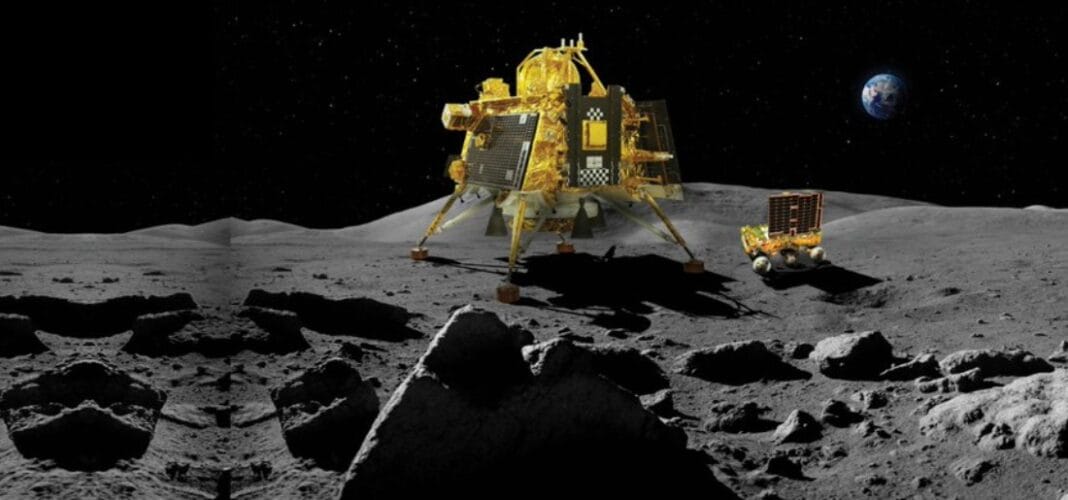
- The soft landing of Chandrayaan-3 is confirmed for Wednesday evening.
- ISRO’s Mission Operations Complex (MOX) is overseeing the final descent and checks.
- The landing will occur in the Moon’s South Polar region, targeting a safe, hazard‑free zone.
Chennai: The soft landing of India’s third Lunar mission Chandrayaan-3 on the South Polar region of the moon will take place as scheduled there there is no postponement or any alternative plans, according to ISRO Chairman Dr.S.Somanath.
Ahead of the soft landing at 6.04 pm on Wednesday evening, he said ISRO was very much focussed on landing its Lander Module (LM).
“We are not looking at any postponement or Plan B”, he said. “The landing is confirmed on Wednesday evening as originally planned,” he said.
Dr Somanath was reacting to reports that the landing will be postponed to August 27, if there are problems in the lander systems.
On Tuesday, ISRO said Chandrayaan-3 mission is on schedule and sailing smooth for a soft landing on the South Polar Region of moon.
The systems are undergoing regular checks and the Mission Operations Complex (MOX) was buzz with energy and excitement.
ISRO in a tweet said “Chandrayaan-3 : the mission is on schedule.” “Systems are undergoing regular checks. Smooth sailing is continuing”, it said.
“The MOX is buzzed with energy & excitement!”, it said. ISRO sources said “The powered descent of lander for a soft landing on the Moon’s surface will take place from a height of about 25 km with a speed of 1.6 km per second.

The focus of the ISRO scientists will be on reducing that speed since the Moon’s gravitational force will also play its part.
In what has been termed as “15 minutes of terror”, the powered descent for soft landing will begin at 1745-1750 hrs and the LM will land at 6.04 pm., two hours after the commands were uploaded and the telemetry signals were analysed.
The soft landing is a tricky and challenging task as it involves a series of complex manoeuvres that included rough and fine braking.
Prior to landing, imaging of the landing site will be done for locating safe and hazard-free zones.
The lander will be hurtling towards the moon in a horizontal position and the Scientists in the MOX at ISRO Telemetry, Tracking and Command Network (ISTRAC), Bengaluru will deploy the commands.
The rough braking will be for about 11 minutes and the remaining will be fine braking.
The lander’s position will be changed to vertical and in that position, it will hover over the moon, take pictures and survey the landing zone and decide on the safe landing spot.