
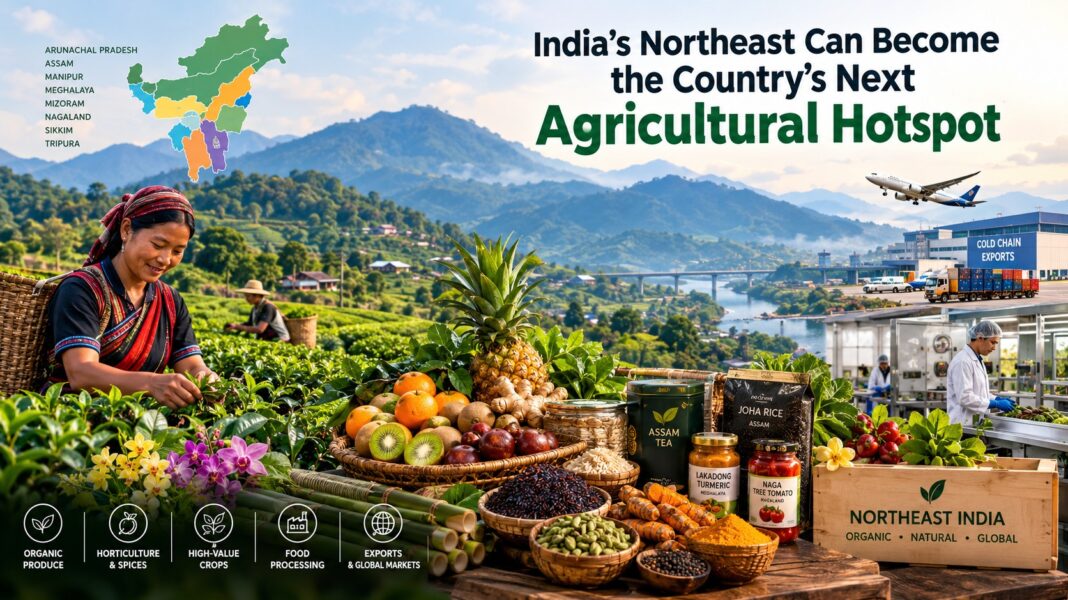

For decades, India has looked at the Northeast primarily through the prisms of geography, security, connectivity and strategic importance. That understanding is changing. The eight states of the Northeast must increasingly be viewed through another prism: their potential to emerge as one of India’s most important centres for high-value agriculture, horticulture, organic produce, food processing and agricultural exports.
The opportunity is considerable. But it would be a mistake to imagine the Northeast competing with Punjab, Haryana, Uttar Pradesh or Madhya Pradesh by replicating the agricultural models developed elsewhere in India. Its strength lies precisely in being different.
The Northeast should not aspire to become another conventional foodgrain belt. It can become India’s high-value agricultural belt.
Its climatic diversity, relatively low chemical intensity in several farming systems, indigenous crop varieties, horticultural wealth and proximity to Southeast Asian markets create conditions for a fundamentally different agricultural strategy. The future lies in organic and naturally grown produce, fruits, spices, medicinal and aromatic plants, specialty rice, bamboo-linked industries, floriculture and processed foods.
There is already a substantial foundation on which to build.
As of May 2026, approximately 2.36 lakh hectares had been brought under the Mission Organic Value Chain Development for North Eastern Region, or MOVCDNER, benefiting nearly 2.70 lakh farmers. The programme had received financial releases of about ₹1,492 crore and supported the formation of 479 Farmer Producer Organisations.
Those numbers are significant because the real agricultural challenge of the Northeast is not simply production. It is aggregation, processing, certification, transportation and access to markets.
The region has products that already possess strong market identities: Assam tea and Joha rice, Meghalaya’s Lakadong turmeric and Khasi mandarin, Nagaland’s Naga tree tomato, Pineapple and Naga cucumber, Manipur’s black rice, Arunachal Pradesh’s kiwi and large cardamom, Tripura’s pineapple, Mizoram’s ginger and Sikkim’s organic agricultural produce, among many others. APEDA’s register of agricultural and food Geographical Indications includes products from several northeastern states, providing an existing platform on which premium regional brands can be developed.
This is where the agricultural conversation about the Northeast needs to change.
The farmer should not merely be encouraged to grow more. The farmer must be enabled to earn more from what is grown.
A kilogram of ginger leaving a farm as an undifferentiated commodity has one economic value. The same agricultural produce cleaned, graded, processed, packaged, branded, certified and sold into a premium domestic or international market has an entirely different economic value. That difference represents the economic opportunity before the Northeast.
India’s own Agriculture Export Policy acknowledges that inadequate post-harvest management, cold-chain infrastructure and processing can create losses in fresh fruits, vegetables and fisheries, with studies cited by APEDA indicating losses ranging roughly from 8 to 18 per cent. The policy consequently emphasises value addition, processing and export-oriented agricultural production.
For the Northeast, therefore, the next agricultural revolution should not be measured simply by hectares cultivated or tonnes harvested. It should be measured by value created per hectare and income generated per farmer.
Consider organic agriculture.
The Northeast possesses a valuable first-mover advantage because the Government of India created a dedicated organic value-chain programme specifically for the region. MOVCD-NER does not restrict itself to cultivation; it covers the chain from production through processing, certification, marketing and post-harvest management. Under the programme, assistance of ₹46,500 per hectare over three years is provided for FPO formation, organic inputs and related support. The important word here is value chain.
Organic farming without certification can leave a farmer producing organically but selling conventionally. Organic production without processing can leave the greatest margins with businesses outside the region. Production without cold storage can turn a bumper horticultural crop into distress selling.
Infrastructure therefore becomes as important as agriculture itself.

By June 2024, MOVCD-NER had already helped establish 394 collection and grading units and 123 processing facilities, alongside the formation of 379 FPOs/FPCs at that stage of the programme. The expansion since then demonstrates movement in the right direction, but the scale of the opportunity demands considerably deeper integration between farms, processing centres, laboratories, warehouses, cold chains, airports, railways and export markets.
Connectivity is particularly important because geography has historically been both the Northeast’s greatest strategic advantage and one of its greatest economic constraints. That too is changing.
Under the Krishi UDAN framework, 25 of the 58 nationally linked airports identified by the government cater to the Northeast, although the region still had only two airports equipped with cold-storage facilities in the cited 2026 government assessment. That contrast captures both the progress and the problem. Air connectivity exists, but agricultural logistics must develop alongside it.
A pineapple from Tripura, kiwi from Arunachal Pradesh or premium vegetable from Meghalaya has limited economic relevance to a consumer in Delhi, Dubai or Singapore if the logistics required to deliver it competitively do not exist.
And this brings us to the Northeast’s greatest long-term advantage: location.
The region sits at India’s gateway to Bangladesh, Bhutan, Myanmar and the wider Southeast Asian economic space. India’s Act East strategy should therefore have an agricultural dimension. Roads, border trade infrastructure and multimodal transport should not merely move manufactured goods into the Northeast; they should enable high-value northeastern agricultural products to move outward.
Imagine an agricultural ecosystem in which farmers produce according to mapped domestic and international demand; FPOs aggregate that production; local enterprises process it; laboratories certify it; regional brands market it; cold chains preserve it; and logistics corridors take it to Indian metropolitan markets and eventually international consumers.
That is not traditional agricultural policy. It is agricultural industrialisation.
The Northeast can also become a laboratory for a more environmentally sustainable model of Indian agriculture. Climate volatility, soil degradation, excessive groundwater extraction and input-intensive cultivation are forcing India to rethink aspects of its agricultural system. The Northeast does not need to repeat every mistake made elsewhere before searching for alternatives. It can leapfrog.
Technology can allow small farmers to participate in sophisticated agricultural markets through satellite-based crop monitoring, digital marketplaces, precision farming, drone applications, traceability systems and AI-based weather and disease forecasting. Farmer Producer Organisations can provide the scale individual smallholders cannot achieve independently.
The government reported that more than 11.44 lakh beneficiaries in the Northeast were covered under the Pradhan Mantri Fasal Bima Yojana during the combined Kharif and Rabi seasons of 2025. Meanwhile, forest-based livelihood programmes had benefited approximately 3.3 lakh gatherers and supported 19,155 self-help groups by May 2026. These initiatives indicate that agriculture, forestry, tribal enterprise and rural entrepreneurship need not operate in separate economic silos.
But government schemes alone will not transform the Northeast.
Private capital must enter food processing. Agricultural universities must work directly with entrepreneurs and farmers. FPOs must evolve from administrative structures into commercially capable enterprises. States must identify a limited number of crops in which they possess genuine competitive advantages rather than attempting to produce everything. Branding, certification, packaging and quality control must become central to agricultural planning.
Most importantly, the Northeast should stop being perceived as India’s distant agricultural frontier. It should be viewed as India’s emerging high-value agricultural gateway to Asia.
The opportunity is not to produce another Green Revolution based principally on volume. It is to create a different revolution based on quality, sustainability, processing, branding and value.
If India gets that strategy right, the agricultural future of the Northeast will not simply be about feeding markets. It will be about creating wealth in the region, building rural enterprises, generating employment for its youth and placing products carrying the identity of Northeast India on shelves across India and eventually across the world.
The Northeast does not need to imitate India’s traditional agricultural heartlands. It has the potential to become something far more distinctive: India’s next high-value agricultural powerhouse.