


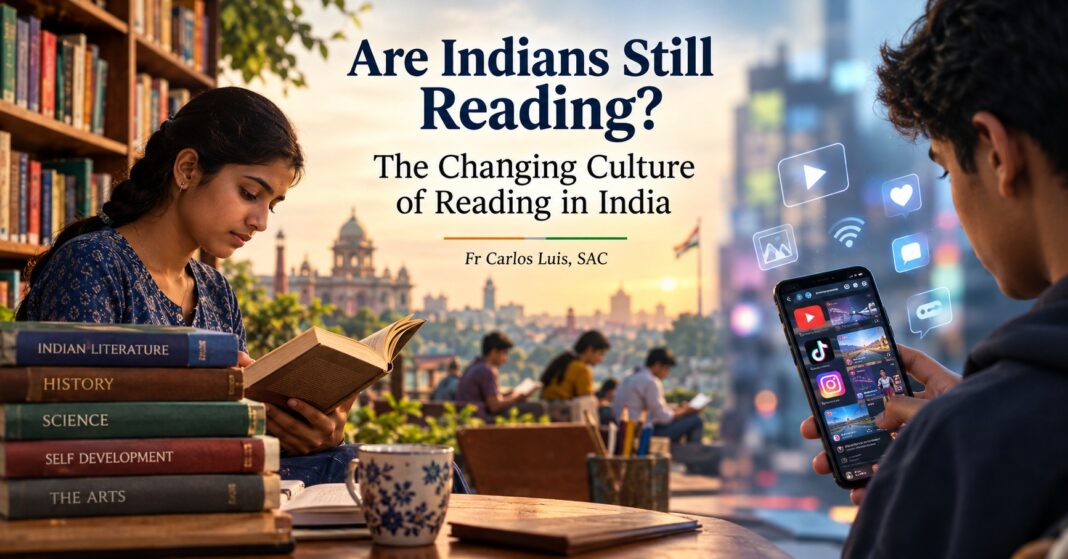

A recent study from the United States made me pause and ask a question about India. Researchers who examined more than two decades of American Time Use Survey data found a substantial decline in the number of Americans who read for pleasure. According to the study, the proportion of people reading for pleasure on an average day fell from 28% in 2004 to 16% in 2023. The research, published in iScience in 2025, examined data from more than 236,000 people and documented a long-term decline in leisure reading across different sections of American society. The finding was striking, but what interested me was not simply what was happening in America. It was what the same question might reveal about India.
India is often described as a nation with a deep reading culture. We take pride in our literary traditions, our regional languages, our publishing industry, our book fairs and our enormous appetite for educational material. Yet there is surprisingly little recent national evidence that allows us to say confidently how Indians read today, particularly when it comes to reading for pleasure. The India of today is very different from the India of even fifteen years ago. Smartphones have transformed access to information, inexpensive mobile data has brought the internet into millions of homes, and social media has become an important part of everyday life. The competition for people’s attention has therefore changed dramatically, and reading now competes not only with television and cinema but with an almost continuous stream of digital content.
One of the most important sources for understanding India’s reading habits remains the National Youth Readership Survey conducted by the National Book Trust in collaboration with the National Council of Applied Economic Research. The survey covered more than 311,000 literate Indians between the ages of 13 and 35 and remains one of the largest attempts to examine reading among India’s young population. Its findings were revealing. Of approximately 333 million literate young people covered by the survey, around 83 million, or roughly one quarter, were identified as readers of books outside their prescribed syllabus. The finding suggests that for a large majority of young Indians, reading was still closely associated with formal education rather than leisure, curiosity or personal interest.
At the same time, the survey challenges the assumption that reading in India has always been primarily an urban and elite activity. Around 44 million of the young book readers surveyed lived in rural India, compared with approximately 39 million in urban areas. Reading was also deeply connected with India’s linguistic diversity. Hindi and several other Indian languages played a major role in the reading habits of young people, reminding us that India’s reading culture cannot be measured through English language publishing alone. The Indian reader has always existed across cities, towns and villages, and across dozens of literary traditions.
The difficulty is that this important survey belongs to an earlier phase of India’s development. When the survey was conducted, the internet had not yet become central to everyday life for most Indians. Today, India has one of the world’s largest internet populations, with hundreds of millions of people accessing the internet, increasingly through smartphones. The transformation has created an extraordinary expansion in access to written material. A person living far from a major city can now access newspapers, books, journals, educational resources and literature in Indian languages without having a physical bookstore or large library nearby. In this sense, technology has the potential to create readers rather than destroy them.
The problem is that the same technology also competes aggressively for attention. A smartphone can provide access to an entire library, but it can also provide an endless supply of short videos, messages, notifications and entertainment. Reading a novel requires sustained concentration, while much of today’s digital environment encourages constant movement from one piece of content to another. This does not mean that every person who uses social media reads less, nor does it mean that digital reading is somehow inferior to reading a printed book. The deeper issue is whether people still have sufficient uninterrupted time and attention for sustained reading.
More recent evidence gives us reason to examine this question seriously. Analysis of India’s Time Use Survey by the National Council of Applied Economic Research found that the proportion of Indians reporting leisure reading declined from 5.4 % in 2019 to around 4 % in 2024. This figure needs to be interpreted carefully because it does not capture every form of reading on digital devices and does not mean that Indians have stopped reading. It nevertheless indicates that leisure reading occupies a relatively small and possibly declining part of the time Indians spend outside work, education and household responsibilities. The same analysis suggests that among those who continue to read, reading time has not necessarily collapsed. This means that the more significant concern may be the shrinking number of people who maintain reading as a leisure habit.

India’s reading challenge also begins much earlier than the smartphone. The country continues to face difficulties in ensuring that children develop strong foundational reading skills. The Annual Status of Education Report (ASER) has repeatedly demonstrated that school enrolment does not automatically translate into adequate reading ability. ASER 2024 showed encouraging improvement in children’s reading outcomes following the disruption caused by the pandemic, but it also demonstrated that many children continue to struggle with age-appropriate reading and comprehension. Before asking whether young Indians are reading enough novels or newspapers, we must first ensure that every child develops the ability to read confidently and understand what is being read.
The education system also has an important role in determining what kind of readers young Indians become. In a highly examination-oriented environment, reading can easily become an instrument for remembering information, preparing for examinations and reproducing answers. Such reading is necessary, but it is different from reading for pleasure, imagination or intellectual discovery. A child who reads only because an examination requires it may become academically literate without developing a lifelong relationship with books. Schools therefore need to create opportunities for students to encounter literature and ideas that are not prescribed in their textbooks.
Libraries are equally important. India has a substantial network of public and institutional libraries, but their quality, accessibility and relevance vary considerably across states and communities. For families who cannot afford to purchase books regularly, a functioning library can make an enormous difference. A library also offers something increasingly rare in contemporary life: a space where sustained attention is possible without the constant interruptions of commercial digital platforms. Investing in libraries should therefore not be seen as preserving an outdated institution. It is an investment in literacy, imagination and public intellectual life.
India’s linguistic diversity offers another important opportunity. The future of Indian reading cannot be measured primarily through English. Millions of Indians read in Hindi, Bengali, Tamil, Telugu, Kannada, Malayalam, Marathi, Gujarati, Odia, Assamese, Punjabi and many other languages. The growth of digital publishing and regional language content can bring literature to readers who previously had limited access to books. Technology can therefore become an important partner in strengthening India’s reading culture, provided digital platforms are designed not merely to capture attention but also to support meaningful engagement with content.
India does not need to prove that it is the world’s greatest reading nation. What matters is whether reading remains a meaningful part of ordinary life. A healthy reading culture cannot be measured simply by the number of books sold or by an impressive statistic circulating on social media. It is reflected in children who read beyond their textbooks, young people who discover books out of curiosity, adults who continue reading despite busy lives, libraries that remain active and communities where books are available in languages people actually speak.
India has never lacked stories, writers or literary traditions. What it increasingly needs to protect is the time and attention required to encounter those stories deeply. The challenge is not to return to an imagined past but to build a future in which technology and reading can coexist without allowing the constant demand for attention to push sustained reading to the margins. The American experience may have prompted the question, but the answer will ultimately depend on what India chooses to do with its own reading culture.